

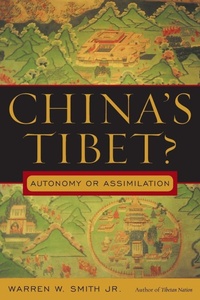
China's Tibet?
Autonomy or Assimilation
Published on 16. November 2009
Book
Paperback/Softback
354 pages
978-0-7425-3990-7 (ISBN)
Description
This groundbreaking book explores China's efforts to assimilate Tibet, in the process rewriting Tibetan history to conform to Beijing's goals. Warren Smith provides the historical context for understanding the current situation through an overview of China's actual-as opposed to its promised-policies toward Tibet over time. His clear-eyed appraisal of Chinese policy convincingly shows that the PRC's ultimate intention is assimilation rather than autonomy. The author argues that Beijing fears that any genuine autonomy or dialogue with the Dalai Lama will fuel renewed nationalism in "China's Tibet," as the Chinese leadership calls its possession.
The book highlights China's past and current propaganda on Tibet to demonstrate China's sensitivity and defensiveness regarding the legitimacy of its rule. It traces the history of Sino-Tibetan dialogue to show how China has tried to use it to defuse Tibetan exile and international criticism, while making no concessions in regard to Tibetan autonomy. In the absence of any solution, Smith advocates the promotion of Tibet's right to self-determination as the most viable strategy for sustaining international attention and maintaining the most essential elements of Tibetan national identity. Smith's thoroughly informed work will be valuable not only to Tibet experts and students, but also to the larger world of Tibet activists, sympathizers, and others attempting to understand China's policies.
The book highlights China's past and current propaganda on Tibet to demonstrate China's sensitivity and defensiveness regarding the legitimacy of its rule. It traces the history of Sino-Tibetan dialogue to show how China has tried to use it to defuse Tibetan exile and international criticism, while making no concessions in regard to Tibetan autonomy. In the absence of any solution, Smith advocates the promotion of Tibet's right to self-determination as the most viable strategy for sustaining international attention and maintaining the most essential elements of Tibetan national identity. Smith's thoroughly informed work will be valuable not only to Tibet experts and students, but also to the larger world of Tibet activists, sympathizers, and others attempting to understand China's policies.
Reviews / Votes
Warren Smith deserves a prize for this work. He has presented a clear-eyed, well-informed, and penetrating analysis of China's blatantly colonial policy in Tibet. If you want to understand the realities of the Tibet question, this book is a must-read. You'll never again hear the oft-repeated phrase 'China's Tibet' in quite the same way. -- Robert Thurman, Columbia University A thorough . . . study of relations between the two entities over the last century. -- . * Library Journal * Admirable because it lays out in jargon-free language the political and cultural nature of the China-Tibet relationship. It is further admirable because Warren Smith, who writes for the Tibetan Service of Radio Free Asia, is scrupulously fair, including in his pages complete policy statements from Beijing and the Dalai Lama's exile government. -- July 2008 * Wall Street Journal Asia * Anyone who is a Tibet activist, a serious student of Tibetan Buddhism, or a history buff will find Smith's book indispensable. . . . What is truly fresh and original in China's Tibet?-and reveals Smith at his most penetrating and disturbing-is his analysis of China's greatest propaganda successes. . . . The tug of war between recorded fact and historical revisionism, autonomy and assimilation, Tibetan Buddhist culture and Chinese real estate, will continue while the rest of the world looks on from the sidelines. In the meantime, we should be very grateful that Warren Smith has kept a superb scorecard for us. * Tricycle Magazine * Smith has extensive living experience in the region and does his research with great care. . . . Recommended. * Choice Reviews * This is a landmark study of China's efforts to fully subsume Tibet and to rewrite Tibetan history to conform to this official reality. Smith's dispassionate, critical, and detailed account makes clear China's goal of complete assimilation and the futility of the Dalai Lama's policy to seek some kind of 'meaningful autonomy' for his country. -- Jamyang Norbu, author of The Mandala of Sherlock Holmes In seven fluid chapters, the book covers recent Tibetan history, with an emphasis on Chinese propaganda and how Chinese leaders have viewed Tibet. . . . China's Tibet? is essential for understanding how the Sino-Tibetan relationship became what it is today. . . . His clear-eyed analysis makes a very convincing case. * Far Eastern Economic Review *More details
Language
English
Place of publication
United States
Publishing group
Bloomsbury Publishing Plc
Dimensions
Height: 229 mm
Width: 152 mm
Thickness: 19 mm
Weight
519 gr
ISBN-13
978-0-7425-3990-7 (9780742539907)
Copyright in bibliographic data and cover images is held by Nielsen Book Services Limited or by the publishers or by their respective licensors: all rights reserved.
Schweitzer Classification
Other editions
Additional editions
E-Book
05/2008
1st Edition
Rowman & Littlefield Publishers
from
€44.29
Available for download
Person
Warren W. Smith, Jr. is a research historian with Radio Free Asia, Tibetan Service, Washington, D.C.
Content
Part 1 Introduction
Part 2 Chapter 1: Historical and Political Background
Part 3 Chapter 2: Tibet under Chinese Communist Rule
Part 4 Chapter 3: Democratic Reforms
Part 5 Chapter 4: Cultural Revolution
Part 6 Chapter 5: Autonomy or Assimilation
Part 7 Chapter 6: Sino-Tibetan Dialogue
Part 8 Chapter 7: The Issue of Tibet
Part 9 Bibliography
Part 2 Chapter 1: Historical and Political Background
Part 3 Chapter 2: Tibet under Chinese Communist Rule
Part 4 Chapter 3: Democratic Reforms
Part 5 Chapter 4: Cultural Revolution
Part 6 Chapter 5: Autonomy or Assimilation
Part 7 Chapter 6: Sino-Tibetan Dialogue
Part 8 Chapter 7: The Issue of Tibet
Part 9 Bibliography