

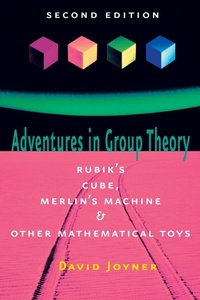
Adventures in Group Theory
Rubik's Cube, Merlin's Machine, and Other Mathematical Toys
2nd Edition
Published on 23. February 2009
Book
Paperback/Softback
328 pages
978-0-8018-9013-0 (ISBN)
Description
This updated and revised edition of David Joyner's entertaining "hands-on" tour of group theory and abstract algebra brings life, levity, and practicality to the topics through mathematical toys. Joyner uses permutation puzzles such as the Rubik's Cube and its variants, the 15 puzzle, the Rainbow Masterball, Merlin's Machine, the Pyraminx, and the Skewb to explain the basics of introductory algebra and group theory. Subjects covered include the Cayley graphs, symmetries, isomorphisms, wreath products, free groups, and finite fields of group theory, as well as algebraic matrices, combinatorics, and permutations. Featuring strategies for solving the puzzles and computations illustrated using the SAGE open-source computer algebra system, the second edition of Adventures in Group Theory is perfect for mathematics enthusiasts and for use as a supplementary textbook.
Reviews / Votes
"Adventures in Group Theory is a tour through the algebra of several 'permutation puzzles'... If you like puzzles, this is a somewhat fun book. If you like algebra, this is a fun book. If you like puzzles and algebra, this is a really fun book." - MAA Online "Joyner has collated all the Rubik lore and integrated it with a self-contained introduction to group theory that equals or, more likely, exceeds what is available in typical dedicated elementary texts." - Choice "Joyner does convey some of the excitement and adventure in picking up knowledge of group theory by trying to understand Rubik's Cube. Enthusiastic students will learn a lot of mathematics from this book." - American Scientist"More details
Edition
second edition
Language
English
Place of publication
Baltimore, MD
United States
Target group
College/higher education
Edition type
Revised edition
Product notice
Paperback (trade)
Illustrations
6 s/w Photographien bzw. Rasterbilder
6 Halftones, black and white
Dimensions
Height: 229 mm
Width: 152 mm
Thickness: 20 mm
Weight
537 gr
ISBN-13
978-0-8018-9013-0 (9780801890130)
DOI
10.56021/9780801890123
Copyright in bibliographic data and cover images is held by Nielsen Book Services Limited or by the publishers or by their respective licensors: all rights reserved.
Schweitzer Classification
Other editions
Additional editions
E-Book
02/2009
2nd Edition
Johns Hopkins University Press
€24.99
Available for download
Book
02/2009
2nd Edition
Johns Hopkins University Press
€69.50
Article exhausted; check different version
Previous edition

Book
06/2002
Johns Hopkins University Press
€40.43
Article exhausted; check for reprint
Person
David Joyner is a professor of mathematics at the U.S. Naval Academy. He is coauthor of Applied Abstract Algebra, also published by Johns Hopkins, and editor of Coding Theory and Cryptography: From Enigma and Geheimschreiber to Quantum Theory.
Content
Preface
Acknowledgments
Where to Begin...
1. Elementary, my dear Watson
2. 'And you do addition?'
3. Bell ringing and other permutations
4. A procession of permutation puzzles
5. What's commutative and purple?
6. Welcome to the machine
7. 'God's algorithm' and graphs
8. Symmetry and the Platonic solids
9. The illegal cube group
10. Words which move
11. The (legal) Rubik's Cube group
12. Squares, two-faces, and other subgroups
13. Other Rubik-like puzzle groups
14. Crossing the Rubicon
15. Some solution strategies
16. Coda: Questions and other directions
Bibliography
Index
Acknowledgments
Where to Begin...
1. Elementary, my dear Watson
2. 'And you do addition?'
3. Bell ringing and other permutations
4. A procession of permutation puzzles
5. What's commutative and purple?
6. Welcome to the machine
7. 'God's algorithm' and graphs
8. Symmetry and the Platonic solids
9. The illegal cube group
10. Words which move
11. The (legal) Rubik's Cube group
12. Squares, two-faces, and other subgroups
13. Other Rubik-like puzzle groups
14. Crossing the Rubicon
15. Some solution strategies
16. Coda: Questions and other directions
Bibliography
Index