

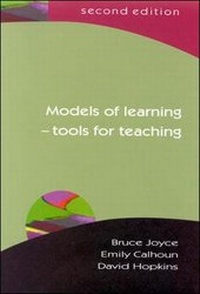
Models of Learning
2nd Edition
Published on 16. April 2002
Book
Paperback/Softback
272 pages
978-0-335-21015-2 (ISBN)
Description
Reviews of 1st Edition:
"This powerful book makes many of its points through the use of case studies and examples... ....Rarely, if ever, has discussion of so wide a variety of approaches to learning been gathered together in a single volume." - British Journal of Educational Technology
This comprehensive, accessible and successful text has been revised and updated to meet the needs of teachers, advisers, inspectors, teacher educators and educational researchers at the beginning of the 21st century.
Key features include:
* A range of teaching models offering a wide repertoire of strategies for teachers
* A wealth of practical examples backed up by relevant research evidence and clear guidelines for implementation
* A clear, engaging and accessible writing style
* A completely new chapter on learning to read and write with the Picture Word Inductive Model
The purpose of this book is to introduce some of the array of models of teaching that have been developed, polished and studied over the last thirty years. Some of these models have been shown both to accelerate rates of learning and also to bring within reach of pupils types of conceptual control and modes of inquiry which have been almost impossible to generate through traditional chalk and talk teaching. Rather than being formulas to be followed slavishly, each model brings teachers into the study of how students learn thereby promoting reflective action research in the classroom.
"This powerful book makes many of its points through the use of case studies and examples... ....Rarely, if ever, has discussion of so wide a variety of approaches to learning been gathered together in a single volume." - British Journal of Educational Technology
This comprehensive, accessible and successful text has been revised and updated to meet the needs of teachers, advisers, inspectors, teacher educators and educational researchers at the beginning of the 21st century.
Key features include:
* A range of teaching models offering a wide repertoire of strategies for teachers
* A wealth of practical examples backed up by relevant research evidence and clear guidelines for implementation
* A clear, engaging and accessible writing style
* A completely new chapter on learning to read and write with the Picture Word Inductive Model
The purpose of this book is to introduce some of the array of models of teaching that have been developed, polished and studied over the last thirty years. Some of these models have been shown both to accelerate rates of learning and also to bring within reach of pupils types of conceptual control and modes of inquiry which have been almost impossible to generate through traditional chalk and talk teaching. Rather than being formulas to be followed slavishly, each model brings teachers into the study of how students learn thereby promoting reflective action research in the classroom.
Reviews / Votes
"!provides a great deal of information, and insight, for practitioners; and includes 'coaching guides' for teachers who wish to undertake peer observation of the various ideas covered in the book!a valuable addition to any library and a book that!will appeal to many practitioners." -- LTSN: Escalate LTSN 20031028 "...flows smoothly and is easy to read. The reader is stimulated to consider how learning is taking place, with a view to making use of these insights in future work. ...the whole book offers lots of food for thought to all concerned with education-not just teachers, but administrators, managers, even parents." - Cynthia Deeson Brit Jnl of Educational Technology 20030301More details
Edition
2nd edition
Language
English
Place of publication
Milton Keynes
United Kingdom
Illustrations
references, index
Dimensions
Height: 239 mm
Width: 173 mm
Thickness: 15 mm
Weight
480 gr
ISBN-13
978-0-335-21015-2 (9780335210152)
Copyright in bibliographic data and cover images is held by Nielsen Book Services Limited or by the publishers or by their respective licensors: all rights reserved.
Schweitzer Classification
Persons
David Hopkins is the inaugural HSBC Chair in International Leadership, International arm of the Specialist Schools and Academies Trust and the Leadership Centre at the Institute of Education, University of London. Between 2002 and 2005 he served three Secretary of States as the Chief Adviser on School Standards at the Department for Education and Skills. Previously, he was Chair of the Leicester City Partnership Board and Dean of the Faculty of Education at the University of Nottingham. David is also an International Mountain Guide who still climbs regularly in the Alps and Himalayas. He has previously outlined his views on teaching quality, school improvement and large scale reform in Hopkins D. (2001) School Improvement for Real, Routledge / Falmer and Hopkins D (2007) Every School a Great School, Open University Press.
Content
Scenarios
An inquiry into learning and teaching
Families of models of teaching
Learning to think inductively
Learning to explore concepts
Learning to think metaphorically
Learning mnemonically
Learning cooperative disciplined inquiry
Learning to study values
Learning through counselling
Learning through simulations
Learning to read and write with the Picture Word Inductive Model
The conditions of learning
integrating models of learning and teaching
Teaching and learning together
Educational policy and the study of teaching
Appendices
References
Index.
An inquiry into learning and teaching
Families of models of teaching
Learning to think inductively
Learning to explore concepts
Learning to think metaphorically
Learning mnemonically
Learning cooperative disciplined inquiry
Learning to study values
Learning through counselling
Learning through simulations
Learning to read and write with the Picture Word Inductive Model
The conditions of learning
integrating models of learning and teaching
Teaching and learning together
Educational policy and the study of teaching
Appendices
References
Index.