

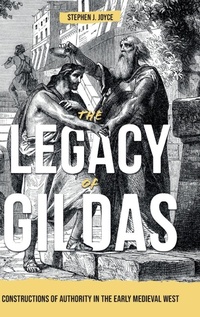
The Legacy of Gildas
Constructions of Authority in the Early Medieval West
Published on 18. February 2022
Book
Hardback
204 pages
978-1-78327-672-1 (ISBN)
Description
Provocative new investigation into the shadowy figure of Gildas, his influence and representation.
Gildas is an essential witness to the Christian culture of the British Isles in the opaque period after the decline and fall of the western Roman empire. His criticisms in De excidio Britanniae of the Britons in the context of spiritual and secular corruption and partition with pagan powers are a crucial source for understanding the transition to the medieval nations of England, Scotland, Wales, and Ireland. But the ways in which this enigmatic ecclesiastical figure has been received over the centuries have shaped an ambivalent reputation. On the one hand, he is seen as a significant contributor to ecclesiastical reform; on the other, as a dour and unreliable chronicler lamenting an inevitable spiritual and political decline.
This book seeks to refine and recuperate the image of Gildas. It does so by examining his self-image as presented in select surviving works, and subsequent representations as developed by the reception of these works - the legacy of Gildas - by church luminaries such as Columbanus, Gregory the Great, and Bede; in exploring how Gildas influenced perceptions of authority in the British Isles and on the continent, it puts this legacy into a wider context. Overall, the volume argues that as one of the earliest authorities to define and defend Christian kingship Gildas deserves to be seen as a significant contributor to the political and ecclesiastical development of the early medieval West.
Gildas is an essential witness to the Christian culture of the British Isles in the opaque period after the decline and fall of the western Roman empire. His criticisms in De excidio Britanniae of the Britons in the context of spiritual and secular corruption and partition with pagan powers are a crucial source for understanding the transition to the medieval nations of England, Scotland, Wales, and Ireland. But the ways in which this enigmatic ecclesiastical figure has been received over the centuries have shaped an ambivalent reputation. On the one hand, he is seen as a significant contributor to ecclesiastical reform; on the other, as a dour and unreliable chronicler lamenting an inevitable spiritual and political decline.
This book seeks to refine and recuperate the image of Gildas. It does so by examining his self-image as presented in select surviving works, and subsequent representations as developed by the reception of these works - the legacy of Gildas - by church luminaries such as Columbanus, Gregory the Great, and Bede; in exploring how Gildas influenced perceptions of authority in the British Isles and on the continent, it puts this legacy into a wider context. Overall, the volume argues that as one of the earliest authorities to define and defend Christian kingship Gildas deserves to be seen as a significant contributor to the political and ecclesiastical development of the early medieval West.
Reviews / Votes
[...] Joyce's study is a valuable contribution to our understanding of Gildas. This volume is well researched, ambitious, and impressively wide in scope. It demonstrates just how much remains to be said of a writer of whose work so little survives. * SPECULUM * The book is wide in scope, including the fragments of Gildas interpreted as being from his letter to Finnian cited by Columbanus, and considering the ways that Gildas' writings were used by others through to the eighth century. Putting Gildas' writings in context is challenging, but what the book provides is a textual network in which they have their place. * JOURNAL OF THE AUSTRALIAN EARLY MEDIEVAL ASSOCIATION * In moving away from the usual discussions of De Excidio as a historical text, Joyce offers a new interpretation of Gildas that recontextualizes both his authority and his works in the early medieval period. For medievalists it provides a fresh look at a controversial author and his often-fraught legacy. I recommend this book to medievalists interested in insular-continental connections or in religious literary history, but scholars of post-Roman Britain may find themselves frustrated. * LIMINA: A JOURNAL OF HISTORICAL & CULTURAL STUDIES *More details
Series
Language
English
Place of publication
Woodbridge
United Kingdom
Publishing group
Boydell & Brewer Ltd
Target group
Professional and scholarly
Product notice
Cloth over boards
Illustrations
6 Karten
6 Maps
Dimensions
Height: 240 mm
Width: 161 mm
Thickness: 16 mm
Weight
476 gr
ISBN-13
978-1-78327-672-1 (9781783276721)
Copyright in bibliographic data and cover images is held by Nielsen Book Services Limited or by the publishers or by their respective licensors: all rights reserved.
Schweitzer Classification
Other editions
Additional editions
Book
approx. 09/2026
Boydell & Brewer
€31.50
Not yet published
E-Book
02/2022
1st Edition
De Gruyter
€48.99
Available for download
E-Book
02/2022
1st Edition
Boydell & Brewer Ltd
€48.99
Available for download
Person
Stephen J. Joyce is a Research Fellow on the ARC Discovery Project, Addressing Injustice in the Medieval Body Politic: From Complaint to Advice, based in the School of Philosophical, Historical, and International Studies at Monash University. His research focuses on the British Isles in the early medieval period.
Content
List of Figures
Preface and Acknowledgements
List of Abbreviations
Introduction
1. Narratives for Early Medieval Britain and Ireland
2. Images of Gildas
3. Gildas's De excidio - Authority and the Monastic Ideal
4. Columbanus and Gregory the Great
5. Gildas and the Hibernensis
6. Bede and Gildas
Conclusion: The Legacy of Gildas
Appendix: De communicatione Gildas
Bibliography
Index
Preface and Acknowledgements
List of Abbreviations
Introduction
1. Narratives for Early Medieval Britain and Ireland
2. Images of Gildas
3. Gildas's De excidio - Authority and the Monastic Ideal
4. Columbanus and Gregory the Great
5. Gildas and the Hibernensis
6. Bede and Gildas
Conclusion: The Legacy of Gildas
Appendix: De communicatione Gildas
Bibliography
Index