

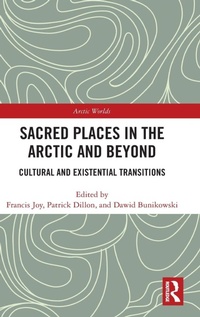
Sacred Places in the Arctic and Beyond
Cultural and Existential Transitions
1st Edition
Published on 22. May 2026
Book
Hardback
304 pages
978-1-032-97373-9 (ISBN)
Description
Sacred Places in the Arctic and Beyond brings together indigenous and nonindigenous scholars, rightsholders, and practitioners to explore the status and management of sacred places, which are important as both tangible and intangible cultural heritage. It acknowledges the critical functions and roles that sacred places play in connection with local people, traditions, beliefs, and practices, as identity markers, places of cultural transmission and memory, and locations that support ecosystems and biodiversity.
An introductory chapter presents an organising framework for this book based in cultural ecology and law. Four chapters present case studies from the Arctic, and four more widen the geographical coverage to North America, South America, Africa, and Europe, each describing the cultural contexts and Indigenous cosmologies of sacred places in their respective regions. The studies raise issues of access to sacred places, destruction and disruption caused by extractive industries and tourism, and implications of these challenges for their management. This book concludes with three chapters that call for policy reappraisals. They address the problem of how Western-orientated discourses and organisational structures frame legislation about, and management of, sacred places in ways which are seldom compatible with how Indigenous people understand these places and engage with them. Major themes from the case studies are integrated with ideas from cultural ecology and legal pluralism into a framework to inform future policy.
An introductory chapter presents an organising framework for this book based in cultural ecology and law. Four chapters present case studies from the Arctic, and four more widen the geographical coverage to North America, South America, Africa, and Europe, each describing the cultural contexts and Indigenous cosmologies of sacred places in their respective regions. The studies raise issues of access to sacred places, destruction and disruption caused by extractive industries and tourism, and implications of these challenges for their management. This book concludes with three chapters that call for policy reappraisals. They address the problem of how Western-orientated discourses and organisational structures frame legislation about, and management of, sacred places in ways which are seldom compatible with how Indigenous people understand these places and engage with them. Major themes from the case studies are integrated with ideas from cultural ecology and legal pluralism into a framework to inform future policy.
Reviews / Votes
"Sacred Places in the Arctic and Beyond blends critical analysis with a global perspective in a deeply insightful examination of sacred places. It reveals both universal struggles and unique regional perspectives. It is a powerful call for policy reform that better respects Indigenous perspectives and practices."- Timo Koivurova, University of Lapland
"The authors of Sacred Places in the Arctic and Beyond sensitively draw important lessons from indigenous cultures, both in the Arctic and further afield. They provide insights into how we can share governance approaches across different cultures, and learn mutual lessons about organisational frameworks for living in harmony with the natural world."
- Tom Oliver, University of Reading
"A brilliantly curated collection of case studies illustrating the importance of restorative, reciprocal relationships with sacred heritage. It integrates cultural ecology, heritage studies, and legal pluralism in promoting locally sensitive and inclusive protection of sacred places."
- John C. Ryan, University of Notre Dame, Australia
"By combining Indigenous perspectives with cultural ecology and legal and policy debates, Sacred Places in the Arctic and Beyond offers important insights into how law and culture intersect in understanding and protecting sacred landscapes."
- Reetta Toivanen, University of Helsinki
"Sacred Places in the Arctic and Beyond bridges Indigenous perspectives and academic insights in accounts of sacred places in the Arctic, Europe, Africa, and the Americas. It is a powerful contribution to how we might protect cultural heritage amid social and environmental changes."
- Nuccio Mazzullo, University of Lapland
More details
Series
Language
English
Place of publication
London
United Kingdom
Publishing group
Taylor & Francis Ltd
Target group
College/higher education
Postgraduate
Product notice
Laminated cover
Illustrations
45 farbige Abbildungen, 45 Farbfotos bzw. farbige Rasterbilder
45 Halftones, color; 45 Illustrations, color
Dimensions
Height: 234 mm
Width: 156 mm
Thickness: 19 mm
Weight
629 gr
ISBN-13
978-1-032-97373-9 (9781032973739)
Copyright in bibliographic data and cover images is held by Nielsen Book Services Limited or by the publishers or by their respective licensors: all rights reserved.
Schweitzer Classification
Other editions
Additional editions
Francis Joy | Patrick Dillon | Dawid Bunikowski
Sacred Places in the Arctic and Beyond
Cultural and Existential Transitions
E-Book
05/2026
Routledge
€56.49
Available for download
Francis Joy | Patrick Dillon | Dawid Bunikowski
Sacred Places in the Arctic and Beyond
Cultural and Existential Transitions
E-Book
05/2026
Routledge
€56.49
Available for download
Persons
Francis Joy is a postdoctoral researcher in the Arctic Anthropology Research Team at the Arctic Centre, University of Lapland in Rovaniemi, Finland. His expertise is in cultural heritage.
Patrick Dillon is Emeritus Professor in the Faculty of Arts, Humanities and Social Sciences at the University of Exeter, UK, and for ten years was Professor in the Philosophical Faculty at the University of Eastern Finland. His expertise is in cultural ecology.
Dawid Bunikowski is Professor at the State University of Applied Sciences in Wloclawek, Poland, and Visiting Scholar at the University of Eastern Finland School of Theology. His expertise is in law.
Patrick Dillon is Emeritus Professor in the Faculty of Arts, Humanities and Social Sciences at the University of Exeter, UK, and for ten years was Professor in the Philosophical Faculty at the University of Eastern Finland. His expertise is in cultural ecology.
Dawid Bunikowski is Professor at the State University of Applied Sciences in Wloclawek, Poland, and Visiting Scholar at the University of Eastern Finland School of Theology. His expertise is in law.
Content
1. Sacred Places in transition. An introduction and organisational framework based on cultural ecology and legal pluralism Part One: The Arctic 2. Mythical landscapes and sacred natural places in the Arctic North, their exploitation through tourism and inadequate protection 3. Relating to Place: Belonging, Identity and the Sami People of Giron (Kiruna), Sweden 4. Guided by the Aahka - Indigenous Art as a tool for relating with the Pluriversal reality of Sami Cosmology 5. The Nenets' sacred places: the life story of the Singing Mountain Yangania Pe Part Two: Broader Contexts 6. Turtle Island Sacred Landscapes as Places of Radical Relationality and Doorways to Mystery 7. Indigeneity and sacred lands in Pauline Melville's The Ventriloquist's Tale 8. Reconciling the 'Sacred' in State-protected Forests: Excerpts from the Mount Cameroon National Park in Sub-Saharan Africa 9. Sacred places as Cultural Ecologies: The case of the Uffington White Horse in the English Chalklands Part Three: New Directions 10. The linguistic complexity of cultural relativity: the idea of a sacred space 11. Legal pluralism, cultural ecology, and protection of sacred places 12. Beyond Borders: How U.S. and German Approaches to Religious Freedom Diverge on Indigenous Sacred Sites 13. Sacred Places. Cultural and existential transitions. Index