

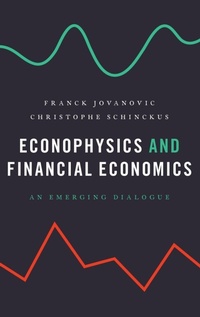
Econophysics and Financial Economics
An Emerging Dialogue
Published on 26. January 2017
Book
Hardback
248 pages
978-0-19-020503-4 (ISBN)
Description
What is econophysics? What makes an econophysicist? Why are financial economists reluctant to use results from econophysics? Can we overcome disputes concerning hypotheses used in financial economics and that make no sense for econophysicists? How can we create a profitable dialogue between financial economists and econophysicists? How do we develop a common theoretical framework allowing the creation of more efficient models for the financial industry?
This book moves beyond the disciplinary frontiers in order to initiate the development of a common theoretical framework that makes sense for both traditionally trained financial economists and econophysicists. Unlike other publications dedicated to econophysics, this book is written by two financial economists and it situates econophysics in the evolution of financial economics. The major issues that concern the collaboration between the two fields are analyzed in detail. More specifically, this book explains the theoretical and methodological foundations of these two fields in an accessible vocabulary providing the first extensive analytic comparison between models and results from both fields. The book also identifies the major conceptual gate-keepers that complicate dialogue between the two communities while it provides elements to overcome them.
By mixing conceptual, historical, theoretical and formal arguments our analysis bridges the current deaf dialogue between financial economists and econophysicists. This book details the recent results in econophysics that bring it closer to financial economics. So doing, it identifies what remains to be done for econophysicists to contribute significantly to financial economics. Beyond the clarification of the current situation, this book also proposes a generic model compatible with the two fields, defining minimal conditions for common models. Finally, this book provides a research agenda for a more fruitful collaboration between econophysicists and financial economists, creating new research opportunities. In this perspective, it lays the foundations for common theoretical framework and models.
This book moves beyond the disciplinary frontiers in order to initiate the development of a common theoretical framework that makes sense for both traditionally trained financial economists and econophysicists. Unlike other publications dedicated to econophysics, this book is written by two financial economists and it situates econophysics in the evolution of financial economics. The major issues that concern the collaboration between the two fields are analyzed in detail. More specifically, this book explains the theoretical and methodological foundations of these two fields in an accessible vocabulary providing the first extensive analytic comparison between models and results from both fields. The book also identifies the major conceptual gate-keepers that complicate dialogue between the two communities while it provides elements to overcome them.
By mixing conceptual, historical, theoretical and formal arguments our analysis bridges the current deaf dialogue between financial economists and econophysicists. This book details the recent results in econophysics that bring it closer to financial economics. So doing, it identifies what remains to be done for econophysicists to contribute significantly to financial economics. Beyond the clarification of the current situation, this book also proposes a generic model compatible with the two fields, defining minimal conditions for common models. Finally, this book provides a research agenda for a more fruitful collaboration between econophysicists and financial economists, creating new research opportunities. In this perspective, it lays the foundations for common theoretical framework and models.
Reviews / Votes
"Twenty years after the creation of econophysics, econophysicists and financial economists still tend to ignore each other. Unraveling the nature and the foundations of these two disciplines is essential in understanding where we are today, and Franck Jovanovic and Christophe Schinckus' book does this extremely well. It provides an outstanding analysis of the current state of knowledge that has emerged between econophysics and financial economics. The authorsstrive to transcend the boundary between the two disciplines and create a profitable dialogue, and they achieve this goal completely. I admire the authors and their work. All economists, financiers and
physicists should read this book!"
-- Eugene Stanley
"Jovanovic and Schinckus have written a highly original book that looks at the intersection of physics and financial economics (econophysics) from a fresh perspective. Written by financial economists rather than physicists, it converts the results and concepts of econophysics into a language that can be grasped by economists and so put into practice. The fluid integration of history, conceptual foundations, formal details, as well as applications renders the
book highly readable and of interest to researchers from a wide variety of disciplines."
-- Dean Rickles, Associate Professor, Faculty of Science, The University of Sydney
More details
Language
English
Place of publication
New York
United States
Target group
College/higher education
Professional and scholarly
Dimensions
Height: 240 mm
Width: 161 mm
Thickness: 18 mm
Weight
537 gr
ISBN-13
978-0-19-020503-4 (9780190205034)
Copyright in bibliographic data and cover images is held by Nielsen Book Services Limited or by the publishers or by their respective licensors: all rights reserved.
Schweitzer Classification
Other editions
Additional editions
E-Book
11/2016
1st Edition
OUP eBook
€80.49
Available for download
E-Book
11/2016
1st Edition
OUP eBook
€80.49
Available for download
Persons
Franck Jovanovic is Associate Professor in Finance at the University of Leicester School of Management, Franck has published or edited 4 books and almost 40 papers. He is regularly invited as visiting professor by universities and research centers. He is research associate with the University of Orleans (France) and with the CIRST (Canada). For several years, Franck has been a research consultant in the private and public sector, including OECD, French Ministry for the Economy and Finance. His research interest focuses on financial economics and its interdisciplinary issues.
Christophe Schinckus is Associate Professor in Finance at the University of Leicester, he published more than 50 papers in peer-reviewed journals. His research interest focuses on interdisciplinary issues in financial economics. He presented more than 40 communications in conference and was invited to give lectures in UK (Cambridge), Canada, Europe, Thailand and Vietnam. He is currently finishing a second PhD in Philosophy of Science at the University of Cambridge.
Christophe Schinckus is Associate Professor in Finance at the University of Leicester, he published more than 50 papers in peer-reviewed journals. His research interest focuses on interdisciplinary issues in financial economics. He presented more than 40 communications in conference and was invited to give lectures in UK (Cambridge), Canada, Europe, Thailand and Vietnam. He is currently finishing a second PhD in Philosophy of Science at the University of Cambridge.
Content
Chapter 1: Foundations of financial economics: the key role of the Gaussian distribution
Chapter 2: Extreme values in financial economics: from their observation to their integration into the Gaussian framework
Chapter 3. New tools for extreme-value analysis: statistical physics goes beyond its borders
Chapter 4: The disciplinary position of Econophysics: new opportunities for financial innovations
Chapter 5. Major contributions of Econophysics to Financial Economics
Chapter 6: Towards a common framework
Conclusion: What kind of future lies in store for econophysics?
Chapter 2: Extreme values in financial economics: from their observation to their integration into the Gaussian framework
Chapter 3. New tools for extreme-value analysis: statistical physics goes beyond its borders
Chapter 4: The disciplinary position of Econophysics: new opportunities for financial innovations
Chapter 5. Major contributions of Econophysics to Financial Economics
Chapter 6: Towards a common framework
Conclusion: What kind of future lies in store for econophysics?