

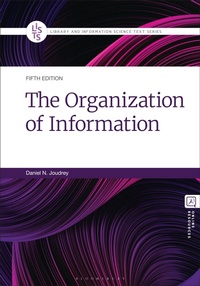
The Organization of Information
5th Edition
Published on 13. November 2025
Book
Hardback
688 pages
978-1-4408-7859-6 (ISBN)
Description
Organizing information is at the heart of the information professions, and the fifth edition of The Organization of Information is a key resource for anyone seeking up-to-date guidance.
For millennia, information organization has been central to the functioning of libraries and other information institutions. The fifth edition of The Organization of Information provides a timely, detailed introduction to organizing in a variety of information contexts, including library cataloging, archival description, indexing, museum registration, metadata creation for digital collections, organizing on the web, linked data, and the development of the Semantic Web.
Examining how and why information professionals organize information in contemporary libraries, archives, museums, and in a variety of online settings, expert Daniel N. Joudrey addresses the types of retrieval tools used throughout information organizations, the functionality of information systems, and the role and effect of technology on information organization. A discussion of encoding follows, explaining the basics of the MARC format, several XML schemas, and the developing BIBFRAME standard. A section on the principles and functionality of metadata covers metadata types, metadata characteristics, and tools used to manage metadata projects. A timely new chapter on conceptual models and frameworks articulates the visions behind the Library Reference Model (LRM), Records-in-Contexts (RiC), and the Semantic Web, including a discussion of RDF as its underlying structural model. Finally, the latter portion of the book describes practices related to the creation of descriptive metadata.
Providing a thorough overview of the field's major issues, challenges, and standards, The Organization of Information is an essential resource for students in library and information science programs as well as for established professionals who want to refresh their knowledge of the latest developments in the field.
For millennia, information organization has been central to the functioning of libraries and other information institutions. The fifth edition of The Organization of Information provides a timely, detailed introduction to organizing in a variety of information contexts, including library cataloging, archival description, indexing, museum registration, metadata creation for digital collections, organizing on the web, linked data, and the development of the Semantic Web.
Examining how and why information professionals organize information in contemporary libraries, archives, museums, and in a variety of online settings, expert Daniel N. Joudrey addresses the types of retrieval tools used throughout information organizations, the functionality of information systems, and the role and effect of technology on information organization. A discussion of encoding follows, explaining the basics of the MARC format, several XML schemas, and the developing BIBFRAME standard. A section on the principles and functionality of metadata covers metadata types, metadata characteristics, and tools used to manage metadata projects. A timely new chapter on conceptual models and frameworks articulates the visions behind the Library Reference Model (LRM), Records-in-Contexts (RiC), and the Semantic Web, including a discussion of RDF as its underlying structural model. Finally, the latter portion of the book describes practices related to the creation of descriptive metadata.
Providing a thorough overview of the field's major issues, challenges, and standards, The Organization of Information is an essential resource for students in library and information science programs as well as for established professionals who want to refresh their knowledge of the latest developments in the field.
More details
Series
Edition
5th edition
Language
English
Place of publication
United States
Publishing group
Bloomsbury Publishing Plc
Target group
College/higher education
Professional and scholarly
Illustrations
Author supplies cataloging records as illustrations (figures) to avoid issues with alignment.
Dimensions
Height: 260 mm
Width: 183 mm
Thickness: 41 mm
Weight
1460 gr
ISBN-13
978-1-4408-7859-6 (9781440878596)
Copyright in bibliographic data and cover images is held by Nielsen Book Services Limited or by the publishers or by their respective licensors: all rights reserved.
Schweitzer Classification
Person
Daniel N. Joudrey is a Professor in the School of Library and Information Science, Simmons University, Boston, Massachusetts, USA, where he teaches information organization and cataloging. His research interests include aboutness determination, subject access to information, and cataloging education.
Content
Preface
Acknowledgments
Chapter 1: Organization of Recorded Information
Chapter 2: Development of the Organization of Recorded Information in Western Civilization
Chapter 3: Retrieval Tools
Chapter 4: Information Systems, Retrieval, and Other Technology Concerns
Chapter 5: Encoding Standards
Chapter 6: Introduction to Metadata
Chapter 7: Conceptual Models
Chapter 8: Description and Access
Chapter 9: Standards for Description and Access
Chapter 10: Authority Control
Chapter 11: Subject Analysis
Chapter 12: Systems for Controlled Vocabulary
Chapter 13: Systems for Categorization
Appendix A: Arrangement of Metadata Displays
Appendix B: Arrangement of Physical Information Resources in Libraries
Appendix C: EAD3 Encoded Finding Aid for Collection Described in Figure 3.9
Appendix D: BIBFRAME 2.1 Record
Appendix E: An Approach to Subject Analysis
Glossary
Bibliography
Index
Acknowledgments
Chapter 1: Organization of Recorded Information
Chapter 2: Development of the Organization of Recorded Information in Western Civilization
Chapter 3: Retrieval Tools
Chapter 4: Information Systems, Retrieval, and Other Technology Concerns
Chapter 5: Encoding Standards
Chapter 6: Introduction to Metadata
Chapter 7: Conceptual Models
Chapter 8: Description and Access
Chapter 9: Standards for Description and Access
Chapter 10: Authority Control
Chapter 11: Subject Analysis
Chapter 12: Systems for Controlled Vocabulary
Chapter 13: Systems for Categorization
Appendix A: Arrangement of Metadata Displays
Appendix B: Arrangement of Physical Information Resources in Libraries
Appendix C: EAD3 Encoded Finding Aid for Collection Described in Figure 3.9
Appendix D: BIBFRAME 2.1 Record
Appendix E: An Approach to Subject Analysis
Glossary
Bibliography
Index