

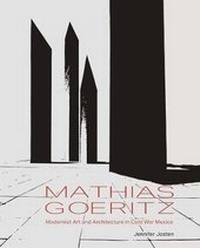
Mathias Goeritz
Modernist Art and Architecture in Cold War Mexico
Published on 16. October 2018
Book
Hardback
352 pages
978-0-300-22860-1 (ISBN)
Description
The first major work in English on Mathias Goeritz (1915-1990), this book illuminates the artist's pivotal role within the landscape of twentieth-century modernism. Goeritz became recognized as an abstract sculptor after arriving in Mexico from Germany by way of Spain in 1949. His call to integrate abstract forms into civic and religious architecture, outlined in his "Emotional Architecture" manifesto, had a transformative impact on midcentury Mexican art and design.
While best known for the experimental museum El Eco and his collaborations with the architect Luis Barragan, including the brightly colored towers of Satellite City, Goeritz also shaped the Bauhaus-inspired curriculum at Guadalajara's School of Architecture and the iconic Cultural Program of Mexico City's 1968 Olympic Games. Josten addresses the Cold War implications of these and other initiatives that pitted Goeritz, an advocate of internationalist abstraction, against Diego Rivera and David Alfaro Siqueiros, ardent defenders of the realist style that prevailed in official Mexican art during the postrevolutionary period. Exploring Goeritz's dialogues with leading figures among the Parisian and New York avant-gardes, such as Yves Klein and Philip Johnson, Josten shows how Goeritz's approach to modernism, which was highly attuned to politics and place, formed part of a global enterprise.
While best known for the experimental museum El Eco and his collaborations with the architect Luis Barragan, including the brightly colored towers of Satellite City, Goeritz also shaped the Bauhaus-inspired curriculum at Guadalajara's School of Architecture and the iconic Cultural Program of Mexico City's 1968 Olympic Games. Josten addresses the Cold War implications of these and other initiatives that pitted Goeritz, an advocate of internationalist abstraction, against Diego Rivera and David Alfaro Siqueiros, ardent defenders of the realist style that prevailed in official Mexican art during the postrevolutionary period. Exploring Goeritz's dialogues with leading figures among the Parisian and New York avant-gardes, such as Yves Klein and Philip Johnson, Josten shows how Goeritz's approach to modernism, which was highly attuned to politics and place, formed part of a global enterprise.
Reviews / Votes
"A terrific subject for our globalist moment."-Jed Perl, New York Review of BooksWinner of the 2020 ALAA-Arvey Foundation Book Award
"Josten's excellent and well-written book fills an important gap in the study of post-war Mexican art."-Yve-Alain Bois, Institute for Advanced Study
"Mathias Goeritz is a vital contribution to the burgeoning scholarship on mid-century Mexican art and cultural politics. Jennifer Josten not only illuminates Goeritz's contributions to Cold War Mexico, but just as significantly, reveals his importance within artistic circuits across the Americas and the Atlantic."-Mary Coffey, Dartmouth College
"German emigre artist, architect, scholar, and curator Mathias Goeritz's eventful life and multifaceted career offers a window into the vibrant artistic culture of post-WWII Mexico City with stops in Madrid, New York, Paris, Tangier, and beyond. By foregrounding transnational exchanges and international circuits the book makes a major overture into what it means to write global history of art."-Eeva-Liisa Pelkonen, Yale School of Architecture
More details
Language
English
Place of publication
United States
Target group
Professional and scholarly
Product notice
Cloth over boards
Illustrations
84 color + 93 b-w illus.
Dimensions
Height: 254 mm
Width: 203 mm
Weight
1361 gr
ISBN-13
978-0-300-22860-1 (9780300228601)
Copyright in bibliographic data and cover images is held by Nielsen Book Services Limited or by the publishers or by their respective licensors: all rights reserved.
Schweitzer Classification
Person
Jennifer Josten is assistant professor in the Department of History of Art and Architecture at the University of Pittsburgh.