

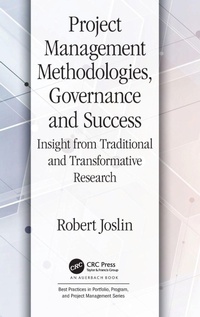
Project Management Methodologies, Governance and Success
Insight from Traditional and Transformative Research
1st Edition
Published on 22. April 2019
Book
Hardback
288 pages
978-1-4665-7771-8 (ISBN)
Description
With all signs pointing to an increased use of and interest in project-based work in modern organizations, the better scholars are able to make sense of the current state of the field through theory development and empirical investigation, the more successful projects promise to become. This book is a welcome addition to our field and will be, I am sure, an important work and source for future reference well into the future.
-Dr. Jeffrey Pinto, Pennsylvania State University
The goal of practicing project managers and scholars alike lies in solving the puzzle of how to manage projects toward successful completion. However, understanding what comprises project "success"-seemingly such an innocent question-has come to represent one of the most challenging problems for project managers and scholars. Who determines success? At what point in time is success best measured? How do diverse stakeholders define success? What happens when their perspectives collide? What is the difference between project success and project management success? These are surprisingly complex problems. For every principle or rule posited, a brief investigation reveals that there are numerous exceptions, muddying the waters and making these ideas increasingly opaque. Project Management Methodologies, Governance and Success addresses this challenge head-on, putting into proper context the critical issues that shape our understanding of the project management research process.
Employing a concept referred to as "philosophical triangulation," the book shows how to overcome the weaknesses or intrinsic biases that disrupt and minimize the impact of so much organizational research. It places organizational governance and success within their proper context allowing scholars to identify the best methods for investigating project-based work. It links together in a cogent manner the diverse themes of research theory and design, projects and project success, and organizational governance. In effect, this book demonstrates that to fully understand how to undertake research in projects, theory and method are inextricably interwoven.
-Dr. Jeffrey Pinto, Pennsylvania State University
The goal of practicing project managers and scholars alike lies in solving the puzzle of how to manage projects toward successful completion. However, understanding what comprises project "success"-seemingly such an innocent question-has come to represent one of the most challenging problems for project managers and scholars. Who determines success? At what point in time is success best measured? How do diverse stakeholders define success? What happens when their perspectives collide? What is the difference between project success and project management success? These are surprisingly complex problems. For every principle or rule posited, a brief investigation reveals that there are numerous exceptions, muddying the waters and making these ideas increasingly opaque. Project Management Methodologies, Governance and Success addresses this challenge head-on, putting into proper context the critical issues that shape our understanding of the project management research process.
Employing a concept referred to as "philosophical triangulation," the book shows how to overcome the weaknesses or intrinsic biases that disrupt and minimize the impact of so much organizational research. It places organizational governance and success within their proper context allowing scholars to identify the best methods for investigating project-based work. It links together in a cogent manner the diverse themes of research theory and design, projects and project success, and organizational governance. In effect, this book demonstrates that to fully understand how to undertake research in projects, theory and method are inextricably interwoven.
More details
Series
Language
English
Place of publication
London
United Kingdom
Publishing group
Taylor & Francis Ltd
Target group
College/higher education
Illustrations
100 s/w Abbildungen
100 Illustrations, black and white
Dimensions
Height: 240 mm
Width: 161 mm
Thickness: 20 mm
Weight
602 gr
ISBN-13
978-1-4665-7771-8 (9781466577718)
Copyright in bibliographic data and cover images is held by Nielsen Book Services Limited or by the publishers or by their respective licensors: all rights reserved.
Schweitzer Classification
Other editions
Additional editions
Robert Joslin
Project Management Methodologies, Governance and Success
Insight from Traditional and Transformative Research
Book
01/2023
1st Edition
Auerbach
€65.60
Shipment within 10-20 days
Robert Joslin
Project Management Methodologies, Governance and Success
Insight from Traditional and Transformative Research
E-Book
04/2019
Auerbach
€62.99
Available for download
Robert Joslin
Project Management Methodologies, Governance and Success
Insight from Traditional and Transformative Research
E-Book
04/2019
1st Edition
Auerbach Publishers Inc.
€63.49
Available for download
Person
Robert Joslin PhD, IPMO-M, IPMO-E, PMP, PgMP, PfMP, CEng, MIEEE, MBCS, is a professor, head of the research advisory board at SBS Swiss Business School, and the founder of AIPMO (Associational of International Project Management Officers). Robert has considerable experience in designing, initiating, and project/ program management delivery of large-scale business transformation, reengineering, infrastructure, and strategy development, having received several awards for ideas and product innovation. Robert presents at conferences as a keynote speaker and publishes books, book chapters, and research papers. Robert is in the process of architecting and co-authoring AIPMO's Body of Knowledge, which comprises several books in the area of PMO and related topics. Previously, he has been a consultant in a wide range of industries including telecom, banking, insurance, manufacturing, and government while working for McKinsey & Co, Logica, and his own consulting and product development companies.
Content
Contents
List of Figures
List of Tables
Foreword
Preface
Acknowledgments
About the Author
Chapter 1 Introduction
Chapter 2 Use of Comparatives-The Basis for the Natural-Science to Social-Science Comparative
Chapter 3 Project Management Methodologies, Project Success, Project Governance, Contingency Theory, Agency Theory, and Stewardship Theory
Chapter 4 Research Methodology
Chapter 5 New Insights into Project Management Research: A Natural Sciences Comparative
(Coauthored with Ralf Mueller)
Chapter 6 The Impact of Project Methodologies on Project Success in Different Project Environments
(Coauthored with Ralf Mueller)
Chapter 7 Relationships Between a Project Management Methodology and Project Success in Different Project Governance Contexts
(Coauthored with Ralf Mueller)
Chapter 8 The Relationship Between Project Governance and Project Success
(Coauthored with Ralf Mueller)
Chapter 9 Using Philosophical and Methodological Triangulation to Identify Interesting Phenomena
(Coauthored with Ralf Mueller)
Chapter 10 Analysis and Theory Building
Chapter 11 Theoretical and Practical Implications
References
Further Reading
Index
List of Figures
List of Tables
Foreword
Preface
Acknowledgments
About the Author
Chapter 1 Introduction
Chapter 2 Use of Comparatives-The Basis for the Natural-Science to Social-Science Comparative
Chapter 3 Project Management Methodologies, Project Success, Project Governance, Contingency Theory, Agency Theory, and Stewardship Theory
Chapter 4 Research Methodology
Chapter 5 New Insights into Project Management Research: A Natural Sciences Comparative
(Coauthored with Ralf Mueller)
Chapter 6 The Impact of Project Methodologies on Project Success in Different Project Environments
(Coauthored with Ralf Mueller)
Chapter 7 Relationships Between a Project Management Methodology and Project Success in Different Project Governance Contexts
(Coauthored with Ralf Mueller)
Chapter 8 The Relationship Between Project Governance and Project Success
(Coauthored with Ralf Mueller)
Chapter 9 Using Philosophical and Methodological Triangulation to Identify Interesting Phenomena
(Coauthored with Ralf Mueller)
Chapter 10 Analysis and Theory Building
Chapter 11 Theoretical and Practical Implications
References
Further Reading
Index