

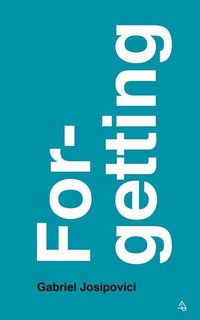
Forgetting
Published on 30. January 2020
Book
Paperback/Softback
160 pages
978-1-78410-890-8 (ISBN)
Description
We cannot understand the phenomenon of remembering without invoking its opposite, forgetting. Taking his cue from Beckett - 'only he who forgets remembers' - Josipovici uncovers a profound cultural shift from societies that celebrated ritual remembrance at fixed times and places, to our own Western world where the lack of such mechanisms leads to a fear of forgetting, to what Nietzsche diagnosed as an unhealthy sleeplessness that infects every aspect of our culture.
Moving from the fear of Alzheimer's to invocations of 'Remember the Holocaust' and 'Remember Kosovo' by unscrupulous demagogues, from the burial rituals of rural societies to the Berlin and Vienna Holocaust Memorials, from eighteenth-century disquiet about the role of tombs and inscriptions to the late poems of Wallace Stevens, Josipovici has produced, in characteristic style, a small book with a very big punch.
Gabriel Josipovici's novel The Cemetery in Barnes (2018) was shortlisted for the 2018 Goldsmiths Prize and longlisted for the 2019 Republic of Consciousness Prize.
Moving from the fear of Alzheimer's to invocations of 'Remember the Holocaust' and 'Remember Kosovo' by unscrupulous demagogues, from the burial rituals of rural societies to the Berlin and Vienna Holocaust Memorials, from eighteenth-century disquiet about the role of tombs and inscriptions to the late poems of Wallace Stevens, Josipovici has produced, in characteristic style, a small book with a very big punch.
Gabriel Josipovici's novel The Cemetery in Barnes (2018) was shortlisted for the 2018 Goldsmiths Prize and longlisted for the 2019 Republic of Consciousness Prize.
Reviews / Votes
'... a fascinating book of reflections on memory and forgetting... This mix of detailed readings has been typical of Josipovici's critical work... It is what has made him one of the outstanding critics of our time.'David Herman, The Jewish Chronicle 'As always, Josipovici asks big questions. Why, as a culture, are we fascinated by issues of forgetting? Is there something a little anxious about the injunction to "never forget"?'
David Herman, The Jewish Chronicle 'Forgetting is second to none on the demands of the present when it comes to our cultural memory. Josipovici writes generously, with deep consideration and empathy, on the subject and has written an enlightening collection that serves as both consolation and a warning during this time of crisis.'
Jack Solloway, Review 31 'To call it a "success" would be praise too simple for such a rich work. It is a book to be remembered and re-remembered'
Scott Beauchamp, The New Criterion 'Josipovici is at his best in his dissections of art's representations, its bridges between personal and cultural worlds.'
Bernadette Ashby, DURA Dundee 'In prose that is lively and learned, perceptive and persuasive, Josipovici's timely meditations proffer both consolation and challenges to the knotty problem of forgetting and remembering...[a] slim yet insightful volume.'
Ian Ellison, Journal of European Studies 'Gabriel Josipovici provides an elegant lesson, to cite the title of his final chapter, in letting go'
Ben Hutchinson, Times Literary Supplement
More details
Language
English
Place of publication
Manchester
United Kingdom
Dimensions
Height: 213 mm
Width: 134 mm
Thickness: 15 mm
Weight
198 gr
ISBN-13
978-1-78410-890-8 (9781784108908)
Copyright in bibliographic data and cover images is held by Nielsen Book Services Limited or by the publishers or by their respective licensors: all rights reserved.
Schweitzer Classification
Other editions
Additional editions
Person
Gabriel Josipovici was born in Nice in 1940 to Jewish parents of Italo-Russian, Romano-Levantine extraction. He lived in Egypt from 1945 to 1956, when he came to England. He read English at a St.Edmund Hall, Oxford and from 1963 to 1998 was first a lecturer, then a Professor in the School of European Studies at the University of Sussex. He is the author of some twenty novels, ten books of criticism, a memoir of his mother, the poet Sacha Rabinovitch, and numerous stage and radio plays. His reviews have appeared in The Guardian, The Independent, The Times Literary Supplement, the New York and the London Review of Books. Carcanet publish his novels and fictions Contre-Jour (1986), In the Fertile Land (1987), Steps (1990), The Big Glass (1991), In a Hotel Garden (1993) and Moo Pak (1995) and his essays Text and Voice (1993). His most recent fictions with Carcanet are The Cemetery in Barnes (2018), longlisted for the 2019 Republic of Consciousness Prize and shortlisted for the 2018 Goldsmiths Prize, and Hotel Andromeda (2014). Carcanet also published his non-fiction Forgetting (2019) and 100 Days (2021) and the combined fiction and literary critical book Partita and A Winter in Zuerau (2024).