

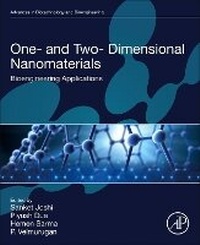
One- and Two- Dimensional Nanomaterials
Bioengineering Applications
Published on 9. July 2025
Book
Paperback/Softback
430 pages
978-0-443-23703-4 (ISBN)
Description
One- and Two- Dimensional Nanomaterials: Bioengineering Applications covers in-depth information on the properties, structures, and preparation methods of one- and two- dimensional nanomaterials, providing readers with tools that can be immediately implemented and adapted to fit a diverse range of applications.
The first part of the book covers the fundamentals of these materials, including properties and synthesis techniques. The second part of the book focuses on the use of several conventional and emerging nanomaterials in the areas of pollution management, remediation practices, and other possible applications in biosensing, biomedicine, and antimicrobial activity.
This book will be a helpful resource to nano-scientists, biotechnologists, and bioengineers engaged in studying the emerging trends and different fabrication techniques of nanostructures and their applications and possible toxicity.
The first part of the book covers the fundamentals of these materials, including properties and synthesis techniques. The second part of the book focuses on the use of several conventional and emerging nanomaterials in the areas of pollution management, remediation practices, and other possible applications in biosensing, biomedicine, and antimicrobial activity.
This book will be a helpful resource to nano-scientists, biotechnologists, and bioengineers engaged in studying the emerging trends and different fabrication techniques of nanostructures and their applications and possible toxicity.
More details
Series
Language
English
Place of publication
San Diego
United States
Publishing group
Elsevier Science Publishing Co Inc
Target group
Professional and scholarly
Product notice
Paperback (trade)
Dimensions
Height: 235 mm
Width: 191 mm
Thickness: 22 mm
Weight
739 gr
ISBN-13
978-0-443-23703-4 (9780443237034)
Copyright in bibliographic data and cover images is held by Nielsen Book Services Limited or by the publishers or by their respective licensors: all rights reserved.
Schweitzer Classification
Other editions
Additional editions
Sanket Joshi | Piyush Dua | Hemen Sarma
One- and Two-Dimensional Nanomaterials
Bioengineering Applications
E-Book
06/2025
Elsevier
€180.00
Available for download
Persons
Dr. Sanket Joshi is currently a Professor at the Amity Institute of Microbial Technology, Amity University, Rajasthan, India. He has academic teaching and research experience of about 16 years, and industrial R&D experience of about 4 years in India and Oman. While working in Indian pharma companies, he undertook several turnkey projects. His current research interests encompass energy (In-situ/ex-situ microbial enhanced light/heavy oil recovery; chemical enhanced oil Recovery; biofuels), microbial products (biosurfactants, biopolymers, R&D and scale-up), and environmental bioremediation (crude oil pollution; analysis, mitigation and control of souring by Sulfate reducing bacteria; HPAM contaminated sites). He has about 125 scientific publications in international journals, book chapters, and conference proceedings, and two books to his credit. He is an Academic/Associate Editor for: Frontiers in Microbiology, PeerJ, Ecotoxicology (Springer), Petroleum Science and Technology (Springer), Biotech (Springer), and Open Biotechnology Journal; guest editor for Frontiers in Microbiology, Sustainability, Scientifica, and Open Biotechnology Journal. Dr. Piyush Dua obtained his Ph.D. degree from Indian Institute of Technology, India, in 2005. After finishing his Doctorate, he has been engaged in teaching and research in various universities of repute in India, South Korea and Sultanate of Oman. He has published numerous articles in refereed journals of international repute including Journal of Biomedical Nanotechnology, International Journals of Nanotechnology, JPCC, Chemistry and Sustainability, Physica B, and more. Dr. Hemen Sarma is an Associate Professor in the Department of Botany at Bodoland University, India, whose multidisciplinary research spans plant sciences, environmental sustainability, nanobiotechnology, and agriculture. His work advances understanding of plant-environment interactions and sustainable agricultural practices, focusing on emerging pollutants, plant-microbe interactions, and biochar technology.
Recognized internationally, Dr. Sarma was elected a Fellow of the Linnean Society of London and received the UNESCO-TWAS award for science popularization in the Global South. He is also acknowledged among the top 2% of most cited authors worldwide. His academic career spans over two decades, including a PhD in Botany with specialization in plant and environmental pollution from Gauhati University, India, and postdoctoral fellowships at institutions such as the University of Texas at El Paso, USA. Dr. Velmurugan is a Professor at the Centre for Material Engineering and Regenerative Medicine, Bharath Institute of Higher Education and Research, India. He has around 11 years of research and 3 years of teaching experience, in India and South Korea. His current research areas of interest are: Bionanomaterials, Quorum sensing, Biopigments, Probiotics, and Nanomaterials. He has worked as Assistant professor and Research professor in India and Chonbuk National university, South Korea. He serves as an editorial board member in: Frontiers in Microbiology (managing Guest Editor), Industrial Crops and Products (Elsevier), Microbiological Research, Journal of Advanced Pharmaceutical Science and Technology, EC Microbiology, Journal of Nanomaterials, International Journal of Modern Science and technology, and SF Journal of Biotechnology and Biomedical Engineering.
Recognized internationally, Dr. Sarma was elected a Fellow of the Linnean Society of London and received the UNESCO-TWAS award for science popularization in the Global South. He is also acknowledged among the top 2% of most cited authors worldwide. His academic career spans over two decades, including a PhD in Botany with specialization in plant and environmental pollution from Gauhati University, India, and postdoctoral fellowships at institutions such as the University of Texas at El Paso, USA. Dr. Velmurugan is a Professor at the Centre for Material Engineering and Regenerative Medicine, Bharath Institute of Higher Education and Research, India. He has around 11 years of research and 3 years of teaching experience, in India and South Korea. His current research areas of interest are: Bionanomaterials, Quorum sensing, Biopigments, Probiotics, and Nanomaterials. He has worked as Assistant professor and Research professor in India and Chonbuk National university, South Korea. He serves as an editorial board member in: Frontiers in Microbiology (managing Guest Editor), Industrial Crops and Products (Elsevier), Microbiological Research, Journal of Advanced Pharmaceutical Science and Technology, EC Microbiology, Journal of Nanomaterials, International Journal of Modern Science and technology, and SF Journal of Biotechnology and Biomedical Engineering.
Content
Part 1: One dimensional and two dimensional nanomaterials: Properties and synthesis
1. Introduction: One-dimensional and two-dimensional nanomaterials
2. Synthesis of nanowires
3. Low-Dimensional Metal Oxide Semiconductors: A Promising Frontier for Biosensing Applications
4. Graphene based nano-biosensors
5. Bioinformatics and Multivariate Algorithms: Current and Future Implications in the Synthesis of Nanowires
6. Nanowires for Bioelectronics
7. Metal oxide nanowires: Synthesis and applications
Part 2: One dimensional and two dimensional nanomaterials: Applications and Safety aspects
8. Biomedical Engineering: Nanowires for organ and bone tissue engineering
9. Nanoparticles and environmental toxicity, an emerging threat to ecosystem
10. Nanowire applications in bioenergy generation
11. Enhancement of bioelectricity production in microbial fuel cells using nanowire
12. Nanomaterials for Environmental Pollution Hazards
13. Nanotechnology-Based Bioremediation of Wastewater
14. 1D/2D heterostructured photocatalysts for energy and environmental applications
15. Two-dimensional nanomaterials: Recent progress, properties, applications, and future directions for wearable body sensors
16. Effects of 1D and 2D ZnO Nanoparticles in Plant Disease Management and Their Impact on Plant Health
1. Introduction: One-dimensional and two-dimensional nanomaterials
2. Synthesis of nanowires
3. Low-Dimensional Metal Oxide Semiconductors: A Promising Frontier for Biosensing Applications
4. Graphene based nano-biosensors
5. Bioinformatics and Multivariate Algorithms: Current and Future Implications in the Synthesis of Nanowires
6. Nanowires for Bioelectronics
7. Metal oxide nanowires: Synthesis and applications
Part 2: One dimensional and two dimensional nanomaterials: Applications and Safety aspects
8. Biomedical Engineering: Nanowires for organ and bone tissue engineering
9. Nanoparticles and environmental toxicity, an emerging threat to ecosystem
10. Nanowire applications in bioenergy generation
11. Enhancement of bioelectricity production in microbial fuel cells using nanowire
12. Nanomaterials for Environmental Pollution Hazards
13. Nanotechnology-Based Bioremediation of Wastewater
14. 1D/2D heterostructured photocatalysts for energy and environmental applications
15. Two-dimensional nanomaterials: Recent progress, properties, applications, and future directions for wearable body sensors
16. Effects of 1D and 2D ZnO Nanoparticles in Plant Disease Management and Their Impact on Plant Health