

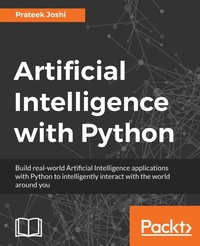
Artificial Intelligence with Python
A Comprehensive Guide to Building Intelligent Apps for Python Beginners and Developers
Published on 27. January 2017
Book
Paperback/Softback
446 pages
978-1-78646-439-2 (ISBN)
Description
Publisher's Note: This edition from 2017 is outdated and not compatible with TensorFlow 2.x or any of the most recent updates to Python libraries. A new edition completely updated and revised for 2020 with seven additional chapters that cover RNNs, AI and big data, fundamental use cases, chatbots, and more, is now available.
Build real-world Artificial Intelligence applications with Python to intelligently interact with the world around you.
Key Features
Step into the amazing world of intelligent apps using this comprehensive guide
Enter the world of Artificial Intelligence, explore it, and create your own applications
Work through simple yet insightful examples that will get you up and running with Artificial Intelligence in no time
Book DescriptionArtificial Intelligence is becoming increasingly relevant in the modern world. By harnessing the power of algorithms, you can create apps which intelligently interact with the world around you, building intelligent recommender systems, automatic speech recognition systems and more.
Starting with AI basics you'll move on to learn how to develop building blocks using data mining techniques. Discover how to make informed decisions about which algorithms to use, and how to apply them to real-world scenarios. This practical book covers a range of topics including predictive analytics and deep learning.What you will learn
Realize different classification and regression techniques
Understand the concept of clustering and how to use it to automatically segment data
See how to build an intelligent recommender system
Understand logic programming and how to use it
Build automatic speech recognition systems
Understand the basics of heuristic search and genetic programming
Develop games using Artificial Intelligence
Who this book is forThis book is for Python developers who want to build real-world Artificial Intelligence applications. This book is friendly to Python beginners, but being familiar with Python would be useful to play around with the code. It will also be useful for experienced Python programmers who are looking to use Artificial Intelligence techniques in their existing technology stacks.
Build real-world Artificial Intelligence applications with Python to intelligently interact with the world around you.
Key Features
Step into the amazing world of intelligent apps using this comprehensive guide
Enter the world of Artificial Intelligence, explore it, and create your own applications
Work through simple yet insightful examples that will get you up and running with Artificial Intelligence in no time
Book DescriptionArtificial Intelligence is becoming increasingly relevant in the modern world. By harnessing the power of algorithms, you can create apps which intelligently interact with the world around you, building intelligent recommender systems, automatic speech recognition systems and more.
Starting with AI basics you'll move on to learn how to develop building blocks using data mining techniques. Discover how to make informed decisions about which algorithms to use, and how to apply them to real-world scenarios. This practical book covers a range of topics including predictive analytics and deep learning.What you will learn
Realize different classification and regression techniques
Understand the concept of clustering and how to use it to automatically segment data
See how to build an intelligent recommender system
Understand logic programming and how to use it
Build automatic speech recognition systems
Understand the basics of heuristic search and genetic programming
Develop games using Artificial Intelligence
Who this book is forThis book is for Python developers who want to build real-world Artificial Intelligence applications. This book is friendly to Python beginners, but being familiar with Python would be useful to play around with the code. It will also be useful for experienced Python programmers who are looking to use Artificial Intelligence techniques in their existing technology stacks.
More details
Language
English
Place of publication
Birmingham
United Kingdom
Target group
Professional and scholarly
Dimensions
Height: 235 mm
Width: 191 mm
Thickness: 25 mm
Weight
827 gr
ISBN-13
978-1-78646-439-2 (9781786464392)
Copyright in bibliographic data and cover images is held by Nielsen Book Services Limited or by the publishers or by their respective licensors: all rights reserved.
Schweitzer Classification
Other editions
Additional editions
Prateek Joshi
Artificial Intelligence with Python
A Comprehensive Guide to Building Intelligent Apps for Python Beginners and Developers
E-Book
06/2024
1st Edition
Packt Publishing Limited
€34.99
Available for download
Person
Prateek Joshi is the founder of Plutoshift and a published author of 9 books on Artificial Intelligence. He has been featured on Forbes 30 Under 30, NBC, Bloomberg, CNBC, TechCrunch, and The Business Journals. He has been an invited speaker at conferences such as TEDx, Global Big Data Conference, Machine Learning Developers Conference, and Silicon Valley Deep Learning. Apart from Artificial Intelligence, some of the topics that excite him are number theory, cryptography, and quantum computing. His greater goal is to make Artificial Intelligence accessible to everyone so that it can impact billions of people around the world.
Content
Table of Contents
Introduction to Artificial Intelligence
Classification and regression using supervised learning
Predictive analytics with ensemble learning
Detecting patterns with unsupervised learning
Building recommender systems
Logic programming
Heuristic search techniques
Genetic algorithms
AI Games
Natural Language Processing
Probabilistic Reasoning for sequential data
Speech Recognition
Object detection and tracking
Artificial Neural Networks
Reinforcement Learning
Deep Learning with convolutional neural networks
Introduction to Artificial Intelligence
Classification and regression using supervised learning
Predictive analytics with ensemble learning
Detecting patterns with unsupervised learning
Building recommender systems
Logic programming
Heuristic search techniques
Genetic algorithms
AI Games
Natural Language Processing
Probabilistic Reasoning for sequential data
Speech Recognition
Object detection and tracking
Artificial Neural Networks
Reinforcement Learning
Deep Learning with convolutional neural networks