

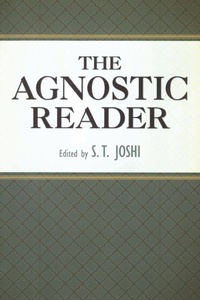
The Agnostic Reader
Published on 1. October 2007
Book
Paperback/Softback
386 pages
978-1-59102-533-7 (ISBN)
Description
Agnosticism - the philosophical argument that it is impossible to know whether God exists or not - has been the point of view of many distinguished thinkers from the 19th century to the present. In contrast to atheism, which asserts that God does not exist, agnosticism holds that reason and the best scientific evidence do not allow one to reach a decisive conclusion regarding the existence of God.
This reader prints selections of some of the most profound and pioneering discussions of agnosticism over the past two centuries. Beginning with early formulations of the agnostic perspective by Thomas Henry Huxley (who coined the term agnostic), Bertrand Russell, and others, editor S. T. Joshi shows how agnosticism received a strong boost in the later 19th century from the so-called higher criticism of the Bible. Selections from Edward Burnett Tylor, Arthur Schopenhauer, Robert G. Ingersoll, and Edward Westermarck made a strong case that religion was a natural product of primitive development and that the Bible was the product of an age of scientific ignorance and superstition.
By the late 19th and early 20th centuries, Christianity in Europe was in a state of decline among the intellectual classes. The writings of W. E. H. Leckey, Leslie Stephen, and Walter Lippmann show that leading commentators were openly pondering a European society in which Christianity was a thing of the past.
The increasing success of the natural sciences during this same time period supported the agnostic viewpoint by accounting for phenomena on a natural, rather than a supernatural, basis. Selections from John William Draper, Albert Einstein, Isaac Asimov, and others demonstrate the scientific respectability of agnosticism.
Finally, selections from such thinkers as Frederic Harrison, H. L. Mencken, and Corliss Lamont emphasize how living with agnosticism can be intellectually and morally satisfying, even exhilarating.
Overall, The Agnostic Reader shows how agnosticism can provide a framework for living with courage and dignity.
This reader prints selections of some of the most profound and pioneering discussions of agnosticism over the past two centuries. Beginning with early formulations of the agnostic perspective by Thomas Henry Huxley (who coined the term agnostic), Bertrand Russell, and others, editor S. T. Joshi shows how agnosticism received a strong boost in the later 19th century from the so-called higher criticism of the Bible. Selections from Edward Burnett Tylor, Arthur Schopenhauer, Robert G. Ingersoll, and Edward Westermarck made a strong case that religion was a natural product of primitive development and that the Bible was the product of an age of scientific ignorance and superstition.
By the late 19th and early 20th centuries, Christianity in Europe was in a state of decline among the intellectual classes. The writings of W. E. H. Leckey, Leslie Stephen, and Walter Lippmann show that leading commentators were openly pondering a European society in which Christianity was a thing of the past.
The increasing success of the natural sciences during this same time period supported the agnostic viewpoint by accounting for phenomena on a natural, rather than a supernatural, basis. Selections from John William Draper, Albert Einstein, Isaac Asimov, and others demonstrate the scientific respectability of agnosticism.
Finally, selections from such thinkers as Frederic Harrison, H. L. Mencken, and Corliss Lamont emphasize how living with agnosticism can be intellectually and morally satisfying, even exhilarating.
Overall, The Agnostic Reader shows how agnosticism can provide a framework for living with courage and dignity.
More details
Series
Language
English
Place of publication
United States
Target group
College/higher education
Product notice
Paperback (trade)
Dimensions
Height: 229 mm
Width: 152 mm
Thickness: 23 mm
Weight
638 gr
ISBN-13
978-1-59102-533-7 (9781591025337)
Copyright in bibliographic data and cover images is held by Nielsen Book Services Limited or by the publishers or by their respective licensors: all rights reserved.
Schweitzer Classification
Person
Edited by S. T. Joshi
Content
Part I: Some Overviews; Part II: The Critical Study of Religion; Part III: Agnosticism and Science; Part IV: The Deficiencies of Religion; Part V: Christianity in Decline; Part VI: The Agnostic Way of Life.