

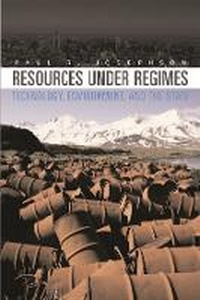
Resources under Regimes
Technology, Environment, and the State
Published on 1. September 2006
Book
Paperback/Softback
278 pages
978-0-674-02243-0 (ISBN)
Description
Democratic or authoritarian, every society needs clean air and water; every state must manage its wildlife and natural resources. In this provocative, comparative study, Paul R. Josephson asks to what extent the form of a government and its economy--centrally planned or market, colonial or post-colonial--determines how politicians, bureaucrats, scientists, engineers, and industrialists address environmental and social problems presented by the transformation of nature into a humanized landscape.
Looking at the experiences of the industrialized and industrializing world, Resources under Regimes explores the relationship between science, technology, and the environment. Josephson considers global responses to deforestation, water pollution, and global warming, showing how different societies bring different values and assumptions to bear on the same problem, and arrive at different conclusions about the ideal outcome and the best way of achieving it. He reveals the important ways in which modern governments facilitate power generation, transportation, water production, and other technologies that improve the quality of life; and the equally critical ways in which they respond to the resulting depredations--the pollution, waste, and depletion that constitute the global environmental crisis at the beginning of the twenty-first century.
Looking at the experiences of the industrialized and industrializing world, Resources under Regimes explores the relationship between science, technology, and the environment. Josephson considers global responses to deforestation, water pollution, and global warming, showing how different societies bring different values and assumptions to bear on the same problem, and arrive at different conclusions about the ideal outcome and the best way of achieving it. He reveals the important ways in which modern governments facilitate power generation, transportation, water production, and other technologies that improve the quality of life; and the equally critical ways in which they respond to the resulting depredations--the pollution, waste, and depletion that constitute the global environmental crisis at the beginning of the twenty-first century.
Reviews / Votes
A worthy examination of this global phenomenon. -- J. H. Hunter * Choice * Common to all modern nations is the tendency to rely on large-scale manipulations of nature to achieve progress: big dams for irrigation and hydroelectricity, industrialized farming and commercial production, nuclear power, and automobiles. According to Josephson, such technologies typically create as many problems as they solve, especially those related to environmental and social inequalities. These problems are evident locally, where citizens often compete with corporations and political elites for control of resources. They appear globally as well, where wealthy industrialized nations are able to enjoy better environmental quality in part by relying on less developed countries to absorb their pollution and resource demands. Ultimately, Josephson's analysis challenges readers to question the wisdom of this kind of progress, upon which nearly every nation in the twenty-first century has come to rely. -- Gregory Summers * Environmental History *More details
Series
Language
English
Place of publication
Cambridge, Mass
United States
Target group
Professional and scholarly
US School Grade: College Graduate Student
Illustrations
1 table
Dimensions
Height: 210 mm
Width: 140 mm
Thickness: 16 mm
ISBN-13
978-0-674-02243-0 (9780674022430)
Copyright in bibliographic data and cover images is held by Nielsen Book Services Limited or by the publishers or by their respective licensors: all rights reserved.
Schweitzer Classification
Other editions
Additional editions
E-Book
07/2009
Harvard University Press
€25.09
Available for download
Person
Paul R. Josephson is Professor of History and chair of the Science, Technology, and Society Program at Colby College.
Content
Introduction: Nature, Technology, and Worldview 1. The Modern State, Industry, and the Transformation of Nature 2. The Coercive Appeal to Order: Authoritarian Approaches to Resource Management 3. Development, Colonialism, and the Environment 4. Biodiversity, Sustainability, and Technology in the Twenty-first Century Notes Index