

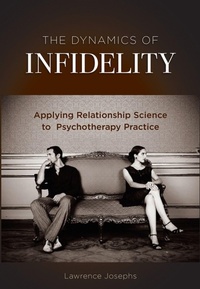
The Dynamics of Infidelity
Applying Relationship Science to Psychotherapy Practice
Published on 18. September 2017
Book
Hardback
384 pages
978-1-4338-2798-3 (ISBN)
Description
In this groundbreaking book, Lawrence Josephs argues for a new understanding of the psychological foundations of amp ldquo cheating. amp rdquo
Relationships are complicated. And as many therapists know, infidelity is a distressingly common issue for romantic couples. Unfortunately, most psychotherapy approaches tend to see infidelity as a manifestation of broader underlying problems and rarely offer insights or interventions to specifically address unfaithfulness and the impulses behind it.
Drawing on research in social, personality, and evolutionary psychology that examines the crucial roles of attachment theory and amp ldquo dark amp rdquo personality traits such as narcissism and low empathy, Josephs offers a complex but intuitive model that explains how and when intimate relationships work, and don amp rsquo t work. His integrative and compassionate approach to treatment is grounded in psychodynamic principles, yet uses interventions from a variety of approaches, including mentalization based therapies, emotion focused therapy, marital communication skills training, and mindfulness/acceptance techniques. This book is a thought-provoking read for individual, family, and couples therapists seeking insights on how to address infidelity in their practice.
Relationships are complicated. And as many therapists know, infidelity is a distressingly common issue for romantic couples. Unfortunately, most psychotherapy approaches tend to see infidelity as a manifestation of broader underlying problems and rarely offer insights or interventions to specifically address unfaithfulness and the impulses behind it.
Drawing on research in social, personality, and evolutionary psychology that examines the crucial roles of attachment theory and amp ldquo dark amp rdquo personality traits such as narcissism and low empathy, Josephs offers a complex but intuitive model that explains how and when intimate relationships work, and don amp rsquo t work. His integrative and compassionate approach to treatment is grounded in psychodynamic principles, yet uses interventions from a variety of approaches, including mentalization based therapies, emotion focused therapy, marital communication skills training, and mindfulness/acceptance techniques. This book is a thought-provoking read for individual, family, and couples therapists seeking insights on how to address infidelity in their practice.
Reviews / Votes
amp ldquo Josephs (Adelphi Univ.) imagines his book, The Dynamics of Infidelity, as a bridge between researchers and clinicians. The result is an organized, accessible, carefully researched textbook on infidelity. Josephs amp rsquo s relationship science approach smoothly blends social, personality, and evolutionary psychology with psychodynamics, marital communications skills, and mindfulness approaches to treatment (among others). The tone avoids being judgmental without compromising the quality of the arguments and evidence. amp rdquo -Choice Josephs (Adelphi Univ.) imagines his book, The Dynamics of Infidelity, as a bridge between researchers and clinicians. The result is an organized, accessible, carefully researched textbook on infidelity. Josephs amp rsquo s relationship science approach smoothly blends social, personality, and evolutionary psychology with psychodynamics, marital communications skills, and mindfulness approaches to treatment (among others). The tone avoids being judgmental without compromising the quality of the arguments and evidence.(Choice) This book is detailed and sophisticated in discussing the psychological foundations of cheating. Individual, couple, and family therapists will find it helpful when looking for literature addressing infidelity and especially the relational dynamics involved in infidelity.
(Doody's Reviews) Josephs has conducted groundbreaking research on jealousy and infidelity in couples. This book is his magnum opus: a brilliant, accessible synthesis of social, evolutionary, personality, and relationship science and a thoroughly sophisticated discussion of clinical applications.
- John T. Jost, PhD, Codirector of the Center for Social and Political Behavior and Professor of Psychology and Politics, New York University, New York Josephs approaches the cultural hot button area of infidelity by masterfully bringing together academic scholarship and clinical acumen. His breadth of knowledge and respect for ordinarily disparate areas of psychological research and clinical practice bring light to an area that has been shrouded in misunderstanding and contradiction.
- George Stricker, PhD, Professor of Psychology, American School of Professional Psychology at Argosy University, Northern Virginia, Arlington Clinicians of all orientations will find this book to be an invaluable resource when treating both couples and individuals who are struggling with infidelity or tensions around conflicting needs for trusting intimacy and sexual excitement. Josephs balances clinical sophistication with practical utility in a text that is destined to become a standard in the field.
- Jeremy D. Safran, PhD, Professor of Psychology, The New School for Social Research, New York, NY
More details
Language
English
Place of publication
Washington DC
United States
Target group
Professional and scholarly
College/higher education
Product notice
sewn/stitched
Cloth over boards
Dimensions
Height: 259 mm
Width: 185 mm
Thickness: 20 mm
Weight
680 gr
ISBN-13
978-1-4338-2798-3 (9781433827983)
Copyright in bibliographic data and cover images is held by Nielsen Book Services Limited or by the publishers or by their respective licensors: all rights reserved.
Schweitzer Classification
Person
Lawrence Josephs, PhD, is a professor of psychology at the Gordon F. Derner Institute of Advanced Psychological Studies of Adelphi University. Dr. Josephs has been an editor for the International Journal of Psychoanalysis, book reviewer for Psychoanalytic Psychology, and a manuscript reviewer for Clinical Psychology and Psychotherapy. He has published articles in Archives of Sexual Behavior, Journal of Sex and Marital Therapy, Self and Identity, International Journal of Psychoanalysis, Psychoanalytic Psychology, Psychoanalytic Dialogues, Contemporary Psychoanalysis, Journal of the American Psychoanalytic Association, and Psychodynamic Psychiatry. In 2 5 The New York Times published an op-ed piece written by Dr. Josephs called amp quot When the Best Sex is Extra-Marital. amp quot Dr. Josephs has a private practice of individual and couples psychotherapy in New York City.
Content
Preface
Introduction
Chapter : To Cheat or Not to Cheat? The Evolution of Fidelity and Infidelity
Chapter 2: Too Close for Comfort: Attachment Style and Infidelity
Chapter 3: The Wandering Eyes of Men and Women: Sex Differences in Motivations for Infidelity
Chapter 4: Fatal Attractions: The Dark Triad and Infidelity
Chapter 5: Am I Sexually Desirable? Fidelity and Infidelity as Proof of Mate Value
Chapter : Sexual Possessiveness and Jealousy: The Psychology of Retaliatory Infidelity
Chapter 7: When the Best Sex Is Extramarital: Infidelity Throughout the Lifespan
Chapter 8: The Problem of Begrudging Partner Sharing: When Cheaters Won amp rsquo t Leave Their Spouses
Chapter 9: Boys Gone Wild: Can Infidelity Be a Symptom of Sex Addiction?
Chapter : Marital Communication Styles That Predict Betrayal
Conclusion: Why People Remain Faithful
References
Index
About the Author
Introduction
Chapter : To Cheat or Not to Cheat? The Evolution of Fidelity and Infidelity
Chapter 2: Too Close for Comfort: Attachment Style and Infidelity
Chapter 3: The Wandering Eyes of Men and Women: Sex Differences in Motivations for Infidelity
Chapter 4: Fatal Attractions: The Dark Triad and Infidelity
Chapter 5: Am I Sexually Desirable? Fidelity and Infidelity as Proof of Mate Value
Chapter : Sexual Possessiveness and Jealousy: The Psychology of Retaliatory Infidelity
Chapter 7: When the Best Sex Is Extramarital: Infidelity Throughout the Lifespan
Chapter 8: The Problem of Begrudging Partner Sharing: When Cheaters Won amp rsquo t Leave Their Spouses
Chapter 9: Boys Gone Wild: Can Infidelity Be a Symptom of Sex Addiction?
Chapter : Marital Communication Styles That Predict Betrayal
Conclusion: Why People Remain Faithful
References
Index
About the Author