

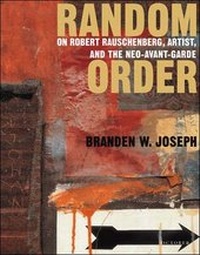
Random Order
Robert Rauschenberg and the Neo-Avant-Garde
Published on 12. September 2003
Book
Hardback
432 pages
978-0-262-10099-1 (ISBN)
Description
Robert Rauschenberg is one of the most important visual artists of the second half of
the twentieth century. In Random Order, Branden Joseph examines Rauschenberg's work in the context
of the American neo-avant-garde. One of the foundations of his study is Rauschenberg's professional
relationship with experimental composer John Cage. From the moment of their encounter at Black
Mountain College in 1952, Joseph argues, Rauschenberg and Cage initiated a new avant-garde project,
one that approached the idea of difference not in terms of negation but as a positive force.
Claiming that Rauschenberg's work cannot be understood solely from the standpoint of the Frankfurt
School--whose theories have dominated discussions of avant-garde and neo-avant-garde
aesthetics--Joseph turns to the theoretical positions of Gilles Deleuze and Jacques Derrida.
Rauschenberg's neo-avant-garde was not a simple repetition of earlier avant-garde movements, Joseph
shows, but a series of practices that opposed the rise of postwar spectacle, commodification, and
mass conformity.Beginning with the White Paintings, Joseph examines Rauschenberg?s artistic
development from 1951 to 1971. He looks at the black paintings, Red Paintings, Elemental Paintings
and Elemental Sculptures, Combines and Combine paintings, transfer drawings and silkscreens,
performances, and explorations in art and technology. Joseph?s study not only offers new
interpretations of Rauschenberg?s work, but also deepens our understanding of the entire
neo-avant-garde project.
the twentieth century. In Random Order, Branden Joseph examines Rauschenberg's work in the context
of the American neo-avant-garde. One of the foundations of his study is Rauschenberg's professional
relationship with experimental composer John Cage. From the moment of their encounter at Black
Mountain College in 1952, Joseph argues, Rauschenberg and Cage initiated a new avant-garde project,
one that approached the idea of difference not in terms of negation but as a positive force.
Claiming that Rauschenberg's work cannot be understood solely from the standpoint of the Frankfurt
School--whose theories have dominated discussions of avant-garde and neo-avant-garde
aesthetics--Joseph turns to the theoretical positions of Gilles Deleuze and Jacques Derrida.
Rauschenberg's neo-avant-garde was not a simple repetition of earlier avant-garde movements, Joseph
shows, but a series of practices that opposed the rise of postwar spectacle, commodification, and
mass conformity.Beginning with the White Paintings, Joseph examines Rauschenberg?s artistic
development from 1951 to 1971. He looks at the black paintings, Red Paintings, Elemental Paintings
and Elemental Sculptures, Combines and Combine paintings, transfer drawings and silkscreens,
performances, and explorations in art and technology. Joseph?s study not only offers new
interpretations of Rauschenberg?s work, but also deepens our understanding of the entire
neo-avant-garde project.
More details
Series
Language
English
Place of publication
Cambridge, Mass.
United States
Publishing group
MIT Press Ltd
Target group
Professional and scholarly
Illustrations
103 s/w Abbildungen
103 b&w illus.
Dimensions
Height: 229 mm
Width: 178 mm
Thickness: 0 mm
Weight
907 gr
ISBN-13
978-0-262-10099-1 (9780262100991)
Copyright in bibliographic data and cover images is held by Nielsen Book Services Limited or by the publishers or by their respective licensors: all rights reserved.
Schweitzer Classification
Persons
Branden W. Joseph is Frank Gallipoli Professor of Modern and Contemporary Art in the Department of Art History and Archaeology at Columbia University and an editor of the journal Grey Room (MIT Press).