

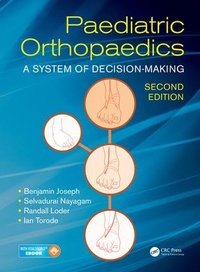
Paediatric Orthopaedics
A System of Decision-Making, Second Edition
2nd Edition
Will be published approx. on 22. January 2016
Book
Hardback
584 pages
978-1-4987-0840-1 (ISBN)
Description
Mastering the art and science of paediatric orthopaedics entails the acquisition of theoretical knowledge, the development of surgical dexterity and learning the process of clinical decision-making. Of these three components, clinical decision-making is arguably the most important.
Featuring a practical focus, Paediatric Orthopaedics: A System of Decision-Making provides a guide to managing a wide spectrum of orthopaedic conditions in children. The book provides strategies for determining an optimum management approach to follow in any given situation, thus empowering surgeons to adapt their approach to the needs of individual patients.
The book addresses 73 topics in 9 sections covering the majority of orthopaedic conditions in children. This simplifies both organization and navigation and creates a design that is suitable for reading either in its entirety or for quick reference.Eminent paediatric orthopaedists have pooled their experience and knowledge to provide a logical approach to the evaluation and treatment of both common and some uncommon conditions.
Readers are given insight into decision-making trees where choices are not always made on science alone but governed also by social issues or patient preference. The text has been fully updated and, with the introduction of colour illustrations, is an invaluable tool for all those working in paediatric orthopaedics.
Featuring a practical focus, Paediatric Orthopaedics: A System of Decision-Making provides a guide to managing a wide spectrum of orthopaedic conditions in children. The book provides strategies for determining an optimum management approach to follow in any given situation, thus empowering surgeons to adapt their approach to the needs of individual patients.
The book addresses 73 topics in 9 sections covering the majority of orthopaedic conditions in children. This simplifies both organization and navigation and creates a design that is suitable for reading either in its entirety or for quick reference.Eminent paediatric orthopaedists have pooled their experience and knowledge to provide a logical approach to the evaluation and treatment of both common and some uncommon conditions.
Readers are given insight into decision-making trees where choices are not always made on science alone but governed also by social issues or patient preference. The text has been fully updated and, with the introduction of colour illustrations, is an invaluable tool for all those working in paediatric orthopaedics.
Reviews / Votes
"An important contribution to the education of residents in pediatric orthopedics. Its clinical decision-making approach is original and can be applied to other orthopedic subspecialties... I wish that all orthopedic trainees could get a hold of this book, because it will make them better orthopedists. The internationally known authors, senior pediatric orthopedists, are to be congratulated for producing a superior book."-Edward Abraham, M.D.(University of Illinois at Chicago College of Medicine), Doody's Book Review Service
Praise for the first edition:
"This is a very good book ... and worth every penny."
-Scottish Medical Journal
"... easy to dip into, with heavy use of illustrations, radiographs and line drawings to make topics clear..."
-Association of Surgeons in Training Yearbook
"This is a very salutary book, a major work which will become a very valuable tool for every orthopaedic trainee and young orthopaedic surgeon."
-Springer
"[The book] rationally evaluates a disorder and then proceeds to outline a management strategy with the emphasis on the author's personal experience. I very highly recommend this work to all orthopedists caring for children, including trainees. It also can serve as an excellent reference for pediatricians and therapists."
-Edward Abraham in Doody's Book Review Service Praise for the first edition:
"This is a very good book ... and worth every penny."
-Scottish Medical Journal
"... easy to dip into, with heavy use of illustrations, radiographs and line drawings to make topics clear..."
-Association of Surgeons in Training Yearbook
"This is a very salutary book, a major work which will become a very valuable tool for every orthopaedic trainee and young orthopaedic surgeon."
-Springer
"[The book] rationally evaluates a disorder and then proceeds to outline a management strategy with the emphasis on the author's personal experience. I very highly recommend this work to all orthopedists caring for children, including trainees. It also can serve as an excellent reference for pediatricians and therapists."
-Edward Abraham in Doody's Book Review Service
More details
Edition
2nd edition
Language
English
Place of publication
Bosa Roca
United States
Publishing group
Taylor & Francis Inc
Target group
Professional and scholarly
Professional Reference
Illustrations
123 farbige Tabellen, 665 farbige Abbildungen
123 Tables, color; 665 Illustrations, color
Dimensions
Height: 280 mm
Width: 210 mm
Weight
1840 gr
ISBN-13
978-1-4987-0840-1 (9781498708401)
Copyright in bibliographic data and cover images is held by Nielsen Book Services Limited or by the publishers or by their respective licensors: all rights reserved.
Schweitzer Classification
Other editions
Additional editions
Benjamin Joseph | Selvadurai Nayagam | Randall Loder
Paediatric Orthopaedics
A System of Decision-Making, Second Edition
Book
08/2020
2nd Edition
CRC Press
€51.98
The article will not be published
Benjamin Joseph | Selvadurai Nayagam | Randall Loder
Paediatric Orthopaedics
A System of Decision-Making, Second Edition
E-Book
01/2016
2nd Edition
CRC Press
€198.99
Available for download
Benjamin Joseph | Selvadurai Nayagam | Randall Loder
Paediatric Orthopaedics
A System of Decision-Making, Second Edition
E-Book
01/2016
2nd Edition
CRC Press
€198.99
Available for download
Persons
Benjamin Joseph, MS (Orth), MCh Orth, FRCS Ed, adjunct professor of paediatric orthopaedics, Christian Medical College, Vellore, India; and consultant paediatric orthopaedic surgeon Aster Medcity, Kochi, India
Selvadurai Nayagam, BSc, MCh(Orth), FRCS Ed (Trauma and Orth), consultant orthopaedic surgeon, Royal Liverpool Children's Hospital; and honorary reader, University of Liverpool, UK
Randall T. Loder, MD, garceau professor of orthopaedic surgery, Indiana University School of Medicine, Indianapolis; and chief of orthopaedics, James Whitcomb Riley Children's Hospital, Indianapolis, USA
Ian Torode, MBBS, FRCS (C), FRACS, former director of clinical orthopaedics and deputy director of orthopaedics, Royal Children's Hospital, Melbourne, Australia
Selvadurai Nayagam, BSc, MCh(Orth), FRCS Ed (Trauma and Orth), consultant orthopaedic surgeon, Royal Liverpool Children's Hospital; and honorary reader, University of Liverpool, UK
Randall T. Loder, MD, garceau professor of orthopaedic surgery, Indiana University School of Medicine, Indianapolis; and chief of orthopaedics, James Whitcomb Riley Children's Hospital, Indianapolis, USA
Ian Torode, MBBS, FRCS (C), FRACS, former director of clinical orthopaedics and deputy director of orthopaedics, Royal Children's Hospital, Melbourne, Australia
Content
Deformities. Dislocations. Deficiencies. Discrepancies of Limb Length. Decreased Joint Mobility. Paralyses. Epiphyseal and Physeal Problems. Infections. Acquired Defects in Bone.