

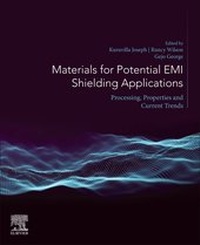
Materials for Potential EMI Shielding Applications
Processing, Properties and Current Trends
Published on 6. November 2019
Book
Paperback/Softback
412 pages
978-0-12-817590-3 (ISBN)
Description
Materials for Potential EMI Shielding Applications: Processing, Properties and Current Trends extensively and comprehensively reviews materials for EMI shielding applications, ranging from the principles to possible applications and various types of shielding materials. The book provides a thorough introduction to electromagnetic interference, its effect on both the environment and other electronic items, various materials that are used for electromagnetic interference shielding applications, and its properties. It explains the mechanism behind EMI shielding, the methods by which EMI SE of a given material is estimated, and the different fabrication methods currently employed for fabricating EMI shielding materials.
Final sections focus on the theoretical background of EMI shielding and shielding mechanisms. This theoretical background is extended to the physics of EMI shielding, wherein the physics behind mechanism of shielding is explained.
Final sections focus on the theoretical background of EMI shielding and shielding mechanisms. This theoretical background is extended to the physics of EMI shielding, wherein the physics behind mechanism of shielding is explained.
More details
Language
English
Place of publication
United States
Target group
Professional and scholarly
Scientists and researchers working in industries, R&Ds, academicians, and PhD and master students in chemical engineering, materials chemistry, and materials science
Illustrations
Approx. 150 illustrations
Dimensions
Height: 276 mm
Width: 216 mm
Weight
1090 gr
ISBN-13
978-0-12-817590-3 (9780128175903)
Copyright in bibliographic data and cover images is held by Nielsen Book Services Limited or by the publishers or by their respective licensors: all rights reserved.
Schweitzer Classification
Other editions
Additional editions
Kuruvilla Joseph | Runcy Wilson | George Gejo
Materials for Potential EMI Shielding Applications
Processing, Properties and Current Trends
E-Book
11/2019
Elsevier
€200.00
Available for download
Persons
Kuruvilla Joseph is a Professor in the Department of Chemistry at the Indian Institute of Space Science and Technology, Thiruvananthapuram, India. His research areas includes nanomaterials and nanocomposites, polymer blends and composites, synthesis of polymers from natural resources, green materials and biocomposites, aging and degradation, and development of biosensors.
Dr. Wilson is an assistant professor in the Department of Chemistry, St. Cyril's College, Kerala, India. He obtained his PhD in Chemistry from Mahatma Gandhi University, Kottayam, India. He has written several publications in international journals and conference proceedings. He has also co-edited two books one titled "Transport Properties of Polymeric Membranes? and the other titled "Materials for Potential EMI Shielding Applications: Processing, Properties and Current Trends? published by Elsevier. He has also conducted research work at Katholieke Universiteit Leuven, Belgium. Dr. Runcy has also almost two years of industrial experience as a junior scientist at the Corporate R&D Centre, HLL Lifecare Limited, a Government of India Enterprise, in the area of synthesis of green polymers. His current research interests include polymer nanocomposites for membrane applications, synthesis of biodegradable polymers for medical applications, and development of high quality EMI shielding material. Dr. George obtained his PhD in Chemistry from Kalasalingam University, Tamil Nadu, India in 2014, specializing in the area of commingled natural fiber composites. He published several articles in high-impact journals (Composite Part A, Composite Part B, Carbon, Scientific Reports etc.) and wrote chapters for several books. He has two and a half years of experience as a junior scientist at the Corporate R&D Centre, HLL Lifecare Limited, a Government of India Enterprise, in the area of graphene/natural rubber latex nanocomposites for contraceptive applications. Dr. George also completed two years of post-doctoral research in the area of EMI shielding materials during his tenure as UGC-DSKPDF at School of Pure and Applied Physics, Mahatma Gandhi University, Kerala, India. He was also a post-doctoral researcher at Division of Materials Science, Lulea University of Technology, Lulea, Sweden for 1 year and 8 months and worked in the area of high quality carbon nanomaterials from biomass. He has also co-edited a book titled "Materials for Potential EMI Shielding Applications: Processing, Properties and Current Trends? published by Elsevier. His present research interests include natural fiber-based composites, carbon nanocomposites for EMI shielding applications, graphene-based composites, and biomass/biochar to advanced carbon nanomaterials.
Dr. Wilson is an assistant professor in the Department of Chemistry, St. Cyril's College, Kerala, India. He obtained his PhD in Chemistry from Mahatma Gandhi University, Kottayam, India. He has written several publications in international journals and conference proceedings. He has also co-edited two books one titled "Transport Properties of Polymeric Membranes? and the other titled "Materials for Potential EMI Shielding Applications: Processing, Properties and Current Trends? published by Elsevier. He has also conducted research work at Katholieke Universiteit Leuven, Belgium. Dr. Runcy has also almost two years of industrial experience as a junior scientist at the Corporate R&D Centre, HLL Lifecare Limited, a Government of India Enterprise, in the area of synthesis of green polymers. His current research interests include polymer nanocomposites for membrane applications, synthesis of biodegradable polymers for medical applications, and development of high quality EMI shielding material. Dr. George obtained his PhD in Chemistry from Kalasalingam University, Tamil Nadu, India in 2014, specializing in the area of commingled natural fiber composites. He published several articles in high-impact journals (Composite Part A, Composite Part B, Carbon, Scientific Reports etc.) and wrote chapters for several books. He has two and a half years of experience as a junior scientist at the Corporate R&D Centre, HLL Lifecare Limited, a Government of India Enterprise, in the area of graphene/natural rubber latex nanocomposites for contraceptive applications. Dr. George also completed two years of post-doctoral research in the area of EMI shielding materials during his tenure as UGC-DSKPDF at School of Pure and Applied Physics, Mahatma Gandhi University, Kerala, India. He was also a post-doctoral researcher at Division of Materials Science, Lulea University of Technology, Lulea, Sweden for 1 year and 8 months and worked in the area of high quality carbon nanomaterials from biomass. He has also co-edited a book titled "Materials for Potential EMI Shielding Applications: Processing, Properties and Current Trends? published by Elsevier. His present research interests include natural fiber-based composites, carbon nanocomposites for EMI shielding applications, graphene-based composites, and biomass/biochar to advanced carbon nanomaterials.
Editor
Outstanding Professor and Dean, Department of Chemistry, Indian Institute of Space Science and Technology, India
Assistant Professor, Department of Chemistry, St. Cyril's College, Kerala, India
Assistant Professor, Research and Post Graduate Department of Chemistry, St. Berchmans College (Autonomous), Changanacherry, Kerala, India
Content
1. Introduction
2. Theory of EMI shielding
3. EMI shielding disclosed through virtual and physical experiments
4. Significance of naturally derived materials for potential EMI shields
5. Thermoplastic polymer composites for EMI shielding applications
6. EMI Shielding Materials Based on Thermosetting Polymers
7. Metal embedded matrices for EMI shielding
8. Elastomer based materials for EMI shielding applications
9. Polymeric blends as EMI shielding materials
10. Biodegradable polymeric materials for EMI shielding
11. Nanomaterials with Potential EMI Shielding Properties
12. Carbon based nanocomposites for EMI Shielding -Recent Advances
13. Carbon fibers-reinforced Composites for EMI shielding
14. Hybrid Polymer Nanocomposites with EMI Shielding Applications
15. Carbon Fiber Reinforced Polymer - Metal Wire Mesh Hybrid Composite for Electromagnetic Interference Shielding
16. Conducting Polymer Composites: An Efficient EMI Shielding Material
17. EMI shielding textile materials based on conducting polymers
18. Porous materials for EMI shielding
19. Electromagnetic Shielding of Ceramic Materials
20. Cement based EMI shielding materials
21. EMI Shielding of Metals, Alloys and Composites
22. EMI shielding textile materials
23. High Temperature Electromagnetic shielding material
2. Theory of EMI shielding
3. EMI shielding disclosed through virtual and physical experiments
4. Significance of naturally derived materials for potential EMI shields
5. Thermoplastic polymer composites for EMI shielding applications
6. EMI Shielding Materials Based on Thermosetting Polymers
7. Metal embedded matrices for EMI shielding
8. Elastomer based materials for EMI shielding applications
9. Polymeric blends as EMI shielding materials
10. Biodegradable polymeric materials for EMI shielding
11. Nanomaterials with Potential EMI Shielding Properties
12. Carbon based nanocomposites for EMI Shielding -Recent Advances
13. Carbon fibers-reinforced Composites for EMI shielding
14. Hybrid Polymer Nanocomposites with EMI Shielding Applications
15. Carbon Fiber Reinforced Polymer - Metal Wire Mesh Hybrid Composite for Electromagnetic Interference Shielding
16. Conducting Polymer Composites: An Efficient EMI Shielding Material
17. EMI shielding textile materials based on conducting polymers
18. Porous materials for EMI shielding
19. Electromagnetic Shielding of Ceramic Materials
20. Cement based EMI shielding materials
21. EMI Shielding of Metals, Alloys and Composites
22. EMI shielding textile materials
23. High Temperature Electromagnetic shielding material