

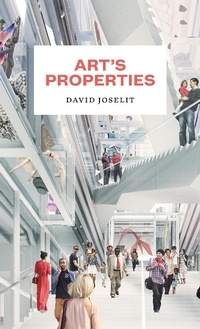
Art's Properties
Published on 14. February 2023
Book
Hardback
184 pages
978-0-691-23604-9 (ISBN)
Description
A revisionist reading of modern art that examines how artworks are captured as property to legitimize power
In this provocative new account, David Joselit shows how art from the nineteenth to the twenty-first centuries began to function as a commodity, while the qualities of the artist, nation, or period themselves became valuable properties. Joselit explores repatriation, explaining that this is not just a contemporary conflict between the Global South and Euro-American museums, noting that the Louvre, the first modern museum, was built on looted works and faced demands for restitution and repatriation early in its history. Joselit argues that the property values of white supremacy underlie the ideology of possessive individualism animating modern art, and he considers issues of identity and proprietary authorship.
Joselit redefines art's politics, arguing that these pertain not to an artwork's content or form but to the way it is "captured," made to represent powerful interests-whether a nation, a government, or a celebrity artist collected by oligarchs. Artworks themselves are not political but occupy at once the here and now and an "elsewhere"-an alterity-that can't ever be fully appropriated. The history of modern art, Joselit asserts, is the history of transforming this alterity into private property.
Narrating scenes from the emergence and capture of modern art-touching on a range of topics that include the Byzantine church, French copyright law, the 1900 Paris Exposition, W.E.B. Du Bois, the conceptual artist Adrian Piper, and the controversy over Dana Schutz's painting Open Casket-Joselit argues that the meaning of art is its infinite capacity to generate experience over time.
In this provocative new account, David Joselit shows how art from the nineteenth to the twenty-first centuries began to function as a commodity, while the qualities of the artist, nation, or period themselves became valuable properties. Joselit explores repatriation, explaining that this is not just a contemporary conflict between the Global South and Euro-American museums, noting that the Louvre, the first modern museum, was built on looted works and faced demands for restitution and repatriation early in its history. Joselit argues that the property values of white supremacy underlie the ideology of possessive individualism animating modern art, and he considers issues of identity and proprietary authorship.
Joselit redefines art's politics, arguing that these pertain not to an artwork's content or form but to the way it is "captured," made to represent powerful interests-whether a nation, a government, or a celebrity artist collected by oligarchs. Artworks themselves are not political but occupy at once the here and now and an "elsewhere"-an alterity-that can't ever be fully appropriated. The history of modern art, Joselit asserts, is the history of transforming this alterity into private property.
Narrating scenes from the emergence and capture of modern art-touching on a range of topics that include the Byzantine church, French copyright law, the 1900 Paris Exposition, W.E.B. Du Bois, the conceptual artist Adrian Piper, and the controversy over Dana Schutz's painting Open Casket-Joselit argues that the meaning of art is its infinite capacity to generate experience over time.
Reviews / Votes
"A fascinating history of art and representation debates . . . [from] the founding of the Louvre . . . to modern controversies over repatriation and representation."---Shanti Escalante-De Mattei, ARTnews "[In Art's Properties], David Joselit moves beyond the proprietary tendencies of the modern artist to advocate for an ethos of freedom and commonality. . . . Provocative."---Alex Kitnick, 4Columns "Joselit takes on often-debated topics like artistic cultural appropriation and the repatriation of artworks, grounding them in current understanding ofthe legacy of colonialism, slavery, and white supremacy. Art's Properties is an excellentfollow-up to the author's After Art." * Choice *More details
Language
English
Place of publication
New Jersey
United States
Product notice
Trade binding
Illustrations
8 color + 3 b/w illus.
Dimensions
Height: 191 mm
Width: 121 mm
Thickness: 19 mm
Weight
282 gr
ISBN-13
978-0-691-23604-9 (9780691236049)
Copyright in bibliographic data and cover images is held by Nielsen Book Services Limited or by the publishers or by their respective licensors: all rights reserved.
Schweitzer Classification
Other editions
Additional editions
David Joselit
Art's Properties
E-Book
01/2023
1st Edition
Princeton University Press
€27.49
Available for download
Person
David Joselit is professor and chair of Art, Film, and Visual Studies at Harvard University. He is the author of After Art (Princeton); Heritage and Debt: Art in Globalization, winner of the 2021 Robert Motherwell Book Award from the Dedalus Foundation; and other books.