

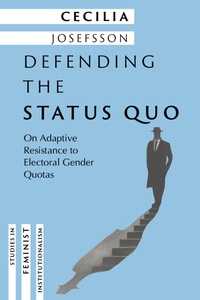
Defending the Status Quo
On Adaptive Resistance to Electoral Gender Quotas
Published on 13. January 2025
Book
Hardback
280 pages
978-0-19-778859-2 (ISBN)
Description
Defending the Status Quo explores political elites' resistance to electoral gender quota reforms. In order to explain this phenomenon, Cecilia Josefsson develops an original theoretical framework that she calls the Resistance Stage Framework.
Anchored in feminist institutionalism and mapped onto the policy process, Josefsson outlines how status quo defenders adapt their resistance strategies to accommodate institutional and ideational changes across agenda setting, policy formulation, decision-making, and implementation phases. She bolsters her theory with a thick description of a 30-year-long process to adopt and implement electoral gender quotas in Uruguay. While Uruguay has been a vanguard in the women's rights movement, men's political dominance has been pervasive in this country. The struggle to introduce a gender quota has been marked by repeated reform attempts, persistent resistance, and a wide variation in the responses of the Uruguayan political parties, making this case apt for developing theory and shedding light on the adaptive nature of resistance.
Drawing on extensive interviews with Uruguayan political elites, three quota debates, and party electoral lists, Josefsson carefully examines the power struggle over gender quota reform. She shows how powerful status quo defenders, seeking to ignore, stall, and undermine gendered institutional change, adapt their resistance strategies across different political parties and over time, as quota advocates make advances and manage to change the institutional and ideational context.
Anchored in feminist institutionalism and mapped onto the policy process, Josefsson outlines how status quo defenders adapt their resistance strategies to accommodate institutional and ideational changes across agenda setting, policy formulation, decision-making, and implementation phases. She bolsters her theory with a thick description of a 30-year-long process to adopt and implement electoral gender quotas in Uruguay. While Uruguay has been a vanguard in the women's rights movement, men's political dominance has been pervasive in this country. The struggle to introduce a gender quota has been marked by repeated reform attempts, persistent resistance, and a wide variation in the responses of the Uruguayan political parties, making this case apt for developing theory and shedding light on the adaptive nature of resistance.
Drawing on extensive interviews with Uruguayan political elites, three quota debates, and party electoral lists, Josefsson carefully examines the power struggle over gender quota reform. She shows how powerful status quo defenders, seeking to ignore, stall, and undermine gendered institutional change, adapt their resistance strategies across different political parties and over time, as quota advocates make advances and manage to change the institutional and ideational context.
Reviews / Votes
Gender quotas are widely adopted but also widely subverted as policy reforms around the globe. In Defending the Status Quo, Cecilia Josefsson presents an original and compelling theoretical account of the evolving nature of resistance to gender quotas, as status quo defenders find new and often effective ways to block or undermine quotas as they move through various stages of the reform process. Relevant to scholars, advocates, and policymakers, the volume is destined to become a classic reference for understanding - and developing tools to overcome - resistance and backlash against gender equality. * Mona Lena Krook, Distinguished Professor of Political Science, Rutgers University *More details
Series
Language
English
Place of publication
New York
United States
Target group
College/higher education
Product notice
sewn/stitched
Cloth over boards
Dimensions
Height: 226 mm
Width: 152 mm
Thickness: 30 mm
Weight
499 gr
ISBN-13
978-0-19-778859-2 (9780197788592)
Copyright in bibliographic data and cover images is held by Nielsen Book Services Limited or by the publishers or by their respective licensors: all rights reserved.
Schweitzer Classification
Other editions
Additional editions
E-Book
10/2024
OUP eBook
€70.49
Available for download
E-Book
10/2024
OUP eBook
€70.49
Available for download
Person
Cecilia Josefsson is an Associate Professor in the Department of Government at Uppsala University, Sweden. Her research focuses on political institutions and representation from a gender perspective. She received her PhD from the Department of Government at Uppsala University in 2020. Her dissertation "Adaptive Resistance: Power Struggles over Gender Quotas in Uruguay" was awarded the European Consortium for Political Research (ECPR) Joni Lovenduski PhD Prize in Gender and Politics in 2023. Currently, she is researching gendered working conditions and leadership in parliament, resistance to gender-equitable institutional change, and political representation in times of crisis.
Content
1. Introduction
2. Resistance to Gender Equitable Policy Change
3. Agenda Setting: Silence and Inaction
4. Policy Formulation: Arguing Against Quotas
5. Decision-Making: Jumping on the Bandwagon and Modifying Policy
6. Implementation: Minimizing Damage and Keeping Women Out
7. The Permanent Quota and Variations in Resistance Across Parties
8. Conclusion
2. Resistance to Gender Equitable Policy Change
3. Agenda Setting: Silence and Inaction
4. Policy Formulation: Arguing Against Quotas
5. Decision-Making: Jumping on the Bandwagon and Modifying Policy
6. Implementation: Minimizing Damage and Keeping Women Out
7. The Permanent Quota and Variations in Resistance Across Parties
8. Conclusion