

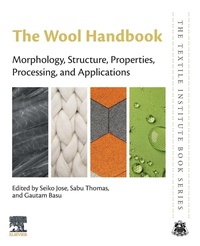
The Wool Handbook
Morphology, Structure, Properties, Processing, and Applications
Published on 23. October 2023
Book
Paperback/Softback
638 pages
978-0-323-99598-6 (ISBN)
Description
The Wool Handbook: Morphology, Structure, Property and Applications explores the fundamental aspects of wool fibers as well as traditional and novel applications of wool in areas including polymer composites and technical textiles. Apart from textiles and garments, wool has long been used for various diversified applications due to its unique material properties. Wool is inherently fire resistant, antimicrobial, flexible and antibacterial, and as a natural material, it can be used to create environmentally sustainable products. This book explains basic and advanced topics related to wool fibers, from shearing to marketing, drawing on academic and industrial research from a range of subjects.
Providing statistics, processing methods, and testing and characterization techniques for wool fiber, this book will help readers to use wool fibers to find new applications and solutions.
Providing statistics, processing methods, and testing and characterization techniques for wool fiber, this book will help readers to use wool fibers to find new applications and solutions.
More details
Series
Language
English
Place of publication
United States
Publishing group
Elsevier Science Publishing Co Inc
Target group
Professional and scholarly
Product notice
Paperback (trade)
Illustrations
125 illustrations (25 in full color); Illustrations
Dimensions
Height: 235 mm
Width: 191 mm
Thickness: 33 mm
Weight
1108 gr
ISBN-13
978-0-323-99598-6 (9780323995986)
Copyright in bibliographic data and cover images is held by Nielsen Book Services Limited or by the publishers or by their respective licensors: all rights reserved.
Schweitzer Classification
Other editions
Additional editions
Seiko Jose | Sabu Thomas | Gautam Basu
The Wool Handbook
Morphology, Structure, Properties, Processing, and Applications
E-Book
10/2023
Woodhead Publishing
€220.00
Available for download
Persons
Seiko Jose PhD is a scientist, working at ICAR-Central Sheep and Wool Research Institute, Avikanagar, Rajasthan, India. He has over 17 years' experience in textiles including time spent in industry and academia. His industrial experience is focused on wet processing of cotton, silk, and linen processing units. For the last 8 eight years of his research career, he has worked with a range of natural fibres such as, wool, jute, pineapple leaf fibre, coir, flax, and ramie. He has contributed to 30 research papers and 9 book chapters. His major research areas are extraction and characterization of natural fibre, textile dyeing and finishing, eco-friendly textile processing, natural fibre composites, and natural dyes. Prof. Sabu Thomas is a globally renowned scientist and one of the leading researchers in polymer science and nanotechnology. He currently serves as Professor of Polymer Science & Engineering and was the former Vice Chancellor of Mahatma Gandhi University, Kerala, India. Prof. Thomas is internationally recognized for his pioneering work on polymer blends, nanocomposites, green materials, and sustainable polymers. Dr Gautam Basu is the former Principal Scientist & Head of the Mechanical Processing Division, ICAR-National Institute of Natural Fibre Engineering and Technology, Kolkata, West Bengal, India. He completed his Masters degree in Textile Technology and his Ph. D. in Polymer Science & Technology from the University of Calcutta. He is a fellow of Institution of Engineers (India). He has published nearly 100 papers, including research, review, training manual, lecture notes, seminar proceedings, in addition to six books and thirteen book chapters. Four patents have been awarded to him and two others are under process. His 40 years of work experience includes 9 years in Industry and 31 years in research institutes. His major areas of work are, investigation of structure and property of natural fibres and their value addition, improvement in process performance of natural fibres through various pre-treatments, technical textiles including geotextiles, and development of machinery & testing instruments. He was a member of various recommending bodies (on natural fibres) formed by Government agencies. He was involved in 28 research projects including as Principal Investigator of the World Bank, and Govt. of India funded projects. He is having more than 950 Google citations with H index of 16.
Content
1. Introduction to wool technology : A brief introduction to wool and its processing technology
2. Wool production and statistics, Current market scenario :Recent statistics in wool production, export and imports, Current market potential of wool and woollen products
3. Wool fibre identification
4. Pre-processing of wool : Brief about shearing, cleaning, grading, scouring
5. Mechanical processing of wool
6. Wool Dyeing
7. Functional Finishes of Wool
8. Wool fibre morphology and chemical structure :The morphological characters of different breeds of wool, description on cuticle, cortex and medulla, their function
9. Quality evaluation of wool: Methods of evaluation of quality of wool, parameters, important standards
10. Chemical and Physical Properties of Wool
11. Physical and chemical modification of wool
12. Morphology studies using microscopic techniques : Advanced microscopic studies on wool
13. Spectroscopic studies on wool fibers
14. Thermal properties of wool: Thermal degradation studies, fire retardant properties
15. Sustainable Moth Repellent Finishing for Wool
16. Microbial attack and prevention methods :Microbial attack on wool fibre, causes, and remedies
17. Anti shrink finishing of woollens :Shrink resist treatment on woollens using various physical and chemical methods
18. Biodegradability and life cycle analysis of wool: Analysis of biodegradation of wool, wool fertilizers, life cycle studies
19. Applications of wool fibre for technical textiles : Recent product developments on woollens for technical textiles
20. Wool in composites : Wool fibre as a component in bio-composites
21. Sound insulation properties of wool fiber
22. Keratin extraction and its application: Extraction of wool keratin and application in diversified fields
23. Blending of wool with other fibres :Mixing of wool with other natural/synthetic fibres for different applications
24. Recycling of wool: Making wool more sustainable
25. By-products during processing of fibre and their use: Generation of by-products during wool processing and their utilization
26. Future prospective in woollens :Future prospective of wool and woollen products
2. Wool production and statistics, Current market scenario :Recent statistics in wool production, export and imports, Current market potential of wool and woollen products
3. Wool fibre identification
4. Pre-processing of wool : Brief about shearing, cleaning, grading, scouring
5. Mechanical processing of wool
6. Wool Dyeing
7. Functional Finishes of Wool
8. Wool fibre morphology and chemical structure :The morphological characters of different breeds of wool, description on cuticle, cortex and medulla, their function
9. Quality evaluation of wool: Methods of evaluation of quality of wool, parameters, important standards
10. Chemical and Physical Properties of Wool
11. Physical and chemical modification of wool
12. Morphology studies using microscopic techniques : Advanced microscopic studies on wool
13. Spectroscopic studies on wool fibers
14. Thermal properties of wool: Thermal degradation studies, fire retardant properties
15. Sustainable Moth Repellent Finishing for Wool
16. Microbial attack and prevention methods :Microbial attack on wool fibre, causes, and remedies
17. Anti shrink finishing of woollens :Shrink resist treatment on woollens using various physical and chemical methods
18. Biodegradability and life cycle analysis of wool: Analysis of biodegradation of wool, wool fertilizers, life cycle studies
19. Applications of wool fibre for technical textiles : Recent product developments on woollens for technical textiles
20. Wool in composites : Wool fibre as a component in bio-composites
21. Sound insulation properties of wool fiber
22. Keratin extraction and its application: Extraction of wool keratin and application in diversified fields
23. Blending of wool with other fibres :Mixing of wool with other natural/synthetic fibres for different applications
24. Recycling of wool: Making wool more sustainable
25. By-products during processing of fibre and their use: Generation of by-products during wool processing and their utilization
26. Future prospective in woollens :Future prospective of wool and woollen products