

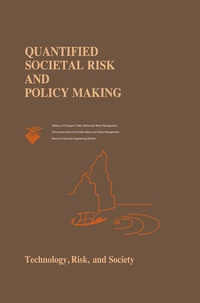
Quantified Societal Risk and Policy Making
Published on 28. February 1998
Book
Hardback
X, 242 pages
978-0-7923-4955-6 (ISBN)
Description
Quantified Societal Risk and Policy Making
is the result of an international workshop on societal risk organized by the Dutch Ministry for Transport, Public Works and Water Management with additional financial support from the Directorate for Transportation (DG VII) of the European Union.
Managing risks, whether there is a strong man-made or natural component, basically means assessing alternative options under uncertainty. The possibility of multiple fatalities is one of the factors that can vary between options.
This volume is concerned with one particular type of risk - the risk of death of a number of people in one accident - and with one particular tool - probabilistic risk analysis - as they are developing in various domains of society nowadays. Generally, this risk is labelled societal risk. This book shows how such comparisons are shaped at present in various hazard domains, such as:
It examines how to represent aggregate risks from major hazards in ways that can be handled by policy-makers. The purpose of the book is to increase the awareness of societal risk, disseminate available knowledge of existing approaches, and exchange information on applications from various domains.
Quantified Societal Risk and Policy Making should be of interest to all those professionally concerned with defining the optimal separation between hazardous activities and equally desirable developments nearby.
Managing risks, whether there is a strong man-made or natural component, basically means assessing alternative options under uncertainty. The possibility of multiple fatalities is one of the factors that can vary between options.
This volume is concerned with one particular type of risk - the risk of death of a number of people in one accident - and with one particular tool - probabilistic risk analysis - as they are developing in various domains of society nowadays. Generally, this risk is labelled societal risk. This book shows how such comparisons are shaped at present in various hazard domains, such as:
- flood protection
- location and physical planning of industry
- transportation of chemicals, and
- prevention of aircraft accidents.
It examines how to represent aggregate risks from major hazards in ways that can be handled by policy-makers. The purpose of the book is to increase the awareness of societal risk, disseminate available knowledge of existing approaches, and exchange information on applications from various domains.
Quantified Societal Risk and Policy Making should be of interest to all those professionally concerned with defining the optimal separation between hazardous activities and equally desirable developments nearby.
More details
Series
Edition
1998 ed.
Language
English
Place of publication
New York
United States
Target group
College/higher education
Professional and scholarly
Research
Illustrations
X, 242 p.
Dimensions
Height: 241 mm
Width: 160 mm
Thickness: 19 mm
Weight
553 gr
ISBN-13
978-0-7923-4955-6 (9780792349556)
DOI
10.1007/978-1-4757-2801-9
Schweitzer Classification
Other editions
Additional editions
Richard E. Jorissen | P.J. Stallen
Quantified Societal Risk and Policy Making
E-Book
04/2013
Springer
€96.29
Available for download
Richard E. Jorissen | P.J. Stallen
Quantified Societal Risk and Policy Making
Book
12/2010
Springer
€106.99
Shipment within 15-20 days
Content
1 Three conceptions of quantified societal risk.- 2 Flood protection, safety standards and societal risk.- 3 Modeling considerations in the analysis of risk management strategies.- 4 Risk criteria for the transportation of hazardous materials.- 5 The role of societal risk in land use planning near hazardous installations and in assessing the safety of the transport of hazardous materials at the national and local level.- 6 Protection of man and environment in the vicinity of hazardous installations in Germany.- 7 Risk assessment and risk management: tools and organization.- 8 On the risks of transporting dangerous goods.- 9 Accident risk in complementary transport chains.- 10 An applied economy-look at transport safety.- 11 Issues in societal risk of hazardous chemicals: the use of FN diagrams, data reliability and uncertainty.- 12 Side notes on negative consequences and uncertainty.- 13 FN data need supplement of temporal trend analysis.- 14 Risk-based decision making in the transportation sector.- 15 The need for risk benefit analysis.- 16 Societal risk amid other risk concerns: the experience of the great belt project (1987-1996).- 17 Methods and models for the assessment of third party risk due to aircraft accidents in the vicinity of airports and their implications for societal risk.- 18 Reflections on source-based approaches.- 19 Quality requirements of societal risk models.- 20 Summary of the issues discussed.- About the participants of the workshop.