

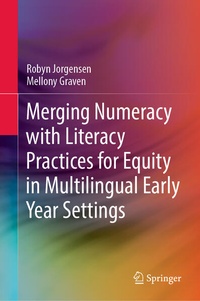
Merging Numeracy with Literacy Practices for Equity in Multilingual Early Year Settings
Description
The book shares the outcomes and strategies for teaching mathematics to early years learners and highlights the importance of literacy practices for learners for whom the language of instruction is different from their home language. Readers will gain a practical sense of how to create contexts, classrooms and practices to scaffold these learners to build robust understandings of mathematics.
Reviews / Votes
"This book may be recommended most for educators, including teachers and administrators, but also researchers interested in numeracy and literacy for young learners. . It is here that chapters are rich with specific examples, resources, pictures, and other invaluable resources that may help educators better support their multicultural and multilingual students in a variety of settings. Researchers will find similar value in these concrete examples . ." (Cristina Runnalls, MAA Reviews, June 18, 2023)More details
Other editions
Additional editions
Persons
Content
Section One: Theories that Frame Our Work: Introduction.- From Exclusion to Inclusion for Marginalised Learners - Theoretical Perspectives.- The Literacy of Numeracy Practices in Multilingual Early Years Settings.- Section 2: Story-based Resources for Developing Number Sense and Reasoning: Exploring Numeracy-Rich Rhymes and Stories.- Designing and Creating Maths-Rich Storybooks, Games and Related Activities.- A Resource Approach to Extending Numeracy Engagement beyond School.- Section Three: Engaging with the Formal Language of School Mathematics: Learning the Academic Language of Mathematics.- Big Books in a Multilingual Context.- Mathematical Language Immersion Learning Environments.- Section Four: Ubuntu and Community Links: Embracing Ubuntu in Community Partnerships.