


Introduction to Systems Ecology
1st Edition
Published on 30. September 2020
Book
Paperback/Softback
360 pages
978-0-367-86609-9 (ISBN)
Description
Possibly the first textbook to present a practically applicable ecosystems theory, Introduction to Systems Ecology helps readers understand how ecosystems work and how they react to disturbances. It demonstrates-with many examples and illustrations-how to apply the theory to explain observations and to make quantitative calculations and predictions.
In this book, Sven Erik Jorgensen takes a first step toward integrating thermodynamics, biochemistry, hierarchical organization, and network theory into a holistic theory of systems ecology. The first part of the book covers the laws of thermodynamics and the basic biochemistry of living organisms, as well as the constraints they impose on ecosystems. To grow and develop, however, ecosystems have to evade these thermodynamic and biochemical constraints, so the second part of the book discusses the seven basic properties that enable ecosystems to grow, develop, and survive:
They are open systems, far from thermodynamic equilibrium.
They are organized hierarchically.
They have a high diversity.
They have high buffer capacities toward changes.
Their components are organized in cooperative networks, which allows for sophisticated feedback, regulation mechanisms, and higher efficiencies.
They contain an enormous amount of information embodied in genomes.
They have emerging system properties.
This timely textbook also looks at how systems ecology is applied in integrated environmental management, particularly in ecological modeling and engineering and in the assessment of ecosystem health using ecological indicators. Acknowledging that there is still much room for improvement, it will inspire ecologists to develop a stronger and more widely applicable ecosystem theory.
In this book, Sven Erik Jorgensen takes a first step toward integrating thermodynamics, biochemistry, hierarchical organization, and network theory into a holistic theory of systems ecology. The first part of the book covers the laws of thermodynamics and the basic biochemistry of living organisms, as well as the constraints they impose on ecosystems. To grow and develop, however, ecosystems have to evade these thermodynamic and biochemical constraints, so the second part of the book discusses the seven basic properties that enable ecosystems to grow, develop, and survive:
They are open systems, far from thermodynamic equilibrium.
They are organized hierarchically.
They have a high diversity.
They have high buffer capacities toward changes.
Their components are organized in cooperative networks, which allows for sophisticated feedback, regulation mechanisms, and higher efficiencies.
They contain an enormous amount of information embodied in genomes.
They have emerging system properties.
This timely textbook also looks at how systems ecology is applied in integrated environmental management, particularly in ecological modeling and engineering and in the assessment of ecosystem health using ecological indicators. Acknowledging that there is still much room for improvement, it will inspire ecologists to develop a stronger and more widely applicable ecosystem theory.
Reviews / Votes
"... the first work that is devoted to the presentation of a practically applicable ecosystems theory. It integrates four aspects of systems ecology, namely, thermodynamics, biochemistry, hierarchical organization and network theory, all of which are illustrated by many examples and exercises to help students better understand the topics."-MAMMALIA, September 2013
More details
Series
Language
English
Place of publication
London
United Kingdom
Publishing group
Taylor & Francis Ltd
Target group
College/higher education
Dimensions
Height: 234 mm
Width: 156 mm
Thickness: 19 mm
Weight
547 gr
ISBN-13
978-0-367-86609-9 (9780367866099)
Copyright in bibliographic data and cover images is held by Nielsen Book Services Limited or by the publishers or by their respective licensors: all rights reserved.
Schweitzer Classification
Other editions
Additional editions
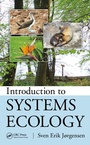
Sven Jorgensen
Introduction to Systems Ecology
E-Book
04/2016
1st Edition
CRC Press
€73.99
Available for download
Sven Jorgensen
Introduction to Systems Ecology
Book
04/2012
1st Edition
CRC Press
€171.70
Shipment within 15-20 days
Person
Dr. Sven Erik Jorgensen is a professor of environmental chemistry at Copenhagen University. He received a doctorate of engineering in environmental technology and a doctorate of science in ecological modeling. He is an honorable doctor of science at Coimbra University, Portugal, and at Dar es Salaam University, Tanzania. He was editor in chief of Ecological Modelling from the journal's inception in 1975 to 2009. He has also been the editor in chief of the Encyclopedia of Ecology. In 2004 Dr. Jorgensen was awarded the prestigious Stockholm Water Prize and the Prigogine Prize. He was awarded the Einstein Professorship by the Chinese Academy of Science in 2005. In 2007 he received the Pascal medal and was elected a member of the European Academy of Science. He has written close to 350 papers, most of which have been published in international peer-reviewed journals. He has edited or written 64 books. Dr. Jorgensen has given lectures and courses in ecological modeling, ecosystem theory, and ecological engineering worldwide.
Content
System Ecology: An Ecological Discipline. Part 1: Conservation of Energy and Matter. Ecosystems: Growth and Development. Irreversibility and Order: The Second and Third Laws of Thermodynamics. The Biochemistry of Ecosystems. The Thermodynamic Interpretation of Ecosystem Growth and Development. The Ecological Law of Thermodynamics. Part 2: Ecosystems Are Open Systems. Ecosystems Have a Hierarchical Organization. Ecosystems Have a High Diversity. Ecosystems Have a High Buffer Capacity. The Components of Ecosystems Form Ecological Networks. Ecosystems Have a Very High Content of Information. Ecosystems Have Emerging Holistic System Properties. Application of System Ecology in Ecological Subdisciplines and Environmental Management. References. Appendix. Index.