

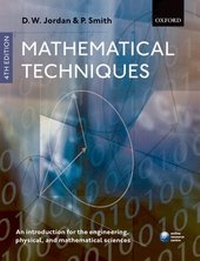
Mathematical Techniques
An Introduction for the Engineering, Physical, and Mathematical Sciences
4th Edition
Published on 13. March 2008
Book
Paperback/Softback
1008 pages
978-0-19-928201-2 (ISBN)
Description
Mathematical concepts and theories underpin much of the physical sciences and engineering. Yet maths is a subject that many students find challenging, and even intimidating - despite it being so central to their field of study.
Mathematical Techniques provides a complete course in mathematics, covering all the essential topics with which a physical sciences or engineering student should be familiar.
By breaking the subject into small, modular chapters, the book introduces and builds on concepts in a progressive, carefully-layered way - always with an emphasis on how to use the power of maths to best effect, rather than on theoretical proofs of the maths presented.
With a huge array of end of chapter problems, and new self-check questions, the fourth edition of Mathematical Techniques provides extensive opportunities for students to build their confidence in the best way possible: by using the maths for themselves.
Online Resources
The online resources feature the following materials for all users of the book:
? Figures from the book in electronic format, ready to download
? A downloadable solutions manual, featuring worked solutions to all end of chapter problems
? Mathematica-based programs, relating to the Projects featured at the end of the book
Mathematical Techniques provides a complete course in mathematics, covering all the essential topics with which a physical sciences or engineering student should be familiar.
By breaking the subject into small, modular chapters, the book introduces and builds on concepts in a progressive, carefully-layered way - always with an emphasis on how to use the power of maths to best effect, rather than on theoretical proofs of the maths presented.
With a huge array of end of chapter problems, and new self-check questions, the fourth edition of Mathematical Techniques provides extensive opportunities for students to build their confidence in the best way possible: by using the maths for themselves.
Online Resources
The online resources feature the following materials for all users of the book:
? Figures from the book in electronic format, ready to download
? A downloadable solutions manual, featuring worked solutions to all end of chapter problems
? Mathematica-based programs, relating to the Projects featured at the end of the book
Reviews / Votes
Review from previous edition This textbook offers an accessible and comprehensive grounding in many of the mathematical techniques required in the early stages of an engineering or science degree and also for the routine methods needed by first and second year mathematics students. * Engineering Designer March/April 2003 * There are also significant changes in content in the opening chapter, where the foundation material has been expanded usefully. The authors do not attempt to dodge theoretical hurdles. They are careful to explain many of the less intuitive properties of functions and to highlight generalisations without becoming over abstract. * Times Higher Education Supplement, November 2002 * Thoroughly recommended. * Zentralblatt MATH, 993:2002 *More details
Edition
4th Revised edition
Language
English
Place of publication
Oxford
United Kingdom
Target group
College/higher education
Edition type
Revised edition
Illustrations
500 figures
Dimensions
Height: 246 mm
Width: 190 mm
Thickness: 47 mm
Weight
1980 gr
ISBN-13
978-0-19-928201-2 (9780199282012)
Copyright in bibliographic data and cover images is held by Nielsen Book Services Limited or by the publishers or by their respective licensors: all rights reserved.
Schweitzer Classification
Other editions
Previous edition
D.W. Jordan
Mathematical Techniques
An introduction for the Engineering, Physical, and Mathematical Sciences
Book
08/2002
3rd Edition
Oxford University Press
€37.13
Article exhausted; check for reprint
Persons
Dominic Jordan is formerly of the Mathematics Department, Keele University, UK.
Peter Smith is Emeritus Professor in the School of Computing and Mathematics, Keele University, UK.
Peter Smith is Emeritus Professor in the School of Computing and Mathematics, Keele University, UK.
Content
PART 1. ELEMENTARY METHODS, DIFFERENTIATION, COMPLEX NUMBERS; PART 2. MATRIX AND VECTOR ALGEBRA; PART 3. INTEGRATION AND DIFFERENTIAL EQUATIONS; PART 4. TRANSFORMS AND FOURIER SERIES; PART 5. MULTIVARIABLE CALCULUS; PART 6. DISCRETE MATHEMATICS; PART 7. PROBABILITY AND STATISTICS; PART 8. PROJECTS; SELF-TESTS: SELECTED ANSWERS; ANSWERS TO SELECTED PROBLEMS; APPENDICES; FURTHER READING; INDEX