

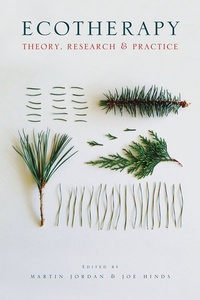
Ecotherapy
Theory, Research and Practice
Published on 10. June 2016
Book
Paperback/Softback
224 pages
978-1-137-48687-5 (ISBN)
Description
The idea of using nature to improve mental and emotional wellbeing has existed for many years, in many forms. However, growing levels of interest in holistic, reciprocal relationships with nature have led to the development of an explicit field, termed Ecotherapy.
In this thought-provoking new book, Martin Jordan and Joe Hinds provide a comprehensive exploration of this emerging area of practice. Divided into three parts, the book offers a unique examination of a range of theoretical perspectives, unpacks the latest research and provides a wealth of illuminating practice examples, with a number of chapters dedicated to authors' own first-hand experiences of the positive psychological effects of having contact with nature.
Topics covered include:
The foundations of ecotherapy, including how it can be defined, its relation to psychotherapy and ecopsychology, and the research and various theory bases that inform it
The benefits of incorporating nature into palliative care
Nature as a tool for crisis recovery
Nature-based therapy for stress-related disorders
The use of nature to promote optimal functioning, with a focus on areas such as generative experiences, emotional development and exploration, autonomy and a sense of belonging.
Written by a collection of leading experts from around the globe, Ecotherapy is a vital introduction to this fast-developing area of therapeutic practice.
In this thought-provoking new book, Martin Jordan and Joe Hinds provide a comprehensive exploration of this emerging area of practice. Divided into three parts, the book offers a unique examination of a range of theoretical perspectives, unpacks the latest research and provides a wealth of illuminating practice examples, with a number of chapters dedicated to authors' own first-hand experiences of the positive psychological effects of having contact with nature.
Topics covered include:
The foundations of ecotherapy, including how it can be defined, its relation to psychotherapy and ecopsychology, and the research and various theory bases that inform it
The benefits of incorporating nature into palliative care
Nature as a tool for crisis recovery
Nature-based therapy for stress-related disorders
The use of nature to promote optimal functioning, with a focus on areas such as generative experiences, emotional development and exploration, autonomy and a sense of belonging.
Written by a collection of leading experts from around the globe, Ecotherapy is a vital introduction to this fast-developing area of therapeutic practice.
Reviews / Votes
This important new anthology integrates ecotherapy theory, practice and research to offer a range of approaches for establishing healing relations with the natural world. Ecotherapy's move beyond an outdated, mechanistic view of self as separate from world has implications and consequences as immediate as personal health and as wide as an Earth-honoring worldview. - Craig Chalquist, Professor and Department Chair of East-West Psychology, California Institute of Integral Studies, USA For the practitioner of the 21st Century, there is no greater calling than tending the relationship between personal health and ecological well-being. No longer may the two be separated. Organized seamlessly, Ecotherapy brings together conceptual and applied writings from experts in the field - a must-read 'toolkit' for students and mentors in all fields of study. - Stephen Aizenstat, Chancellor & Founding President, Pacifica Graduate Institute, USAMore details
Edition
1st ed. 2016
Language
English
Place of publication
London
United Kingdom
Publishing group
Bloomsbury Publishing PLC
Target group
College/higher education
Product notice
Unsewn / adhesive bound
Illustrations
30 s/w Abbildungen
40 bw illus
Dimensions
Height: 235 mm
Width: 155 mm
Thickness: 12 mm
Weight
353 gr
ISBN-13
978-1-137-48687-5 (9781137486875)
DOI
10.1057/978-1-137-48688-2
Schweitzer Classification
Other editions
New editions
Book
04/2026
2nd Edition
Bloomsbury Academic
€40.00
Shipment within 15-20 days
Persons
Martin Jordan is a Counselling Psychologist, Psychotherapist and expert in the field of Ecotherapy. Formerly, he was a Senior Lecturer at the University of Brighton, UK.
Joe Hinds is a Psychotherapist and counsellor, and is Senior Lecturer in Psychology at Canterbury Christ Church University, UK.
Joe Hinds is a Psychotherapist and counsellor, and is Senior Lecturer in Psychology at Canterbury Christ Church University, UK.
Content
Biographies of Contributors List of figures and Tables Ecotherapy: An Introduction; Joe Hinds and Martin Jordan PART I: THEORY 1. Theoretical and Empirical Foundations for Ecotherapy; Thomas J. Doherty 2. Nature-based Practice: a Buddhist Psychotherapy Perspective; Caroline Brazier 3. Eudemonic Philosophy and Human(istic)-nature Relationships; Joe Hinds 4. Ecotherapy as Psychotherapy - Towards an Ecopsychotherapy; Martin Jordan 5. The Many Ecotherapies; Linda Buzzell PART II: RESEARCH 6. Working with Nature in Palliative Care; Deborah Kelly 7. Experiencing Existential Dimensions in Nature Based Rehabilitation; Eva Sahlin 8. A Salotugenic Approach in Nature-based Rehabilitation (NRB) for Individuals with Stress-related Mental Disorders; Anna Maria Palsdottir 9. Growing Together: Nature Connectedness, Belonging and Social Identity in a Mental Health Ecotherapy Programme; Matthew Adams and Martin Jordan PART III: PRACTICE 10. Prescribing Nature: Techniques, Challenges, and Ethical Considerations; Patricia Hasbach 11. A Vital Protocol - Embodied-relational Depth in Nature; Hayley Marshall 12. Feet on the Ground and Branching Out: being with Nature as a Tool for Recovery in Crisis within NHS Mental Health Services; Vanessa Jones, Brian Thompson and Julie Watson 13. Renewed by Nature: Nature Therapy as a Framework to Help People Deal with Crises, Trauma and Loss; Ronen Berger 14. Equine Assisted Therapy: Developing Theoretical Context; Joe Hinds and Louise Ranger Afterword; Martin Jordan and Joe Hinds