

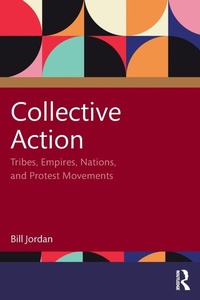
Collective Action
Tribes, Empires, Nations, and Protest Movements
1st Edition
Published on 29. July 2022
Book
Paperback/Softback
136 pages
978-1-032-30887-6 (ISBN)
Description
This book examines how different levels and forms of human collectivity have interacted, voluntarily or coercively, and how these transformed societies and polities.
Every size and type of human collective involve co-operation among members and competition with other groups. The two most recent trends in human relations - individualism and economic globalisation - have contributed to authoritarianism in politics and inequality among citizens. This book analyses how collective action might offset the most destructive consequences for well-being of these two tendencies. It explores these manifestations of collective action and their impact on social relations and social policies in the developed world. Further, the volume sets out a programme for more progressive and egalitarian future for global populations.
Engaging, accessible and transdisciplinary, this book will be of great interest to scholars and researchers of politics and public policy, sociology, social psychology, social policy and social work, as well as political philosophy, political economy and migration studies.
Every size and type of human collective involve co-operation among members and competition with other groups. The two most recent trends in human relations - individualism and economic globalisation - have contributed to authoritarianism in politics and inequality among citizens. This book analyses how collective action might offset the most destructive consequences for well-being of these two tendencies. It explores these manifestations of collective action and their impact on social relations and social policies in the developed world. Further, the volume sets out a programme for more progressive and egalitarian future for global populations.
Engaging, accessible and transdisciplinary, this book will be of great interest to scholars and researchers of politics and public policy, sociology, social psychology, social policy and social work, as well as political philosophy, political economy and migration studies.
More details
Language
English
Place of publication
London
United Kingdom
Publishing group
Taylor & Francis Ltd
Target group
College/higher education
Postgraduate
Dimensions
Height: 234 mm
Width: 156 mm
Thickness: 8 mm
Weight
237 gr
ISBN-13
978-1-032-30887-6 (9781032308876)
Copyright in bibliographic data and cover images is held by Nielsen Book Services Limited or by the publishers or by their respective licensors: all rights reserved.
Schweitzer Classification
Other editions
Additional editions
E-Book
07/2022
1st Edition
Routledge India
€55.49
Available for download
E-Book
07/2022
1st Edition
Routledge India
€55.49
Available for download
Book
07/2022
1st Edition
Routledge India
€205.70
Shipment within 10-20 days
Person
Bill Jordan is Honorary Professor of Social Policy and Social Work at the University of Plymouth. He has written over 30 books on politics, economics, migration, social policy and social work. He worked for ten years in the UK public services and was also an activist in a union for claimants of welfare benefits, later acting as a consultant to several local authorities. He lectured in New Zealand, Australia and Canada. Since then, he has held visiting chairs in the Netherlands, Denmark, Germany, Slovakia, Hungary and the Czech Republic. His books have been translated into Portuguese, Hungarian and Japanese.
Content
1. Introduction, 2. The History and Dynamics of Collective Action: Crisis and Transformation, 3. Relationship: The Dynamics of Feeling, 4. Couples and Families, 5. Well-being and Social Value, 6. Civic Relationships and Civil Society, 7. Globalisation, 8. Conflict and Coercion, 9. A New Direction?, 10. The Revival of Nationalism, 11. The State, 12. Mobility and Migration, 13. Extremism, Political and Religious, 14. Nations and Sustainability, 15. A New Cold War?, 16. A New Basis for Citizenship, 17. Conclusions