

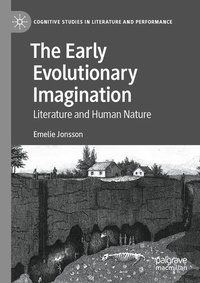
The Early Evolutionary Imagination
Description
Darwinian evolution is an imaginative problem that has been passed down to us unsolved. It is our most powerful explanation of humanity's place in nature, but it is also more cognitively demanding and less emotionally satisfying than any myth. From the publication of the Origin of Species in 1859, evolution has pushed our capacity for storytelling into overdrive, sparking fairy tales, adventure stories, political allegories, utopias, dystopias, social realist novels, and existential meditations. Though this influence on literature has been widely studied, it has not been explained psychologically. This book argues for the adaptive function of storytelling, integrates traditional humanist scholarship with current knowledge about the evolved and adapted human mind, and calls for literary scholars to reframe their interpretation of the first authors who responded to Darwin.
Reviews / Votes
"The Early Evolutionary Imagination breaks a new path for thinking about the relationship between imaginative culture and metaphysical naturalism. Jonsson writes well, is deeply immersed in the relevant literature, and deftly handles a complex story with multiple layers. She shows how literature from the Victorian and Edwardian era poses a model for how modernity-right up to the present-carves out a human world of meaning amidst a cosmic context of indifference."--Stephen Asma , Professor of Philosophy at Columbia College, and senior fellow of the Research Group in Mind, Science and Culture
"Jonsson is the first scholar in this historical field to assimilate the most recent empirical knowledge about our evolved human nature and the psychology of imagination. Her theoretical framework provides robust explanatory power, her interpretive critiques are incisive and authoritative, and her style is lucid and vigorous. Like the best critics of any literary school, she evokes the whole imaginative world view of the authors she discusses."
-- Joseph Carroll , Curator's Distinguished Professor Emeritus, University of St. Louis, Missouri
"Jonsson's new book is brilliantly conceived, elegantly written, and deeply illuminating. Her premise is that Darwinian thinking represented a profound challenge to the foundational concepts of literary culture-the autonomy of the individual, the meaningfulness of human life, the importance of moral choice, and the value of art. Her argument is that literary culture in the years following Darwin explored ways of confronting this challenge, opening up a space between difficult truths and soothing fictions, and making it possible for people to grasp the unique disturbance of the Darwinian message without being destroyed by its implications."
-- Geoffrey Harpham , senior fellow at the Kenan Institute for Ethics, Duke University
"This beautifully written monograph finds persuasive new ways to link a comprehensive Darwinian understanding of the ways in which human beings function to the specifics of literary history, illuminating a range of texts that were themselves written under the influence of Darwin's theories. Emelie Jonsson communicates complex ideas with clarity, enthusiasm, and wit. The book is based on deep familiarity with the past achievements of evolutionary literary criticism, and will make a substantial contribution to the field."
-- Dominic Rainsford , Professor of Literature in English, Aarhus University
More details
Other editions
Additional editions
Person
Content
1. Chapter 1: Using Evolution to Explain the Evolutionary Imagination.- Chapter 2 Myth-Making in Early Evolutionary Thought.- Chapter 3: Darwinism in Literature.- Chapter 4: From Adventure to Utopia.- Chapter 5: Jack London's Evolutionary Imagination.- Chapter 6: H. G. Wells's Evolutionary Imagination.- Chapter 7: Joseph Conrad's Evolutionary Imagination.- The Unimaginable Place in Nature.