

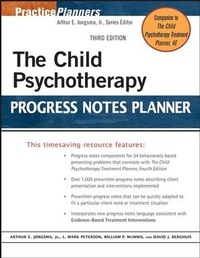
The Child Psychotherapy Progress Notes Planner
3rd Edition
Published on 1. January 2007
Book
Paperback/Softback
408 pages
978-0-471-78536-1 (ISBN)
Description
The Child Psychotherapy Progress Notes Planner, Third Edition contains complete prewritten session and patient presentation descriptions for each behavioral problem in The Child Psychotherapy Treatment Planner, Fourth Edition. The prewritten progress notes can be easily and quickly adapted to fit a particular client need or treatment situation.
* Saves you hours of time-consuming paperwork, yet offers the freedom to develop customized progress notes
* Organized around 34 main presenting problems, from blended family problems and children of divorce to ADHD, attachment disorder, academic problems, and speech and language disorders
* Features over 1,000 prewritten progress notes (summarizing patient presentation, themes of session, and treatment delivered)
* Provides an array of treatment approaches that correspond with the behavioral problems and DSM-IV-TR diagnostic categories in The Child Psychotherapy Treatment Planner, Fourth Edition
* Offers sample progress notes that conform to the requirements of most third-party payors and accrediting agencies, including CARF, JCAHO, and NCQA
* Presents new and updated information on the role of evidence-based practice in progress notes writing and the special status of progress notes under HIPAA
Additional resources in the PracticePlanners(r) series:
Treatment Planners
cover all the necessary elements for developing formal treatment plans, including detailed problem definitions, long-term goals, short-term objectives, therapeutic interventions, and DSM diagnoses.
Homework Planners
feature behaviorally based, ready-to-use assignments to speed treatment and keep clients engaged between sessions.
For more information on our PracticePlanners(r) products, including our full line of Treatment Planners, visit us on the Web at: www.wiley.com/practiceplanners
More details
Other editions
New editions
Arthur E. Jongsma | L. Mark Peterson | William P. McInnis
The Child Psychotherapy Progress Notes Planner
Book
08/2014
5th Edition
Wiley
Unfortunately, price unknown
Article exhausted; check for reprint
Persons
ARTHUR E. JONGSMA, JR., PHD, is Series Editor for the bestselling PracticePlanners(r). Since 1971, he has provided professional mental health services to both inpatient and outpatient clients. He managed a group private practice for twenty-five years and now is the Executive Director of Life Guidance Services in Grand Rapids, Michigan.
L. MARK PETERSON, ACSW, is Program Manager for Bethany Christian Services' Residential Treatment and Family Counseling programs in Grand Rapids, Michigan.
WILLIAM P. MCINNIS, PSYD, is in private practice with Aspen Psychological Services in Grand Rapids, Michigan. He is also coauthor of the bestselling The Child Psychotherapy Treatment Planner, Fourth Edition and The Adolescent Psychotherapy Treatment Planner, Fourth Edition.
DAVID J. BERGHUIS, MA, LLP, is in private practice and has worked in community mental health for more than a decade. He is also coauthor of numerous titles in the PracticePlanners(r) series.
Content
PracticePlanners(r) Series Preface.
Acknowledgements.
Introduction.
Academic Underachievement.
Adoption.
Anger Management.
Anxiety.
Attachment Disorder.
Attention-Deficit/Hyperactivity Disorder (ADHD).
Autism/Pervasive Developmental Disorder.
Blended Family.
Bullying/Intimidation Perpetrator.
Conduct Disorder/Delinquency.
Depression.
Disruptive/Attention-Seeking.
Divorce Reaction.
Enuresis/Encopresis.
Fire Setting.
Gender Identity Disorder.
Grief/Loss Unresolved.
Low Self-Esteem.
Lying/Manipulative.
Medical Condition.
Mental Retardation.
Obsessive-Compulsive Disorder (OCD).
Oppositional Defiant.
Parenting.
Peer/Sibling Conflict.
Physical/Emotional Abuse Victim.
Posttraumatic Stress Disorder (PTSD).
School Refusal.
Separation Anxiety.
Sexual Abuse Victim.
Sleep Disturbance.
Social Phobia/Shyness.
Specific Phobia.
Speech/Language Disorders.