

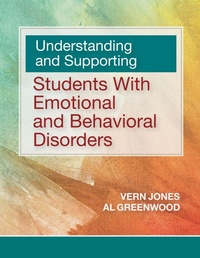
Understanding and Supporting Students with Emotional and Behavioral Disorders
Description
This comprehensive textbook is focused on helping the reader develop a conceptual framework for supporting students with EBD, a better understanding of the nature of EBD, and strategies for implementing research-based methods and interventions when helping these students.
More details
Persons
Dr. Jones has been a junior high school teacher of students with EBD, a junior high school vice principal, and a district coordinator for students with EBD. He has consulted with university faculty, state departments of education, school districts, and educators in over 25 states in the areas of classroom management, programs and individual interventions for students with EBD, and school violence prevention. Dr. Jones is Emeritus Professor of Education at Lewis & Clark College in Portland, Oregon where he was chair of the education and special education departments in the Graduate School of Education and Counseling. His books include Comprehensive Classroom Management, 12th Ed. (2021), Effective Supports for Students with Emotional and Behavioral Disorders, (2016), Practical Classroom Management 2nd Ed. (2015), Creating Effective Programs for Students with Emotional and Behavior Discipline (2004), Responsible School Discipline (1981), and Adolescents with Behavior Problems, (1980). He was selected by the National Association of Colleges of Teacher Education to write the chapter on classroom management for the Handbook of Research on Teacher Education (1996) and wrote the chapter "How Do Teachers Learn to Be Effective Classroom Managers?" for the Handbook for Classroom Management: Research, Practice, and Contemporary Issues (2006).
Dr. Greenwood is a licensed Clinical Psychologist. Dr. Greenwood spent the first 10 years of his career at Good Samaritan Hospital in Portland, Oregon working with children having complex neurodevelopmental, learning and behavior challenges. Since 1989 he has been an independent practitioner providing support to children with EBD and their families and has been actively engaged as a special programs consultant to school districts and education service districts. Dr. Greenwood has conducted numerous trainings and workshops on the BSP process and supportive interventions for students experiencing EBD. He is often called upon to be an independent evaluator in special education litigation. For over 20 years Dr. Greenwood was also an adjunct professor in the Graduate School of Education and Counseling at Lewis & Clark College in Portland, Oregon. He currently consults with school districts on special education issues, program development, and best practice methods for supporting students with emotional and behavioral disorders. He is also co-founder of 321 Insight, a web-based company providing training and support for educators.
Content
About the Authors
Preface
Acknowledgments
Dedication
Chapter 1: Key Concepts and Assumptions Related To Effective Support For Students With Emotional And Behavioral Disorders
Services and Levels of Success for Students With EBD
Key Assumptions Underlying Effective Support for Students Experiencing EBD
Case Study
Summary
References
Chapter 2: Developing A Foundational Understanding of Emotional and Behavioral Disorders
Appreciate the Complex Nature of Behavior Associated With EBD
Develop Accurate Conceptualizations
Utilize a Developmental Perspective
Be Knowledgeable About Risk and Protective Factors
Recognize Key Skill Deficits and Unique Characteristics of Students With EBD
Use Methods and Practices That Facilitate Effective Supports
Understand and Utilize Mental Health Systems and Perspectives
Summary
References
Chapter 3: Creating Supportive Adult-Student and Peer Relationships
The Importance of Adult-Student Relationships in Supporting Students With EBD
Creating Supportive Peer Relationships in the Classroom
Developing Supportive Relationships With Caregivers
Summary
References
Chapter 4: Developing Behavior Standards and Increasing Students' Motivation to Learn
Developing Clear and Effective General Classroom Behavior Standards and Procedures
Increasing Students' Motivation to Learn and Enhancing Their Academic Success
Summary
References
Chapter 5: Responding Effectively to Disruptive Behavior
Methods for Responding Effectively to Disruptive or Defiant Behavior
Responding to Violent Student Behavior
Creating an Effective Classroom Discipline Procedure
Incorporating Social Problem Solving Into the Classroom and School Discipline System
Disciplinary Exclusion for Students Identified as EBD
Summary
References
Chapter 6: Developing Individualized Behavior Support Plans: Planning for Student Success
Understanding the Behavior Support Plan Process
Components of the BSP Process
Implementing the BSP Across a Continuum of Services
Increasing the Effectiveness of the BSP
Summary
References
Chapter 7: Social-Emotional Learning Methods for Supporting Student Success
Understanding Social-Emotional Learning
Methods and Strategies for Developing Self-Regulation
Facilitating Self-Awareness and Understanding School Behavior Skills: Learning and Demonstrating Behaviors That Are Adaptive and Socially Acceptable in a School Setting
Using Systematic Desensitization and Cognitive Restructuring to Assist Students in Adjusting to Stressful Situations
Summary
References
Chapter 8: Developing an Effective Program for Students Identified as EBD
Components of an Effective Specialized Program for Students Identified as EBD
Ensuring Program Quality
Summary
References