

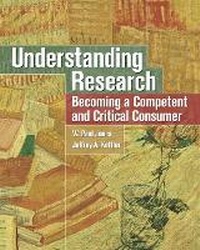
Understanding Research
Becoming a Competent and Critical Consumer
Published on 19. May 2005
Book
Paperback/Softback
240 pages
978-0-13-119844-9 (ISBN)
Description
Understanding Research: Becoming A Compotent and Critical Consumer, first edition, teaches students how to read research articles and can be used as a core text in an introduction to educational research course or any course that focuses on teaching students how to read research articles. It can also be used as a supplementary text in courses that cover both producing and consuming research. This is the only text available that focuses primarily on teaching students how to read research articles.
More details
Language
English
Place of publication
United States
Publishing group
Pearson Education (US)
Target group
Professional and scholarly
Dimensions
Height: 254 mm
Width: 203 mm
Thickness: 10 mm
Weight
434 gr
ISBN-13
978-0-13-119844-9 (9780131198449)
Copyright in bibliographic data and cover images is held by Nielsen Book Services Limited or by the publishers or by their respective licensors: all rights reserved.
Schweitzer Classification
Content
Chapter 1 What is Research and Why You Should Care?
Chapter 2 What is the Question and Why is it Important? Evaluating the Introduction of a Research Report
Chapter 3 Who Answered the Question? Evaluating the Participant Sample
Chapter 4 Could They Answer the Question? Evaluating the Procedures and Instrumentation
Chapter 5 What Was the (Simple) Answer Please? Evaluating the Results Section
Chapter 6 So, Now What? Evaluating the Discussion Section
Chapter 7 Not the Last Chapter
Appendix A. Teaching Ethics to Mental Health Practica Students at the Master's Level: A Comparative Study.
Appendix B. Segregated Classrooms, Integrated Intent: How One School Responded to the Challenge of Developing Positive Interethnic Relations.
Appendix C. Procrastination in College Students: The Role of Self Efficacy and Anxiety.
Bibliography.
Index.
Chapter 2 What is the Question and Why is it Important? Evaluating the Introduction of a Research Report
Chapter 3 Who Answered the Question? Evaluating the Participant Sample
Chapter 4 Could They Answer the Question? Evaluating the Procedures and Instrumentation
Chapter 5 What Was the (Simple) Answer Please? Evaluating the Results Section
Chapter 6 So, Now What? Evaluating the Discussion Section
Chapter 7 Not the Last Chapter
Appendix A. Teaching Ethics to Mental Health Practica Students at the Master's Level: A Comparative Study.
Appendix B. Segregated Classrooms, Integrated Intent: How One School Responded to the Challenge of Developing Positive Interethnic Relations.
Appendix C. Procrastination in College Students: The Role of Self Efficacy and Anxiety.
Bibliography.
Index.