

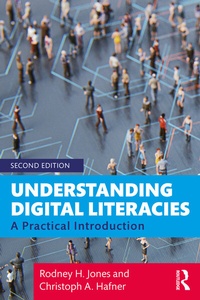
Understanding Digital Literacies
A Practical Introduction
1st Edition
Published on 2. April 2012
Book
Paperback/Softback
214 pages
978-0-415-67315-0 (ISBN)
Description
Assuming no knowledge of linguistics, Understanding Digital Literacies provides an accessible and timely introduction to new media literacies. It supplies readers with the theoretical and analytical tools with which to explore the linguistic and social impact of a host of new digital literacy practices. Each chapter in the volume covers a different topic, presenting an overview of the major concepts, issues, problems and debates surrounding the topic, while also encouraging students to reflect on and critically evaluate their own language and communication practices.
Features include:
coverage of a diverse range of digital media texts, tools and practices including blogging, hypertextual organisation, Facebook, Twitter, YouTube, Wikipedia, websites and games
an extensive range of examples and case studies to illustrate each topic, such as how blogs have affected our thinking about communication, how the creation and sharing of digital images and video can bring about shifts in social roles, and how the design of multiplayer online games for children can promote different ideologies
a variety of discussion questions and mini-ethnographic research projects involving exploration of various patterns of media production and communication between peers, for example in the context of Wikinomics and peer production, social networking and civic participation, and digital literacies at work
end of chapter suggestions for further reading and links to key web and video resources
a companion website providing supplementary material for each chapter, including summaries of key issues, additional web-based exercises, and links to further resources such as useful websites, articles, videos and blogs.
This book will provide a key resource for undergraduate and graduate students studying courses in new media and digital literacies.
Features include:
coverage of a diverse range of digital media texts, tools and practices including blogging, hypertextual organisation, Facebook, Twitter, YouTube, Wikipedia, websites and games
an extensive range of examples and case studies to illustrate each topic, such as how blogs have affected our thinking about communication, how the creation and sharing of digital images and video can bring about shifts in social roles, and how the design of multiplayer online games for children can promote different ideologies
a variety of discussion questions and mini-ethnographic research projects involving exploration of various patterns of media production and communication between peers, for example in the context of Wikinomics and peer production, social networking and civic participation, and digital literacies at work
end of chapter suggestions for further reading and links to key web and video resources
a companion website providing supplementary material for each chapter, including summaries of key issues, additional web-based exercises, and links to further resources such as useful websites, articles, videos and blogs.
This book will provide a key resource for undergraduate and graduate students studying courses in new media and digital literacies.
Reviews / Votes
"Finally, a definitive user's guide for the fast changing world of digital media and digital literacies. Understanding Digital Literacies: A practical introduction is lucid, entertaining, spot on, and, while practical indeed, is wholly a theoretically sophisticated and empirically trustworthy guide." James Paul Gee, Arizona State University, USA"Understanding Digital Literacies is an excellent introduction to this newly emerging field, providing a comprehensive guide to the concepts needed to understand the area. Enthusiastically written, the book addresses the reader directly and is clearly illustrated with detailed case studies." David Barton, Lancaster University, UK
"This highly readable and incisively argued volume represents a milestone contribution to better understanding communication in late modernity. The authors provide theoretically astute and empirically rich coverage of digital literacies in a wide array of new media contexts. The text is rich with examples, provides a variety of exercises and project types for students, and includes comprehensive suggestions for additional reading and investigation. This book is an invaluable resource for students and teachers engaged in literacy studies, applied linguistics, digital cultures research, and exploration of new media as they relate to workplaces, education, and social life." Steven L. Thorne, Portland State University, USA and University of Groningen, The Netherlands
'.. I found myself being almost disturbingly enthusiastic about the subject of digital literacy whilst reading this book.' - Journal of Pedagogic Development
While much of the research around digital technologies tends to be polarised between dystopian and utopian visions, Understanding Digital Literacies is able to cut a path through the middle. It gives both sides of the debate and then describes the skills and thinking needed to bridge these seemingly incompatible discourses. The accessible writing and clear and practical structure means it is suitable for young adult students, but it also has enough substance and complexity to extend the knowledge of those more familiar with this area of study.' - English in Australia 'Finally, a definitive user's guide for the fast changing world of digital media and digital literacies. Understanding Digital Literacies: A practical introduction is lucid, entertaining, spot on, and, while practical indeed, is wholly a theoretically sophisticated and empirically trustworthy guide.' - James Paul Gee, Arizona State University, USA
'Understanding Digital Literacies is an excellent introduction to this newly emerging field, providing a comprehensive guide to the concepts needed to understand the area. Enthusiastically written, the book addresses the reader directly and is clearly illustrated with detailed case studies.' - David Barton, Lancaster University, UK
'This highly readable and incisively argued volume represents a milestone contribution to better understanding communication in late modernity. The authors provide theoretically astute and empirically rich coverage of digital literacies in a wide array of new media contexts. The text is rich with examples, provides a variety of exercises and project types for students, and includes comprehensive suggestions for additional reading and investigation. This book is an invaluable resource for students and teachers engaged in literacy studies, applied linguistics, digital cultures research, and exploration of new media as they relate to workplaces, education, and social life.' - Steven L. Thorne, Portland State University, USA and University of Groningen, the Netherlands
'Impressively broad in the information that it provides while not oversimplifying the complex issues covered... A valuable contribution to advanced undergraduate or graduate courses that provide a multidisciplinary perspective on this complex and widely researched issue.' - LINGUIST List
More details
Language
English
Place of publication
London
United Kingdom
Publishing group
Taylor & Francis Ltd
Target group
College/higher education
Dimensions
Height: 234 mm
Width: 156 mm
Weight
350 gr
ISBN-13
978-0-415-67315-0 (9780415673150)
Copyright in bibliographic data and cover images is held by Nielsen Book Services Limited or by the publishers or by their respective licensors: all rights reserved.
Schweitzer Classification
Other editions
New editions
Book
07/2021
2nd Edition
Routledge
€62.10
Shipment within 10-20 days
Additional editions
Book
04/2012
1st Edition
Routledge
€193.13
Article exhausted; check for reprint
Persons
Rodney H. Jones is Associate Head and Associate Professor in the Department of English at City University of Hong Kong
Christoph A. Hafner is Assistant Professor in the Department of English at City University of Hong Kong
Christoph A. Hafner is Assistant Professor in the Department of English at City University of Hong Kong
Content
1. Mediated Me Part 1: Digital Tools 2. Information Everywhere 3. Hyperreading and Hyperwriting 4. Multimodality 5. Online Language and Social Interaction 6. Attention Structures 7. Critical Literacy Part 2: Digital Practices 8. Online Cultures and Intercultural Communication 9. Games, Learning and Literacy 10. Social Networking 11. Collaboration and Peer Production 12: Digital Literacies at Work Afterword: Mediated Me 2.0. References. Glossary