

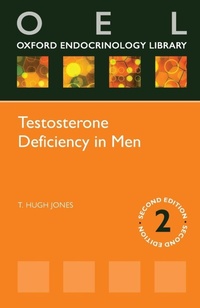
Testosterone Deficiency in Men
2nd Edition
Published on 20. December 2012
Book
Paperback/Softback
180 pages
978-0-19-965167-2 (ISBN)
Description
Over the last few years there has been a substantial increase in the interest not only by the medical profession but also the media in the role of testosterone in health and disease. This interest has been mirrored by a rapid increase in research publications and development of improved modes of delivery of testosterone therapy.
The second edition of this successful pocketbook provides clinicians with an update on the management of testosterone deficiency in men, and covers updated management guidelines, a new chapter on testosterone and mortality, and a concluding chapter of helpful case vignettes.
The second edition of this successful pocketbook provides clinicians with an update on the management of testosterone deficiency in men, and covers updated management guidelines, a new chapter on testosterone and mortality, and a concluding chapter of helpful case vignettes.
Reviews / Votes
This book gives an excellent overview of male hypogonadism, an underdiagnosed condition which may present to a range of medical specialties. Non-specific symptoms and difficulty in interpretation of the biochemical markers make this book a 'must-have' for any specialist, as well as primary care doctors, who would like to make an initial diagnosis. It provides a comprehensive approach to this complex area, being structured in a very systematic format... Diabetologists, endocrinologists, cardiologists, geriatricians, urologists and psychiatrists will find practical guidance in this book, which is easily read and informative. * British Journal of Hospital Medicine, June 2013 *More details
Series
Edition
2nd Revised edition
Language
English
Place of publication
Oxford
United Kingdom
Target group
Professional and scholarly
This pocketbook is ideal for specialists and trainees in endocrinology, diabetes, and urology; specialist nurses; interested GPs; and other healthcare professionals caring for patients with testosterone problems.
Edition type
Revised edition
Illustrations
numerous illustrations throughout
Dimensions
Height: 198 mm
Width: 129 mm
Thickness: 10 mm
Weight
198 gr
ISBN-13
978-0-19-965167-2 (9780199651672)
Copyright in bibliographic data and cover images is held by Nielsen Book Services Limited or by the publishers or by their respective licensors: all rights reserved.
Schweitzer Classification
Other editions
Previous edition
Hugh Jones
Testosterone Deficiency in Men
Book
09/2008
Oxford University Press
€16.08
Article exhausted; check for reprint
Person
Edited by Hugh Jones, Barnsley Hospital NHS Foundation Trust, Gawber Road, Barnsley, South Yorkshire, UK
Contributors:
Bradley D. Anawalt, Associate Chief of Medicine, VA Puget Sound Healthcare System, Seattle and Professor of Medicine, University of Washington, USA
Stefan Arver, Director and Associate Professor, Centre for Andrology and Sexual Medicine Department of Endocrinology,
Metabolism and Diabetes, Karolinska University Hospital and Karolinska Institute, Stockholm, Sweden
Hermann Behre, Director, Center of Reproductive Medicine and Andrology, University Hospital Halle, Halle, Germany
Shalender Bhasin, Professor of Medicine and Chief of Endocrinology, Diabetes and Nutrition, Boston University School of
Medicine, Section of Endocrinology, Diabetes and Nutrition, Boston Medical Center, Boston, USA
Pierre-Marc Bouloux, Professor of Endocrinology, Centre for Neuroendocrinology, Royal Free and University College Medical School, Hampstead, London, UK
Ahmed El-Sakka, Department of Urology, Suez Canal University, School of Medicine, Ismailia, Egypt and Al-Noor Specialist Hospital, Makkah, Saudi Arabia
Arif Hambda, Specialist Registrar Centre for Neuroendocrinology, Royal Free and University College Medical School, Hampstead, London, UK
Trudy Hannington, Sexual Therapist, Leger Clinic, St. Vincent Medical Centre, Doncaster, UK
T. Hugh Jones, Consultant Physician and Endocrinologist and Honorary Professor of Andrology, Robert Hague Centre for
Diabetes and Endocrinology, Barnsley Hospital NHS Foundation Trust, Barnsley, and Academic Unit of Diabetes, Endocrinology and Metabolism, The Medical School, University of Sheffield, Sheffield, UK
Mikael Lehtihet, Centre for Andrology and Sexual Medicine Department of Endocrinology, Metabolism and Diabetes
Karolinska University Hospital and Karolinska Institute, Stockholm, Swedenxii
Farid Saad, Professor and Head of Global Scientific Affairs, Bayer Schering Pharma, Scientific Affairs Men's Healthcare, Berlin, Germany, and Gulf Medical University School of Medicine, Ajman, United Arab Emirates
Doug Savage, General Practitioner, Leger Clinic, St. Vincent Medical Centre, Doncaster, UK
Aksam Yassin, Consultant Urologist and Professor of Urology and Human Sexuality, Segeburger Kliniken, Norderstedt- Hamburg, Germany and Gulf Medical University School of medicine, Ajman, United Arab Emirates
Michael Zitzmann, Clinical Director, Institute of Reproductive Medicine, Universitaksklinikum Munster, Munster, Germany
Contributors:
Bradley D. Anawalt, Associate Chief of Medicine, VA Puget Sound Healthcare System, Seattle and Professor of Medicine, University of Washington, USA
Stefan Arver, Director and Associate Professor, Centre for Andrology and Sexual Medicine Department of Endocrinology,
Metabolism and Diabetes, Karolinska University Hospital and Karolinska Institute, Stockholm, Sweden
Hermann Behre, Director, Center of Reproductive Medicine and Andrology, University Hospital Halle, Halle, Germany
Shalender Bhasin, Professor of Medicine and Chief of Endocrinology, Diabetes and Nutrition, Boston University School of
Medicine, Section of Endocrinology, Diabetes and Nutrition, Boston Medical Center, Boston, USA
Pierre-Marc Bouloux, Professor of Endocrinology, Centre for Neuroendocrinology, Royal Free and University College Medical School, Hampstead, London, UK
Ahmed El-Sakka, Department of Urology, Suez Canal University, School of Medicine, Ismailia, Egypt and Al-Noor Specialist Hospital, Makkah, Saudi Arabia
Arif Hambda, Specialist Registrar Centre for Neuroendocrinology, Royal Free and University College Medical School, Hampstead, London, UK
Trudy Hannington, Sexual Therapist, Leger Clinic, St. Vincent Medical Centre, Doncaster, UK
T. Hugh Jones, Consultant Physician and Endocrinologist and Honorary Professor of Andrology, Robert Hague Centre for
Diabetes and Endocrinology, Barnsley Hospital NHS Foundation Trust, Barnsley, and Academic Unit of Diabetes, Endocrinology and Metabolism, The Medical School, University of Sheffield, Sheffield, UK
Mikael Lehtihet, Centre for Andrology and Sexual Medicine Department of Endocrinology, Metabolism and Diabetes
Karolinska University Hospital and Karolinska Institute, Stockholm, Swedenxii
Farid Saad, Professor and Head of Global Scientific Affairs, Bayer Schering Pharma, Scientific Affairs Men's Healthcare, Berlin, Germany, and Gulf Medical University School of Medicine, Ajman, United Arab Emirates
Doug Savage, General Practitioner, Leger Clinic, St. Vincent Medical Centre, Doncaster, UK
Aksam Yassin, Consultant Urologist and Professor of Urology and Human Sexuality, Segeburger Kliniken, Norderstedt- Hamburg, Germany and Gulf Medical University School of medicine, Ajman, United Arab Emirates
Michael Zitzmann, Clinical Director, Institute of Reproductive Medicine, Universitaksklinikum Munster, Munster, Germany
Content
1. Testosterone deficiency: an overview ; 2. Clinical physiology of testosterone ; 3. Diagnosis of hyopogonadism: Symptoms, signs, tests and guidelines ; 4. Primary hypogonadism ; 5. Secondary hypogonadism ; 6. Late-onset hypogonadism ; 7. Testosterone replacement therapy ; 8. The prostate and other safety issues ; 9. Puberty and fertility ; 10. Testosterone and erectile dysfunction ; 11. Obesity, metabolic syndrome, and diabetes ; 12. The heart and cardiovascular disease ; 13. Testosterone and the brain ; 14. The role of androgens in osteoperosis and frailty ; 15. Testosterone and mortality ; 16. A perspective from primary care ; 17. Case vignettes