

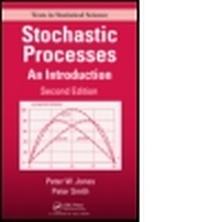
Stochastic Processes
An Introduction, Second Edition
2nd Edition
Published on 15. October 2009
Book
Paperback/Softback
232 pages
978-1-4200-9960-7 (ISBN)
Description
Based on a highly popular, well-established course taught by the authors, Stochastic Processes: An Introduction, Second Edition discusses the modeling and analysis of random experiments using the theory of probability. It focuses on the way in which the results or outcomes of experiments vary and evolve over time.
The text begins with a review of relevant fundamental probability. It then covers several basic gambling problems, random walks, and Markov chains. The authors go on to develop random processes continuous in time, including Poisson, birth and death processes, and general population models. While focusing on queues, they present an extended discussion on the analysis of associated stationary processes. The book also explores reliability and other random processes, such as branching processes, martingales, and a simple epidemic. The appendix contains key mathematical results for reference.
Ideal for a one-semester course on stochastic processes, this concise, updated textbook makes the material accessible to students by avoiding specialized applications and instead highlighting simple applications and examples. The associated website contains Mathematica (R) and R programs that offer flexibility in creating graphs and performing computations.
The text begins with a review of relevant fundamental probability. It then covers several basic gambling problems, random walks, and Markov chains. The authors go on to develop random processes continuous in time, including Poisson, birth and death processes, and general population models. While focusing on queues, they present an extended discussion on the analysis of associated stationary processes. The book also explores reliability and other random processes, such as branching processes, martingales, and a simple epidemic. The appendix contains key mathematical results for reference.
Ideal for a one-semester course on stochastic processes, this concise, updated textbook makes the material accessible to students by avoiding specialized applications and instead highlighting simple applications and examples. The associated website contains Mathematica (R) and R programs that offer flexibility in creating graphs and performing computations.
Reviews / Votes
... a clear, easily understandable and rather short overview on stochastic processes. The different topics are motivated very well, there are many graphs and 50-theoretical and practical-examples. ... the book is written very carefully ... for beginners, one could not imagine a better book.-Dominik Wied, Statistical Papers (2011) 52
... a good resource as a textbook or as a reference to complement other literature, especially with the examples and problems provided.
-Biometrics, 67, September 2011
More details
Series
Edition
2nd New edition
Language
English
Place of publication
United Kingdom
Publishing group
Taylor & Francis Ltd
Target group
Undergraduate and graduate students in mathematics and statistics; researchers in engineering, medicine, and biology.
Edition type
New edition
Product notice
Paperback (UK-B)
Illustrations
N/A, 38 s/w Abbildungen, 2 s/w Tabellen
N/A; Over 100; 2 Tables, black and white; 38 Illustrations, black and white
Dimensions
Height: 235 mm
Width: 156 mm
Weight
392 gr
ISBN-13
978-1-4200-9960-7 (9781420099607)
Copyright in bibliographic data and cover images is held by Nielsen Book Services Limited or by the publishers or by their respective licensors: all rights reserved.
Schweitzer Classification
Other editions
Additional editions
Book
06/2017
2nd Edition
CRC Press
€215.41
Article exhausted; check different version
Persons
Peter W. Jones is a professor and Pro Vice Chancellor for Research and Enterprise at Keele University in Staffordshire, UK.
Peter Smith is a Professor Emeritus in the School of Computing and Mathematics at Keele University in Staffordshire, UK.
Peter Smith is a Professor Emeritus in the School of Computing and Mathematics at Keele University in Staffordshire, UK.
Content
Some Background on Probability
Introduction
Probability
Conditional probability and independence
Discrete random variables
Continuous random variables
Mean and variance
Some standard discrete probability distributions
Some standard continuous probability distributions
Generating functions
Conditional expectation
Some Gambling Problems
Gambler's ruin
Probability of ruin
Some numerical simulations
Duration of the game
Some variations of gambler's ruin
Random Walks
Introduction
Unrestricted random walks
The probability distribution after n steps
First returns of the symmetric random walk
Markov Chains
States and transitions
Transition probabilities
General two-state Markov chains
Powers of the transition matrix for the m-state chain
Gambler's ruin as a Markov chain
Classification of states
Classification of chains
Poisson Processes
Introduction
The Poisson process
Partition theorem approach
Iterative method
The generating function
Variance in terms of the probability generating function
Arrival times
Summary of the Poisson process
Birth and Death Processes
Introduction
The birth process
Birth process: Generating function equation
The death process
The combined birth and death process
General population processes
Queues
Introduction
The single-server queue
The stationary process
Queues with multiple servers
Queues with fixed service times
Classification of queues
A general approach to the M(?)/G/1 queue
Reliability and Renewal
Introduction
The reliability function
Exponential distribution and reliability
Mean time to failure
Reliability of series and parallel systems
Renewal processes
Expected number of renewals
Branching and Other Random Processes
Introduction
Generational growth
Mean and variance
Probability of extinction
Branching processes and martingales
Stopping rules
The simple epidemic
An iterative solution scheme for the simple epidemic
Computer Simulations and Projects
Answers and Comments on End-of-Chapter Problems
Appendix
References and Further Reading
Index
Problems appear at the end of each chapter.
Introduction
Probability
Conditional probability and independence
Discrete random variables
Continuous random variables
Mean and variance
Some standard discrete probability distributions
Some standard continuous probability distributions
Generating functions
Conditional expectation
Some Gambling Problems
Gambler's ruin
Probability of ruin
Some numerical simulations
Duration of the game
Some variations of gambler's ruin
Random Walks
Introduction
Unrestricted random walks
The probability distribution after n steps
First returns of the symmetric random walk
Markov Chains
States and transitions
Transition probabilities
General two-state Markov chains
Powers of the transition matrix for the m-state chain
Gambler's ruin as a Markov chain
Classification of states
Classification of chains
Poisson Processes
Introduction
The Poisson process
Partition theorem approach
Iterative method
The generating function
Variance in terms of the probability generating function
Arrival times
Summary of the Poisson process
Birth and Death Processes
Introduction
The birth process
Birth process: Generating function equation
The death process
The combined birth and death process
General population processes
Queues
Introduction
The single-server queue
The stationary process
Queues with multiple servers
Queues with fixed service times
Classification of queues
A general approach to the M(?)/G/1 queue
Reliability and Renewal
Introduction
The reliability function
Exponential distribution and reliability
Mean time to failure
Reliability of series and parallel systems
Renewal processes
Expected number of renewals
Branching and Other Random Processes
Introduction
Generational growth
Mean and variance
Probability of extinction
Branching processes and martingales
Stopping rules
The simple epidemic
An iterative solution scheme for the simple epidemic
Computer Simulations and Projects
Answers and Comments on End-of-Chapter Problems
Appendix
References and Further Reading
Index
Problems appear at the end of each chapter.