

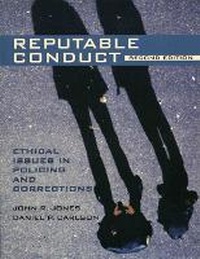
Reputable Conduct
Ethical Issues in Policing and Corrections
2nd Edition
Published on 3. February 2004
Book
Paperback/Softback
208 pages
978-0-13-112333-5 (ISBN)
Description
For courses in Criminology, Criminal Justice, Victimology, Special Topics in Policing and Ethics.
This student-friendly and easy-to-read text provides the most challenging and engaging introduction to the study of ethical issues in policing and corrections available in the U.S. today. It looks at the peculiar ethical demands of these professions, with particular emphasis on sub-cultural constraints, and how loyalty to colleagues can sometimes cause a sacrifice of individuality. Recent findings and events, real-life ethical dilemmas, and the application of moral theories to the field of justice give students a lively and relevant approach to sometimes difficult, sensitive, and even controversial material.
This student-friendly and easy-to-read text provides the most challenging and engaging introduction to the study of ethical issues in policing and corrections available in the U.S. today. It looks at the peculiar ethical demands of these professions, with particular emphasis on sub-cultural constraints, and how loyalty to colleagues can sometimes cause a sacrifice of individuality. Recent findings and events, real-life ethical dilemmas, and the application of moral theories to the field of justice give students a lively and relevant approach to sometimes difficult, sensitive, and even controversial material.
Reviews / Votes
"Reputable Conduct: Ethical Issues in Policing and Corrections has won praise from students, recruits, instructors and practitioners for its lively, relevant approach to the study of ethical dilemmas and professional problems faced by police officers and correctional workers. Now, in this revised edition, John R. Jones and Daniel P Carlson incorporate recent findings and events in the field. They have also incorporated several important and valuable suggestions made by the reviewers of the text. The result is a book that provides the most challenging and engaging introduction to the study of ethical issues in policing and corrections available in the United States today." - Special Agent Stanley B. Burke, Law Enforcement Ethics Unit, FBI Academy, Quantico, VAMore details
Other editions
Previous edition
Book
07/2000
Pearson
€37.13
Article exhausted; check for reprint
Persons
John Jones. Dr. John Jones has worked for more than 30 years in the human development field, as minister, hospital chaplain, youth leader, correctional officer, high school teacher, probation officer, and correctional institution administrator. During the last 21 years he has worked as an administrator and professor in the Law and Justice Centre at a Canadian college of applied arts and technology, where he has enjoyed teaching ethics to justice students.
John has also been active in training and consulting in the justice field. He has trained several thousand participants in Ethics in the Workplace, Team Development with an Ethical Twist, and Hostage Survival Skills. He is considered to be a caring, compassionate, humorous, and skilled facilitator, seminar leader and speaker. He has also been called in court as an expert witness on the subject of officer subculture.
John holds a joint honors bachelor of arts degree in psychology and philosophy from the University of Wales, Cardiff; a master of education degree from the University of Toronto (The Ontario Institute for Studies in Education); and a doctor of philosophy degree from the University of Toronto. John is the author of Ethics for Career and Personal Success, published by Pearson Education Canada (2001).
John has lived and worked in Great Britain, Jamaica, Australia, and Canada. He is married with three children.
Dan Carlson. During the course of a law enforcement career that began in 1967, Dan Carlson worked for several years as a police patrolman and then a deputy sheriff before joining the New York State Police. After 21 years of full-time law enforcement service, he retired from the state police at the rank of captain-assistant director of training and moved fully into the field of training and education. Dan managed a regional police academy in the state of Texas, formed a private management consulting and training organization, and in 1992 was selected to guide the formation and development of the Center for Law Enforcement Ethics, the first organization of its kind in the United States.
Dan has presented ethics training programs for criminal justice organizations across the United States and Canada and has been a regular guest speaker before law enforcement groups across North America. Widely published in the areas of ethics and management, Dan has authored more than two dozen articles for a range of professional journals. He graduated from the State University of New York and was the 1985 recipient of the George Searle Award for Excellence in Law Enforcement Training. Dan has served on the ethics committees of both the American Society of Law Enforcement Trainers and the International Association of Chiefs of Police. He is the author of When Cultures Clash: The Troubled Nature of Police-Community Relations and Suggestions for Improvement, published by Prentice Hall (2001).
Dan and his wife, Bonnie, reside in Texas, only a short drive from their three children and five grandchildren.
John has also been active in training and consulting in the justice field. He has trained several thousand participants in Ethics in the Workplace, Team Development with an Ethical Twist, and Hostage Survival Skills. He is considered to be a caring, compassionate, humorous, and skilled facilitator, seminar leader and speaker. He has also been called in court as an expert witness on the subject of officer subculture.
John holds a joint honors bachelor of arts degree in psychology and philosophy from the University of Wales, Cardiff; a master of education degree from the University of Toronto (The Ontario Institute for Studies in Education); and a doctor of philosophy degree from the University of Toronto. John is the author of Ethics for Career and Personal Success, published by Pearson Education Canada (2001).
John has lived and worked in Great Britain, Jamaica, Australia, and Canada. He is married with three children.
Dan Carlson. During the course of a law enforcement career that began in 1967, Dan Carlson worked for several years as a police patrolman and then a deputy sheriff before joining the New York State Police. After 21 years of full-time law enforcement service, he retired from the state police at the rank of captain-assistant director of training and moved fully into the field of training and education. Dan managed a regional police academy in the state of Texas, formed a private management consulting and training organization, and in 1992 was selected to guide the formation and development of the Center for Law Enforcement Ethics, the first organization of its kind in the United States.
Dan has presented ethics training programs for criminal justice organizations across the United States and Canada and has been a regular guest speaker before law enforcement groups across North America. Widely published in the areas of ethics and management, Dan has authored more than two dozen articles for a range of professional journals. He graduated from the State University of New York and was the 1985 recipient of the George Searle Award for Excellence in Law Enforcement Training. Dan has served on the ethics committees of both the American Society of Law Enforcement Trainers and the International Association of Chiefs of Police. He is the author of When Cultures Clash: The Troubled Nature of Police-Community Relations and Suggestions for Improvement, published by Prentice Hall (2001).
Dan and his wife, Bonnie, reside in Texas, only a short drive from their three children and five grandchildren.
Content
1. Introduction.
2. Ideas.
3. The Ethics of Teaching Ethics in Justice Programs.
4. The Role of the Ethics Educator: The Lurking Dangers of Indoctrination.
5. Subculture and the Individual Officer.
6. Subculture: What the Practitioners Think.
7. Tough Decisions.
8. Tools for Moral Decision Making.
9. Where Do You Stand?
10. Reputable Officers.
References.
Index.
2. Ideas.
3. The Ethics of Teaching Ethics in Justice Programs.
4. The Role of the Ethics Educator: The Lurking Dangers of Indoctrination.
5. Subculture and the Individual Officer.
6. Subculture: What the Practitioners Think.
7. Tough Decisions.
8. Tools for Moral Decision Making.
9. Where Do You Stand?
10. Reputable Officers.
References.
Index.