

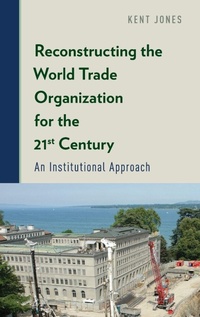
Reconstructing the World Trade Organization for the 21st Century
An Institutional Approach
Published on 19. March 2015
Book
Hardback
322 pages
978-0-19-936604-0 (ISBN)
Description
The institutional shortcomings of the World Trade Organization (WTO) became apparent during the Doha Round of Trade negotiations that began in 2001 and which aimed to improve the success of developing countries' trading by lowering trade barriers and adjusting other trade rules. This "development agenda " meant different things to rich and poor countries. In addition, many of the circumstances that supported success in General Agreement on Tariffs and Trade (GATT) negotiations of 1947 were no longer present after the WTO was founded in 1995.
In Reconstructing the World Trade Organization for the 21st Century, Kent Jones examines the difficulties of the WTO in completing multilateral trade negotiations and possible ways to restore its ability to do so. The problem lies in the institutional structure it inherited from the GATT, which was designed for a more limited scope of trade negotiations among a relatively small number of wealthier, industrialized countries. Jones presents an institutional model of the GATT/WTO system, which describes why such an organization exists and how it is supposed to accomplish its goals.
Institutional reforms will be necessary to restore the WTO's ability to complete global trade agreements, including a more flexible application of the consensus rule, a common understanding among all members about the limits of domestic policy space that is subject to negotiation, and clearer rules on reciprocity obligations. The popularity of bilateral and regional trade agreements, which have emerged as the alternative to WTO agreements, presents a threat to the WTO's relevance in trade negotiations, but also an opportunity to "multilateralize " new and deeper trade integration in future WTO agreements. Aid for trade may also play an instrumental role in bringing more developing countries into WTO disciplines. Above all, WTO members must develop new ways to find common ground in order to negotiate for mutual gains from trade.
In Reconstructing the World Trade Organization for the 21st Century, Kent Jones examines the difficulties of the WTO in completing multilateral trade negotiations and possible ways to restore its ability to do so. The problem lies in the institutional structure it inherited from the GATT, which was designed for a more limited scope of trade negotiations among a relatively small number of wealthier, industrialized countries. Jones presents an institutional model of the GATT/WTO system, which describes why such an organization exists and how it is supposed to accomplish its goals.
Institutional reforms will be necessary to restore the WTO's ability to complete global trade agreements, including a more flexible application of the consensus rule, a common understanding among all members about the limits of domestic policy space that is subject to negotiation, and clearer rules on reciprocity obligations. The popularity of bilateral and regional trade agreements, which have emerged as the alternative to WTO agreements, presents a threat to the WTO's relevance in trade negotiations, but also an opportunity to "multilateralize " new and deeper trade integration in future WTO agreements. Aid for trade may also play an instrumental role in bringing more developing countries into WTO disciplines. Above all, WTO members must develop new ways to find common ground in order to negotiate for mutual gains from trade.
Reviews / Votes
Kent Joness Reconstructing the World Trade Organization for the 21st Century examines the difficulties of the current trading system in completing multilateral trade negotiations and presents possible ways to restore its ability to do so. * Nicolas Albertoni (Universtiy of Southern California), The New Dynamics of the International Trading System * I highly recommend this book, both as an inspiration for potential changes to the existing institutional framework of the WTO as well as a basis for discussion for not only economists but also lawyers, political scientists and trade negotiators from the respective WTO members. * Henrik Andersen, International Trade Law & Regulation * As with his previous books on the WTO, Kent Jones has written a lucid introduction to the problems afflicting the world trading system and multilateral trade negotiations. This book will be valuable to anyone interested in the future of the WTO. * Douglas Irwin, Dartmouth College *More details
Language
English
Place of publication
New York
United States
Target group
College/higher education
Professional and scholarly
Dimensions
Height: 240 mm
Width: 161 mm
Thickness: 22 mm
Weight
649 gr
ISBN-13
978-0-19-936604-0 (9780199366040)
Copyright in bibliographic data and cover images is held by Nielsen Book Services Limited or by the publishers or by their respective licensors: all rights reserved.
Schweitzer Classification
Other editions
Additional editions
Kent Jones
Reconstructing the World Trade Organization for the 21st Century
An Institutional Approach
E-Book
01/2015
1st Edition
OUP eBook
€44.99
Available for download
Kent Jones
Reconstructing the World Trade Organization for the 21st Century
An Institutional Approach
E-Book
01/2015
1st Edition
OUP eBook
€44.99
Available for download
Person
Kent Jones is Professor of Economics at Babson College, where he has taught since 1982. He has also served as visiting professor at Brandeis University, Tufts University (Fletcher School), and the University of Innsbruck. He has held positions at the US International Trade Commission and the US Department of State. Dr. Jones is the author of several books and articles on international trade policy, including The Doha Blues: Institutional Crisis and Reform in the WTO (Oxford University Press, 2010). His research focuses on globalization, trade policy and international institutions.
Content
Introduction: Why Isn't There More Trade? ; Chapter 1: The Doha Round: What Went Wrong and What's at Stake? ; Chapter 2: Institutional Foundations of the GATT/WTO System ; Chapter 3: The GATT-WTO Transition and Institutional Crisis in the Doha Round ; Chapter 4: Impediments to Doha Round Consensus and the Search for WTO Solutions ; Chapter 5: WTO Governance and Committee Chair Representation ; Chapter 6: Regional vs. Multilateral Trade Liberalization ; Chapter 7: Trade, Embedded Liberalism, and Development ; Chapter 8: Pathways Back to Geneva