

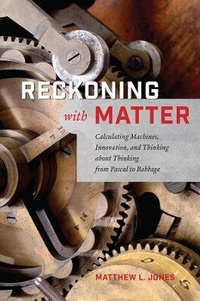
Reckoning with Matter
Calculating Machines, Innovation, and Thinking about Thinking from Pascal to Babbage
Will be published approx. on 29. November 2016
Book
Hardback
336 pages
978-0-226-41146-0 (ISBN)
Description
From Blaise Pascal in the 1600s to Charles Babbage in the first half of the nineteenth century, inventors struggled to create the first calculating machines. All failed but that doesn't mean we can't learn from the trail of ideas, correspondence, machines, and arguments they left behind. In Reckoning with Matter, Matthew Jones draws on the remarkably extensive and well-preserved records of the quest to explore the concrete processes involved in imagining, elaborating, testing, and building calculating machines. He explores the writings of philosophers, engineers, and craftspeople, showing how they thought about technical novelty, their distinctive areas of expertise, and ways they could coordinate their efforts, to argue that the conceptions of creativity and making they exhibited are often more incisive and more honest than those that dominate our current legal, political, and aesthetic culture.
More details
Language
English
Place of publication
Chicago
United States
Publishing group
The University of Chicago Press
Target group
College/higher education
Professional and scholarly
Dimensions
Height: 23 mm
Width: 16 mm
Thickness: 3 mm
Weight
595 gr
ISBN-13
978-0-226-41146-0 (9780226411460)
Copyright in bibliographic data and cover images is held by Nielsen Book Services Limited or by the publishers or by their respective licensors: all rights reserved.
Schweitzer Classification
Other editions
Additional editions
Matthew L. Jones
Reckoning with Matter
Calculating Machines, Innovation, and Thinking about Thinking from Pascal to Babbage
E-Book
05/2024
1st Edition
University of Chicago Press
from
€54.29
Available for download
Person
Matthew L. Jones is the James R. Barker Professor of Contemporary Civilization in the Department of History at Columbia University and the author of The Good Life in the Scientific Revolution,