

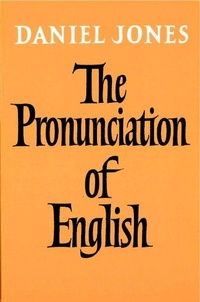
The Pronunciation of English
4th Edition
Published on 31. December 1956
Book
Paperback/Softback
248 pages
978-0-521-09369-9 (ISBN)
Description
This revised edition incorporates the final results of Daniel Jones' lifelong study of English pronunciation usage. It is the standard work on English phonetics. The Pronunciation of English was written originally as a detailed description of the phonetics of English, presented from the point of view of the native English-speaking student. Since the book provided key information needed by foreign students, it soon established itself as a standard textbook in universities where English was spoken as a foreign language. Most of the book is devoted to a descriptive account of English pronunciation. This is followed by illustrative texts in phonetic transcription of Received Pronunciation and several regional varieties, Scottish and American pronunciation and reconstructions of Shakespearian and Chaucerian speech.
More details
Series
Edition
4th Revised edition
Language
English
Place of publication
Cambridge
United Kingdom
Target group
ELT/ESL
Edition type
Revised edition
Product notice
Paperback (trade)
Dimensions
Height: 203 mm
Width: 127 mm
Thickness: 15 mm
Weight
303 gr
ISBN-13
978-0-521-09369-9 (9780521093699)
Copyright in bibliographic data and cover images is held by Nielsen Book Services Limited or by the publishers or by their respective licensors: all rights reserved.
Schweitzer Classification
Other editions
Additional editions

Daniel Jones
The Pronunciation of English
Book
01/1956
4th Edition
Cambridge University Press
€37.14
Article exhausted; check for reprint
Previous edition
Daniel Jones
The Pronunciation of English
Book
01/1956
4th Edition
Cambridge University Press
€37.14
Article exhausted; check for reprint
Person
Dan Jones, an experienced educator and Master Flip Educator, dedicates himself to reimagining teaching methodologies. With 18 years of classroom experience, Dan's passion for Flipped Learning has led him to play an essential role as a founding member of the International Faculty for Training Educators, helping to elevate global education standards. His contributions to the Flipped Learning community also include his position as the K-12 editor for FLR Magazine and as President of the K-12 Advisory Board for the Coalition of Flipped Learning 3.0 Universities.Acknowledged as the first Certified Flipped Learning Masterclass Facilitator, Dan shares his deep expertise, guiding others in their journeys through the educational landscape. He is also a founding member of the Academy of Active Learning Arts and Sciences (AALAS), working towards enriching active learning experiences worldwide.Beyond the classroom, Dan engages with the broader teaching community as the host of the "What Works" podcast on the Bam Radio Network. Here, he shares practical insights and experiences to support fellow educators when we stop teaching from the front of the room.His vast experience in various educational settings, from private to public to inner-city charter education, has enabled Dan to simplify complex concepts into understandable strategies. His commitment to providing enriching educational experiences led his students to be the first in the U.S. to engage in distance learning sessions with esteemed institutions.Dan Jones is driven by a simple yet powerful aim: to enhance the learning experience for all students and to provide fellow educators with the support and resources they need. His work serves as an illustration of the impact of continuous learning, collaboration, and innovative thinking in shaping the future of education.
Content
Foreword; Preface; List of illustrations; List of phonetic symbols; Cursive forms of phonetic symbols and specimens of phonetic writing; Part I. Phonetic Theory: 1. Types of pronunciation; 2. Organs of speech; 3. Sounds and letters; 4. Classification of sounds; 5. Principles of transcription; 6. English speech sounds in detail; 7. Theory of plosive consonants; 8. Nasalization; 9. Similitude, assimilation, elision; 10. Syllables; 11. Duration; 12. Stress; 13. Breath-groups, sense-groups; 14. Intonation; 15. Practical exercises; 16. Ear training; 17. Phonemes; 18. Syllable separation; Part II. Phonetic Texts: Notes on the texts; Appendixes; Other works by Daniel Jones.