

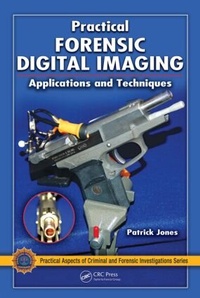
Practical Forensic Digital Imaging
Applications and Techniques
1st Edition
Published on 10. February 2011
Book
Hardback
402 pages
978-1-4200-6012-6 (ISBN)
Description
Well-documented scenes can prove to be invaluable pieces of evidence at trial, and the ability to take compelling photographs is a critical skill for forensic scientists and investigators. Practical Forensic Digital Imaging: Applications and Techniques is an up-to-date and thorough treatment of digital imaging in the forensic sciences. Balancing practical considerations with scientific and standards-based requirements, the book's clear, concise presentation illustrates the essentials of digital imaging required by professionals in the field.
Enhanced with crisp color photos, the book covers a host of critical topics, including:
The fundamentals of photographing crime scenes
The history of photography and the transition to digital imaging
Digital camera hardware and photographic techniques
Light, filters, and macro/micro imaging
Lay, professional, and expert witnesses, and the implications of Frye and Daubert
Enhancement of images and digital panoramic camera scanning
Storage of digital media
Ultraviolet and infrared imaging
Digital photo imaging microscopes
Covering the full range of scenarios that forensic professionals encounter, the author includes special sections dedicated to photography involving footwear and tire impressions, vehicles, death and morgue scenes, and taphonomic and entomological imaging, as well as fingerprints, burglaries, fire and arson, sex offenses, blood, and trace evidence and microscopy. The techniques in this volume enable photographers to capture the images that will not only tell the story, but will also stand up in court.
Watch Patrick Jones in his laboratory on the CRC Press YouTube channel.
Enhanced with crisp color photos, the book covers a host of critical topics, including:
The fundamentals of photographing crime scenes
The history of photography and the transition to digital imaging
Digital camera hardware and photographic techniques
Light, filters, and macro/micro imaging
Lay, professional, and expert witnesses, and the implications of Frye and Daubert
Enhancement of images and digital panoramic camera scanning
Storage of digital media
Ultraviolet and infrared imaging
Digital photo imaging microscopes
Covering the full range of scenarios that forensic professionals encounter, the author includes special sections dedicated to photography involving footwear and tire impressions, vehicles, death and morgue scenes, and taphonomic and entomological imaging, as well as fingerprints, burglaries, fire and arson, sex offenses, blood, and trace evidence and microscopy. The techniques in this volume enable photographers to capture the images that will not only tell the story, but will also stand up in court.
Watch Patrick Jones in his laboratory on the CRC Press YouTube channel.
Reviews / Votes
I can honestly say that this is not just another forensic sciences book! Patrick's diverse background, his experiences in the field and the classroom have been translated into a work that not only gets the essential information into the hands of the reader, it does so in a way that readers will find refreshing and intuitive. The book and its sections balance practical considerations with scientific and standards based requirements. The coverage of the topics in each section are clear and concise, and the breadth of coverage of the book is inclusive of what one needs to know about the fundamentals of digital imaging, as it relates to forensics.-Dr. Marcus K. Rogers, Professor/University Faculty Scholar, Fellow of CERIAS, Director - Cyber Forensics Program, Purdue University, from the Foreword
" ... a ''How To'' text, simplistic in nature yet thorough in covering highly technical material. ... Check it out. You will not regret it."
-Journal of Forensic Sciences
More details
Series
Language
English
Place of publication
Bosa Roca
United States
Publishing group
Taylor & Francis Inc
Target group
Professional and scholarly
Forensic scientists, technicians, and crime scene investigators.
Illustrations
541 farbige Abbildungen, 9 s/w Tabellen
9 Tables, black and white; 541 Illustrations, color
Dimensions
Height: 254 mm
Width: 178 mm
Weight
1022 gr
ISBN-13
978-1-4200-6012-6 (9781420060126)
Copyright in bibliographic data and cover images is held by Nielsen Book Services Limited or by the publishers or by their respective licensors: all rights reserved.
Schweitzer Classification
Other editions
Additional editions
E-Book
02/2011
1st Edition
CRC Press
€185.99
Available for download
E-Book
02/2011
1st Edition
CRC Press
€185.99
Available for download
Person
Patrick Jones is the Forensic Science Laboratory director at Purdue University. In addition to managing two laboratories, he teaches Crime Scene Investigation, Introduction to Forensic Science, Criminalistics Lab, and Advanced Criminalistics Lab. Mr. Jones has more than 34 years of experience in law enforcement, forensics investigation, security, and training. As a Crime Scene Investigator (CSI), he has worked on the John Wayne Gacy case, the Larry Eyler case (both serial killers) and the Ed Ling case among many others. He lectures and presents these cases for students and interested groups. Patrick Jones is also currently a White County Indiana Deputy Coroner and is an Indiana State Certified Medicolegal Death Investigator.
Content
Documentation. The Transition from 35-mm Film to Digital Imaging. Digital Camera Hardware. Digital Imaging. Light. Filters. Macro/Micro Imaging. Law. Enhancement of Images. Footwear and Tire Impressions. Digital Panoramic Camera Scanning. Death Investigation. Morgue Photo Imaging. Taphonomic and Entomological Imaging. Auto Process. Fingerprints. Burglary. Storage of Digital Media. Fire and Arson Scene. Sex Offenses. Trace Evidence and Microscopy. Blood. Ultraviolet and Infrared Imaging. Digital Photo Imaging Microscope. SWGIT. Bibliography. Appendix A: Glossary. Appendix B: Photo I.D. Card. Index.