

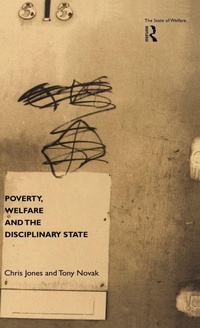
Poverty, Welfare and the Disciplinary State
1st Edition
Published on 26. August 1999
Book
Hardback
232 pages
978-0-415-18289-8 (ISBN)
Description
In a forward looking appraisal of the welfare state, Poverty, Welfare and the Disciplinary State examines such issues as: *the current dynamics of poverty in Britain, drawing on similar developments in Europe and the US *the major areas of social policy within which this abandonment and demonisation of the poor is taking place *the historical antecendents to this relationship between the state and the poor *the creation and expansion of a 'welfare' state that characterised the era of social democracy until the mid-1970s and from the point of view of the poor, was limited and conditional *the ideology and organisation of the New Right *the new terrain on which the struggle over the future of welfare and social policy must take place.
More details
Language
English
Place of publication
London
United Kingdom
Publishing group
Taylor & Francis Ltd
Target group
College/higher education
Professional and scholarly
Postgraduate, Professional, and Undergraduate
Dimensions
Height: 222 mm
Width: 145 mm
Thickness: 17 mm
Weight
464 gr
ISBN-13
978-0-415-18289-8 (9780415182898)
Copyright in bibliographic data and cover images is held by Nielsen Book Services Limited or by the publishers or by their respective licensors: all rights reserved.
Schweitzer Classification
Other editions
Additional editions
Chris Jones | Tony Novak
Poverty, Welfare and the Disciplinary State
E-Book
10/2012
Routledge
€68.49
Available for download
Chris Jones | Tony Novak
Poverty, Welfare and the Disciplinary State
E-Book
10/2012
Routledge
€68.49
Available for download
Chris Jones | Tony Novak
Poverty, Welfare and the Disciplinary State
Book
08/1999
1st Edition
Routledge
€74.00
Shipment within 15-20 days
Persons
Chris Jones is Professor of Social Policy and Social Work at Liverpool University;, Tony Novak is Lecturer in Social Policy also at Liverpool University.
Content
Chapter 1 Redefining the Poor; Chapter 2 Impoverishing the Poor; Chapter 3 The Abuse of the Poor; Chapter 4 The Vile Maxim of the Masters; Chapter 5 Re-Tooling the State; Chapter 6 Abandoning the Poor;