

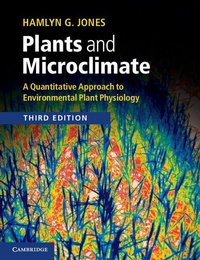
Plants and Microclimate
A Quantitative Approach to Environmental Plant Physiology
3rd Edition
Published on 12. December 2013
Book
Paperback/Softback
423 pages
978-0-521-27959-8 (ISBN)
Description
This rigorous yet accessible text introduces the key physical and biochemical processes involved in plant interactions with the aerial environment. It is designed to make the more numerical aspects of the subject accessible to plant and environmental science students, and will also provide a valuable reference source to practitioners and researchers in the field. The third edition of this widely recognised text has been completely revised and updated to take account of key developments in the field. Approximately half of the references are new to this edition and relevant online resources are also incorporated for the first time. The recent proliferation of molecular and genetic research on plants is related to whole plant responses, showing how these new approaches can advance our understanding of the biophysical interactions between plants and the atmosphere. Remote sensing technologies and their applications in the study of plant function are also covered in greater detail.
Reviews / Votes
'For those working with plants in an environmental context, this book is a must. It became the standard reference in bioclimatology, plant ecophysiology and plant ecology. Hamlyn Jones translates complex physical principles into a language biologists greatly appreciate. It's wonderful to see a third edition, underlining the lasting impact this book has.' Christian Koerner, University of Basel 'I have strongly recommended the previous editions to all my students in plant physiology or applied crop management and will continue to do so with this excellent new edition. Hamlyn Jones provides an excellent combination of experimental experience with the mathematical and physical bases of plant physiology and environmental physics. This true systems approach to understanding plant responses to the environment is precisely what is needed as we address complex issues such as climate change. This is a book that should be read by any scientist attempting to understand and affect plant responses to the environment at the whole plant and crop level, but especially at the molecular level. The combination of clear conceptual explanations, and many well-chosen figures and tables, along with their mathematical basis is particularly helpful to those with different learning styles and goals.' Alan N. Lakso, Cornell University 'This book's continued emphasis on using primary quantitative data to illustrate plant behaviour and function maintains its authoritative position as the core text for environmental plant physiology. This third edition sees the scope of the book expanding upwards and outwards with a new section on remote sensing, and inwards to cover the emerging 'omics', whilst always retaining its focus on the whole plant. I have lost four copies of the second edition to light-fingered students over the years - convincing evidence of its irresistible value. I firmly expect this third edition to be equally desirable!' Mark Rayment, Bangor UniversityMore details
Edition
3rd Revised edition
Language
English
Place of publication
Cambridge
United Kingdom
Target group
Professional and scholarly
College/higher education
Edition type
Revised edition
Product notice
Paperback (trade)
Illustrations
24 Halftones, unspecified; 146 Line drawings, unspecified
Dimensions
Height: 246 mm
Width: 189 mm
Thickness: 23 mm
Weight
819 gr
ISBN-13
978-0-521-27959-8 (9780521279598)
Copyright in bibliographic data and cover images is held by Nielsen Book Services Limited or by the publishers or by their respective licensors: all rights reserved.
Schweitzer Classification
Other editions
Additional editions
E-Book
12/2013
Cambridge University Press
€42.99
Available for download
E-Book
11/2013
3rd Edition
Cambridge University Press
€49.99
Available for download
Previous edition
Book
06/1992
2nd Edition
Cambridge University Press
€68.09
Article exhausted; check for reprint
Person
Hamlyn G. Jones is Emeritus Professor of Plant Ecology at the University of Dundee. His research uses experimental approaches and mathematical modelling to investigate the characteristics that enable plants to be adapted to specific environments and to tolerate environmental stress.
Content
Preface; Acknowledgements; Detailed glossary of symbols and abbreviations; 1. A quantitative approach to plant-environment interactions; 2. Radiation; 3. Heat, mass and momentum transfer; 4. Plant water relations; 5. Energy balance and evaporation; 6. Stomata; 7. Photosynthesis and respiration; 8. Light and plant development; 9. Temperature; 10. Drought and other abiotic stresses; 11. Other environmental factors: wind, altitude, climate change and pollutants; 12. Physiology and crop yield improvement; Appendices; References; Index.