

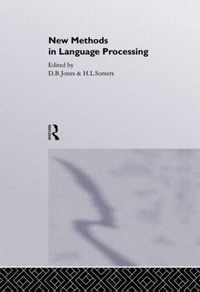
New Methods In Language Processing
Published on 28. May 1997
Book
Hardback
384 pages
978-1-85728-711-0 (ISBN)
Description
Studies in Computational Linguistics presents authoritative texts from an international team of leading computational linguists. The books range from the senior undergraduate textbook to the research level monograph and provide a showcase for a broad range of recent developments in the field. The series should be interesting reading for researchers and students alike involved at this interface of linguistics and computing.
More details
Series
Language
English
Place of publication
London
United Kingdom
Publishing group
Taylor & Francis Ltd
Target group
College/higher education
Professional and scholarly
Dimensions
Height: 234 mm
Width: 156 mm
Weight
771 gr
ISBN-13
978-1-85728-711-0 (9781857287110)
Copyright in bibliographic data and cover images is held by Nielsen Book Services Limited or by the publishers or by their respective licensors: all rights reserved.
Schweitzer Classification
Other editions
Additional editions
D. B. Jones | H. Somers
New Methods In Language Processing
E-Book
11/2013
1st Edition
Routledge
€60.49
Available for download
D. B. Jones | H. Somers
New Methods In Language Processing
E-Book
11/2013
1st Edition
Routledge
€60.49
Available for download
Persons
D. B. Jones, H. Somers
Content
Part I Analogy-based methods Skousen's analogical modelling algorithm: a comparison with lazy learning; Analogy, computation and linguistic theory; Constraints and preferences at work: an analogy-based approach to parsing grammatical relations. Part II Connectionist methods Towards a hybrid abstract generation system; Recurrent neural networks and natural language processing; Learning the semantics of aspect; Experiments in robust parsing with a guided propogation network; Learning semantic relationships and syntactic roles in a simple recurrent network. Part III Corpus-based methods A system for automating concordance line selection; A machine learning approach to anaphoric reference; Some methods for the extraction of bilingual terminology; Probabilistic part-of-speech tagging using decision trees; A new direction for sublanguage NLP; Efficient disambiguation by means of stochastic tree substitution grammars. Part IV Example-based machine translation Towards automatically aligning German compounds with English word groups; Corpus-based acquistion of transfer functions using psycholinguistic principles; A natural language translation neural network; Direct parse-tree translation in co-operation with the transfer method. Part V Statistical approaches Evaluating the information gain of probability based PP-disambiguation methods; Automatic error detection in part-of-speech tagging; A method of parsing English based on sentence form; A new approach to center tracking; Structuring raw discourse. Part VI Hybrid approaches Coarse-grained parallelism in natural language understanding: parsing as message passing; Parameterized message-passing for non-head-driven parsing; A stochastic government-binding parser; Evolutionary algorithms for dialogue optimization as an example of a hybrid nlp system; More for less: learning a wide covering grammar from a small training set. Part contents.