

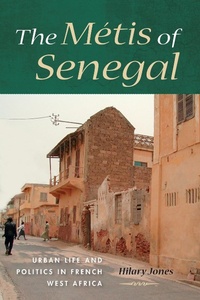
The Metis of Senegal
Urban Life and Politics in French West Africa
Published on 18. March 2013
Book
Paperback/Softback
296 pages
978-0-253-00674-5 (ISBN)
Description
The Metis of Senegal is a history of politics and society among an influential group of mixed-race people who settled in coastal Africa under French colonialism. Hilary Jones describes how the metis carved out a niche as middleman traders for European merchants. As the colonial presence spread, the metis entered into politics and began to assert their position as local elites and power brokers against French rule. Many of the descendants of these traders continue to wield influence in contemporary Senegal. Jones's nuanced portrait of metis ascendency examines the influence of family connections, marriage negotiations, and inheritance laws from both male and female perspectives.
Reviews / Votes
[This] book brings welcome new emphasis to family and gender dynamics, as viewed, for example, through the material life of metis households. [The author's] use of marriage contracts and genealogies, as well as documents she located in Bordeaux, has helped her to advance existing scholarship.85.1 Feb. 2015(Africa) Jones's book is the result of extensive research in state, parish, and private archives and newspapers in Dakar and St Louis, Bordeaux, and Paris. . . The book expands the recent historiography on the meanings of the term 'metis' beyond the perspectives of French colonial society. Furthermore, Jones makes the important contribution of arguing for the ways in which women and household politics continued to influence the public sphere even as the French bolstered African men and state institutions as the locus of political power and wealth.55.3 Nov.2014
(Journal of African History) [T]his well-documented and well-written book represents a compelling case study for understanding the nature of the colonial encounter between Africans and Europeans in French West Africa.
(International Journal of African Historical Studies) The metis (mixed-ancestry community of Saint-Louis has played an important role in Senegal's history. The most prominent descended from signares, successful female entrepreneurs and high-status 'companions' of European men. Historian Jones . . . rescues the metis from lingering voluptuary associations, exploring their 18th-century origins and how they created a distinct communty identity. . . . Recommended.
(Choice) Overall, Jones's book represents an important contribution to studies of the French colonial presence in Africa, exploring that presence through a new and productive perspective that offers nuanced and often surprising insights.
(Bulletin of Francophone Postcolonial Studies) [T]his is an immensely successful first book, and we can only hope that Jones will delve deeper into some of these topics in her future work.
(American Historical Review)
More details
Language
English
Place of publication
Bloomington, IN
United States
Target group
Professional and scholarly
Product notice
Paperback (trade)
Illustrations
9 b&w illus., 5 maps
Dimensions
Height: 229 mm
Width: 152 mm
Thickness: 15 mm
Weight
427 gr
ISBN-13
978-0-253-00674-5 (9780253006745)
Copyright in bibliographic data and cover images is held by Nielsen Book Services Limited or by the publishers or by their respective licensors: all rights reserved.
Schweitzer Classification
Other editions
Additional editions
E-Book
03/2013
Indiana University Press
€9.49
Available for download
Person
Hilary Jones is Assistant Professor of History at the University of Maryland, College Park.
Content
Introduction: Urban Life, Politics, and French Colonialism
1. Signares, Habitants, and Grumets in the Making of Saint Louis
2. Metis Society and Transformations in the Colonial Economy (1820-1870)
3. Religion, Marriage, and Material Culture
4. Education, Association, and an Independent Press
5. From Outpost to Empire
6. Electoral Politics and the Metis (1870-1890)
7. Urban Politics and the Limits of Republicanism (1890-1920)
Conclusion
Appendix: Family Histories
Notes
Bibliography
Index
1. Signares, Habitants, and Grumets in the Making of Saint Louis
2. Metis Society and Transformations in the Colonial Economy (1820-1870)
3. Religion, Marriage, and Material Culture
4. Education, Association, and an Independent Press
5. From Outpost to Empire
6. Electoral Politics and the Metis (1870-1890)
7. Urban Politics and the Limits of Republicanism (1890-1920)
Conclusion
Appendix: Family Histories
Notes
Bibliography
Index