

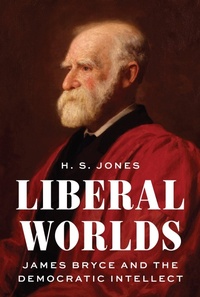
Liberal Worlds
James Bryce and the Democratic Intellect
Published on 18. November 2025
Book
Hardback
464 pages
978-0-691-18011-3 (ISBN)
Description
The intellectual biography of a Victorian Liberal polymath
James Bryce (1838-1922) was a leading figure in Britain's Liberal Party and a distinguished historian, a versatile scholar-politician who moved seamlessly between academia and politics. He was, among many other things, a cabinet minister and a popular ambassador, an expert on American politics and on Roman law, an advocate for the Armenian people and an architect of the League of Nations, a world traveller and a climber of Mount Ararat. In Liberal Worlds, Stuart Jones offers an intellectual biography of Bryce, tracing a Scots-Ulster Presbyterian's assimilation to the increasingly multiconfessional Victorian state, and a late Victorian Liberal's encounter with the wider world. Jones shows how a polymathic intelligence grappled with a dizzyingly wide range of concerns and issues, including the challenges of democracy and race relations, the rise of modern universities and the reconstruction of the international order after World War I.
In mapping the evolution of Bryce's thought, Liberal Worlds illuminates the international intellectual networks and the many places across the globe that shaped his thinking. Jones considers, for example, why a man who had a lifelong revulsion against slavery seemed to accept racial segregation in the American South; how a vigorous activist for girls' and women's education became a tenacious parliamentary critic of women's suffrage; and why, over the objections of his Ulster Presbyterian family, he backed Irish home rule. Above all, Jones rescues Bryce-immensely influential in his time, now little remembered-from being consigned to a historical pigeonhole, restoring him to the centre of late nineteenth- and early twentieth-century debates over the nature of democratic politics.
James Bryce (1838-1922) was a leading figure in Britain's Liberal Party and a distinguished historian, a versatile scholar-politician who moved seamlessly between academia and politics. He was, among many other things, a cabinet minister and a popular ambassador, an expert on American politics and on Roman law, an advocate for the Armenian people and an architect of the League of Nations, a world traveller and a climber of Mount Ararat. In Liberal Worlds, Stuart Jones offers an intellectual biography of Bryce, tracing a Scots-Ulster Presbyterian's assimilation to the increasingly multiconfessional Victorian state, and a late Victorian Liberal's encounter with the wider world. Jones shows how a polymathic intelligence grappled with a dizzyingly wide range of concerns and issues, including the challenges of democracy and race relations, the rise of modern universities and the reconstruction of the international order after World War I.
In mapping the evolution of Bryce's thought, Liberal Worlds illuminates the international intellectual networks and the many places across the globe that shaped his thinking. Jones considers, for example, why a man who had a lifelong revulsion against slavery seemed to accept racial segregation in the American South; how a vigorous activist for girls' and women's education became a tenacious parliamentary critic of women's suffrage; and why, over the objections of his Ulster Presbyterian family, he backed Irish home rule. Above all, Jones rescues Bryce-immensely influential in his time, now little remembered-from being consigned to a historical pigeonhole, restoring him to the centre of late nineteenth- and early twentieth-century debates over the nature of democratic politics.
Reviews / Votes
"An excellent book. . . . Recommended, and also very well written."---Tyler Cowen, Marginal Revolution "Bryce was one kind of polymath, and it is characteristic of such figures that they can be a bit intimidating, even tiring. . . .He had done so much, over such a long span of time, both in his writings and in his public life. That makes him a challenge for a modern historian, usually schooled in a particular specialism, but Stuart Jones has met that challenge, dealing authoritatively with all the elements that make up Bryce's story. This is an outstanding work of intellectual history, one that can be read with pleasure and profit even by those who may think beforehand that they have little interest in James Bryce."---Stefan Collini, Dublin Review of Books "In truth, no one has pushed [James Bryce's] partisan readings very far, because Bryce was too fastidious a writer to scatter wild generalisations through his writing. On the contrary, he was committed to exploding them, to an extent which has frustrated biographers looking for simple explanations of his beliefs. Stuart Jones has now tackled the problem with an intellectual biography based on a thorough reading of Bryce's large output, which succeeds admirably because Jones is such a fastidious historian himself. Primarily a contextual study of Bryce's political thought, it is scrupulously fair without turning a blind eye to those opinions which grate on modern sensibilities, particularly as relating to race. Indeed, Bryce turns out to be much more interesting when his imperfections are taken into proper account."---Jonathan Parry, London Review of BooksMore details
Language
English
Place of publication
New Jersey
United States
Target group
College/higher education
Professional and scholarly
Product notice
Trade binding
Illustrations
15 b/w illus.
Dimensions
Height: 243 mm
Width: 168 mm
Thickness: 36 mm
Weight
804 gr
ISBN-13
978-0-691-18011-3 (9780691180113)
Copyright in bibliographic data and cover images is held by Nielsen Book Services Limited or by the publishers or by their respective licensors: all rights reserved.
Schweitzer Classification
Other editions
Additional editions
E-Book
11/2025
1st Edition
Princeton University Press
€43.99
Available for download
Person
Stuart Jones is professor of intellectual history at the University of Manchester. He is the author of The French State in Question: Public Law and Political Argument in the Third Republic, Victorian Political Thought, and Intellect and Character in Victorian England: Mark Pattison and the Invention of the Don.