

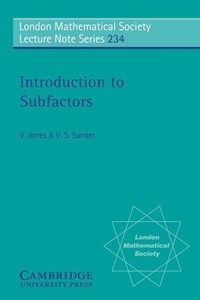
Introduction to Subfactors
Published on 15. May 1997
Book
Paperback/Softback
176 pages
978-0-521-58420-3 (ISBN)
Description
Subfactors have been a subject of considerable research activity for about fifteen years and are known to have significant relations with other fields such as low dimensional topology and algebraic quantum field theory. These notes give an introduction to the subject suitable for a student who has only a little familiarity with the theory of Hilbert space. A new pictorial approach to subfactors is presented in a late chapter.
Reviews / Votes
'The presentation is a pleasure to read, and the careful selection of topics leads the reader on a very direct route to some of the most fascinating problems and results in the theory of von Neumann algebras ... an excellent introduction at graduate level to current research in this field.' Monatshefte fuer Mathematik 'This book is a model of clear exposition and keen pricing. Those working in operator algebras will find it self-recommending, and research students and others outside the area wishing to learn the subject need look no further. It is a most valuable addition to the literature.' Bull. London Math. Soc. 'The book is compact and well written ...' European Mathematical SocietyMore details
Series
Language
English
Place of publication
Cambridge
United Kingdom
Target group
Professional and scholarly
Product notice
Paperback (trade)
Illustrations
44 Line drawings, unspecified
Dimensions
Height: 229 mm
Width: 152 mm
Thickness: 10 mm
Weight
265 gr
ISBN-13
978-0-521-58420-3 (9780521584203)
Copyright in bibliographic data and cover images is held by Nielsen Book Services Limited or by the publishers or by their respective licensors: all rights reserved.
Schweitzer Classification
Other editions
Additional editions
V. Jones | V. S. Sunder
Introduction to Subfactors
E-Book
03/2011
1st Edition
Cambridge University Press
€66.49
Available for download
Persons
Content
1. Factors; 2. Subfactors and index; 3. Some basic facts; 4. The principal and dual graphs; 5. Commuting squares; 6. Vertex and spin models.