

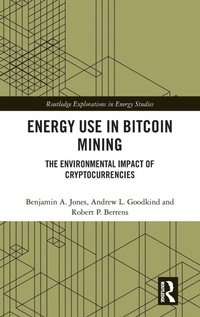
Energy Use in Bitcoin Mining
The Environmental Impact of Cryptocurrencies
1st Edition
Published on 15. April 2025
Book
Hardback
158 pages
978-1-032-56919-2 (ISBN)
Description
This book provides a unique introduction to Bitcoin mining's energy use and environmental impacts. Bitcoin, the largest and most well-known cryptocurrency, has ignited the world of decentralized finance and digital currencies. However, Bitcoin has a major problem: it uses massive amounts of energy to produce or 'mine' the coins, and this energy use has tremendous environmental consequences. By recent estimates, Bitcoin mining's global electricity use is larger than entire countries such as the Netherlands and Argentina. In this book, the authors explain the process by which Bitcoin is mined, why it requires significant energy, and what we know about where that energy comes from. It also explores the environmental impacts and associated monetary damages of this energy use. Further, the book presents the current state of scientific knowledge around these questions and provides original economic damage estimates from the authors and compares them to those of other goods and services. The book discusses links between Bitcoin and climate change, public health, air pollution, 'e-waste', water, and land use. It concludes by discussing alternative ways in which Bitcoin mining can be made green by using less energy, as well as the policy and regulatory challenges that may hinder progress toward this goal. Innovative and insightful, this book will be of great interest to students, scholars, and industry professionals who are researching and working in the areas of cryptocurrencies, economics, business and finance, engineering, energy, and environmental studies more broadly.
More details
Series
Language
English
Place of publication
London
United Kingdom
Publishing group
Taylor & Francis Ltd
Target group
College/higher education
Postgraduate and Undergraduate Advanced
Illustrations
10 s/w Abbildungen, 10 s/w Zeichnungen, 2 s/w Tabellen
2 Tables, black and white; 10 Line drawings, black and white; 10 Illustrations, black and white
Dimensions
Height: 240 mm
Width: 161 mm
Thickness: 14 mm
Weight
426 gr
ISBN-13
978-1-032-56919-2 (9781032569192)
Copyright in bibliographic data and cover images is held by Nielsen Book Services Limited or by the publishers or by their respective licensors: all rights reserved.
Schweitzer Classification
Other editions
Additional editions
Benjamin A. Jones | Andrew L. Goodkind | Robert P. Berrens
Energy Use in Bitcoin Mining
The Environmental Impact of Cryptocurrencies
Book
approx. 07/2026
1st Edition
Routledge
€57.50
Not yet published
Benjamin A. Jones | Andrew L. Goodkind | Robert P. Berrens
Energy Use in Bitcoin Mining
The Environmental Impact of Cryptocurrencies
E-Book
04/2025
Routledge
€60.49
Available for download
Benjamin A. Jones | Andrew L. Goodkind | Robert P. Berrens
Energy Use in Bitcoin Mining
The Environmental Impact of Cryptocurrencies
E-Book
04/2025
Routledge
€60.49
Available for download
Persons
Benjamin A. Jones is Associate Professor of Economics at the University of New Mexico in Albuquerque, NM, USA. He is an environmental economist who researches the economic impacts of pollution and pollution exposure, especially as it relates to human health and well-being.
Andrew L. Goodkind is Associate Professor of Economics at the University of New Mexico in Albuquerque, NM, USA. He is an environmental economist specializing in modeling air pollution and its human health effects.
Robert P. Berrens is Regents Professor of Economics at the University of New Mexico in Albuquerque, NM, USA. He is an environmental economist with interests in environmental policy, climate change adaptation, non-market valuation, water resources management, and institutional issues.
Andrew L. Goodkind is Associate Professor of Economics at the University of New Mexico in Albuquerque, NM, USA. He is an environmental economist specializing in modeling air pollution and its human health effects.
Robert P. Berrens is Regents Professor of Economics at the University of New Mexico in Albuquerque, NM, USA. He is an environmental economist with interests in environmental policy, climate change adaptation, non-market valuation, water resources management, and institutional issues.
Content
1. What is Bitcoin and How is it Mined? 2. A Feature and Not a Bug: Bitcoin Mining's Energy Use Problem 3. Bitcoin's Climate Emissions and Damages 4. Bitcoin's PM2.5 Air Pollution Damages 5. How Does Bitcoin's Climate Footprint Compare to Other Things? 6. Bitcoin Mining's Additional Environmental Impacts 7. Can Bitcoin Be Made Green? 8. Bitcoin Mining Regulation and its Discontents