

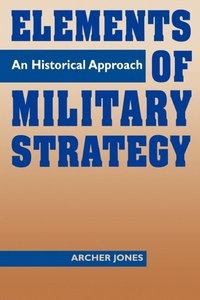
Elements of Military Strategy
An Historical Approach
Published on 30. September 1996
Book
Paperback/Softback
288 pages
978-0-275-95527-4 (ISBN)
Description
This book uses history in two ways: as the source of ideas about strategy and as examples to illustrate the elements by showing their application to specific campaigns and their utility in understanding the role of strategy in military operations. The focus is on American military campaigns from the American Indian Wars to the War in the Gulf. Those case studies are used to illustrate the strategy behind land, sea, and air campaigns. Over a fifth of the book examines the U.S. war against Japan because it furnishes such fine examples of independent and interdependent operations on land, on the sea, and in the air. The cases studied are not only intended to illustrate strategic ideas but also to show the utility of the author's distinctive approach to organizing military strategy. The book will appeal to military professionals, students of military science, and enthusiasts.
More details
Language
English
Place of publication
United States
Publishing group
Bloomsbury Publishing Plc
Target group
College/higher education
Professional and scholarly
Interest Age: From 7 to 17 years
Dimensions
Height: 234 mm
Width: 156 mm
Thickness: 16 mm
Weight
442 gr
ISBN-13
978-0-275-95527-4 (9780275955274)
Copyright in bibliographic data and cover images is held by Nielsen Book Services Limited or by the publishers or by their respective licensors: all rights reserved.
Schweitzer Classification
Other editions
Additional editions
E-Book
09/1996
1st Edition
Praeger Publishers Inc
€38.49
Available for download
Person
ARCHER JONES is Professor Emeritus of History and a former dean at North Dakota State University. He is the author of Confederate Strategy from Shiloh to Vicksburg (1961), The Art of War in the Western World (1987), and Civil War Command and Strategy (1992) and joint author of Politics of Command, Factions and Ideas in Confederate Strategy (1973), How the North Won: A Military History of the Civil War (1983), and Why the South Lost the Civil War (1986). He has served as Morrison Professor of History at the U. S. Army Command and General Staff College, member of the Department of the Army Historical Advisory Committee, and trustee of the American Military Institute.
Content
Preface
Introduction
Operations Within a Base Area
The English Colonists' Warfare against the Native Americans
The United States in the Second Seminole War
The United States in the Great Sioux War
Operations from a remote Base Area
The Commerce-Raiding War in the Atlantic, 1940-1945
Air Warfare in Northwestern Europe 1940-1945
The Allied Western Europe Campaign 1944-1945
The United States in the Pacific in World War II
The Strategy of the Korean War
The Persian Gulf Conflict of 1990-1991
Operations with a Mixture of Base Area Access
The United States in Vietnam
Some Unifying Elements
Political Aspects
The Principles of War and Some Related Ideas
Some Factors Affecting Strategic Choice and Outcomes
Appendix: Weapons and Strategy in the Twentieth Century
Introduction
Operations Within a Base Area
The English Colonists' Warfare against the Native Americans
The United States in the Second Seminole War
The United States in the Great Sioux War
Operations from a remote Base Area
The Commerce-Raiding War in the Atlantic, 1940-1945
Air Warfare in Northwestern Europe 1940-1945
The Allied Western Europe Campaign 1944-1945
The United States in the Pacific in World War II
The Strategy of the Korean War
The Persian Gulf Conflict of 1990-1991
Operations with a Mixture of Base Area Access
The United States in Vietnam
Some Unifying Elements
Political Aspects
The Principles of War and Some Related Ideas
Some Factors Affecting Strategic Choice and Outcomes
Appendix: Weapons and Strategy in the Twentieth Century