

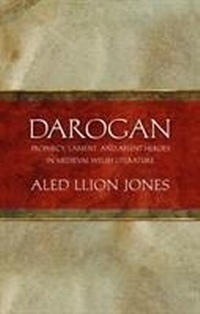
Darogan
Prophecy, Lament and Absent Heroes in Medieval Welsh Literature
Will be published approx. on 31. October 2013
Book
Hardback
400 pages
978-0-7083-2675-6 (ISBN)
Description
Political prophecy was a common mode of literature in the British Isles and much of Europe from the Middle Ages to at least as late as the Renaissance. At times of political instability especially, the manuscript record bristles with prophetic works that promise knowledge of dynastic futures. In Welsh, the later development of this mode is best known through the figure of the mab darogan, the 'son of prophecy', who - variously named as Arthur, Owain or a number of other heroes - will return to re-establish sovereignty. Such a returning hero is also a potent figure in English, Scottish and wider European traditions. This book explores the large body of prophetic poetry and prose contained in the earliest Welsh-language manuscripts, exploring the complexity of an essentially multilingual, multi-ethnic and multinational literary tradition, and with reference to this wider tradition critical and theoretical questions are raised of genre, signification and significance.
More details
Language
English
Place of publication
Wales
United Kingdom
Target group
Professional and scholarly
Product notice
Laminated cover
Illustrations
Not illustrated
Dimensions
Height: 223 mm
Width: 143 mm
Thickness: 32 mm
Weight
549 gr
ISBN-13
978-0-7083-2675-6 (9780708326756)
Copyright in bibliographic data and cover images is held by Nielsen Book Services Limited or by the publishers or by their respective licensors: all rights reserved.
Schweitzer Classification
Other editions
Additional editions
E-Book
10/2013
1st Edition
University of Wales Press
from
€181.09
Available for download
E-Book
10/2013
1st Edition
University of Wales Press
€37.99
Available for download
Person
Aled Llion Jones is a lecturer in the School of Welsh, Bangor University.
Content
Chapter 1 1a. Beginnings 1b. Terminology 1c. The mab darogan 1d. 'Armes Prydain Fawr' - 'The Great Prophecy of Britain' Chapter 2 2a. Furor poeticus: the silence of praise. 2b. The authority of death 2c. Zero-degree poetry: praise of absence 2d. Galarnad ('lament'): absence of praise 2e. Lament without beginning 2f. Englynion: fragments of silence Chapter 3 3a. Manuscript survey c.1250 - c.1540 3b. Manuscript context: copies 3c. Manuscript context: internal 3d. The multilingual manuscripts 3e. Peniarth MSS 50 and 26 3f. Mobile fragments Chapter 4 4a. History and fiction 4b. The poetic craft of Rhys Fardd: formal considerations 4c. The poetic craft of Rhys Fardd: temporality 4d. Facelessness and pseudonymity 4e. Peniarth 50 and internationalism Conclusion