

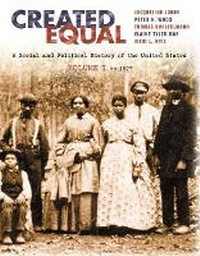
Created Equal
A Social and Political History fo the United States, Volume I: to 1877 (Chapters 1-15)
Published on 28. November 2005
Book
Paperback/Softback
704 pages
978-0-321-05298-8 (ISBN)
Description
With its sweeping, inclusive view of American history, Created Equal emphasizes social history-including the lives and labors of women, immigrants, working people, and persons of color in all regions of the country-while delivering the basics of political and economic history.
This new text acknowledges and reflects the diversity of class, culture, region, and gender that have always been the American story, and pays unique attention to the large middle class that has been central to the development of American society.
This new text acknowledges and reflects the diversity of class, culture, region, and gender that have always been the American story, and pays unique attention to the large middle class that has been central to the development of American society.
Reviews / Votes
"You have a truly revolutionary text here and one that, in parts, is so well written that it may take over the market."- Constance M. McGovern, Frostburg State University
"You may have found somewhat of a cure for the 'won't read' disease that, like an epidemic, has spread across our college campuses. Created Equal is a solid thematic history in an informative and interesting narrative. Created Equal is a text that works on many levels...it is a great model for students to emulate."
- Gaylen Lewis, Bakersfield College
"I congratulate the authors for their willingness to take on such a difficult task, and commend them for their ability to weave so complex a tale."
- Melanie Perreault, University of Central Arkansas
"I think that the level, language and style of writing is both entertaining and superb...this is an engaging volume..."
- Kenneth Adderley, Upper Iowa University
"It is a joy to read a text that gives so much attention to the non-Anglo settlers and settlements...Created Equal gives [students] an excellent introduction to the lives of others."
- Gaylen Lewis, Bakersfield College
"As we live in a multicultural society, this approach correctly belongs at the center of any textbook. Students will respond very positively to this approach."
- Yvonne Johnson, Central Missouri State University
"I found the authors' approach and emphasis refreshing. What sets this text apart is [that] most U.S. history surveys give a nod to class, race and gender. I found the straightforward approach highlighting America (1)s common people to be refreshing and told in clear, powerful style."
- William A. Pelz, Elgin Community College
"I would definitely adopt such a text as my chosen text. The themes are excellent, especially for those like me who have become bored with the traditional views of U.S. history."
- Abel A. Bartley, University of Akron
"The overall themes - multiculturalism, class, international history, and environment - are excellent."
- Steven D. Reschly, Truman State University
"By placing the environment at the center of their discussion, the authors include an important topic that today's students expect to discuss."
- Melanie Perreault, University of Central Arkansas
"This text addresses many of the questions current students bring into history, such as the role of race, gender, and environmentalism in American history. This text's material would easily lead into discussions of our current societal problems and issues."
- Jeremy Johnston, Northwest College
"The Table of Contents is one of the most sensible I have seen in any college textbook because of its symmetrical outline of 'parts' each with three chapters...All in all, this book's organization would fit nicely with my two-semester sequence in U.S. history."
- Earl Mulderink, Southern Utah University
"This chapter [3] is an intriguing story well told...it is well-written, easily understood, sophisticated, and exciting...Kudos to the chapter author."
- Constance M. McGovern, Frostburg State University
"While all of the chapters capture and hold attention, my favorite is Chapter 4... concision, clarity, and content are essential elements in good writing. 'African Enslavement' is a very good write."
- Gaylen Lewis, Bakersfield College
"The chapter (11) has a lot of new content I have not seen before. Its coverage is a good blend of geography and multiculturalism with proper attention to the rise of white male democracy and those who felt no benefit from rising democracy. Ending with the dominant symbol Jackson is appropriate, along with a reminder of its inherent contradictions"
- Gregory L. Goodwin, Bakersfield College
"I think this chapter [13] is the best I've read."
- Melanie Perreault, University of Central Arkansas
"Students who read this [Chapter 14] will come away with a greater appreciation for the complexity of the Civil War and American history in general."
- Melanie Perreault, University of Central Arkansas
"The overall theme of this chapter [16] is excellent - an increasingly standardized economy and society."
- Steven D. Reschly, Truman State University
"This chapter [17] includes a great diversity of topics...how these amazingly diverse themes fit together to form a big picture of the era...would be of great benefit to students."
- Steven D. Reschly, Truman State University
"This chapter [19] best represents the goal of a blended history. Great work on the Harlem Renaissance!"
-Tommy L. Bynum, Georgia Perimeter College
"A model chapter [21]. This chapter is so good, so well written, so intriguing ...The author's use of Stoddard and Fitzgerald, and F. Scott and Zelda, sharecropper woman and Zelda, just to cite a few ...is a delight."
- Constance M. McGovern, Frostburg State University
"A superb presentation of the materials and themes of this period."
- Constance M. McGovern, Frostburg State University
"This is the best, most objective treatment I have seen of the 1980s."
- Robert C. Pierce, Foothill College
"Each of the themes is fully developed and a delight to read. The author easily and smoothly lays out the theme, gives compelling illustrations, is inclusive, makes clear connections, and reflects thoughtfully on historical roots."
- Constance M. McGovern, Frostburg State University
More details
Language
English
Place of publication
United States
Publishing group
Pearson Education (US)
Target group
Professional and scholarly
Dimensions
Height: 276 mm
Width: 216 mm
ISBN-13
978-0-321-05298-8 (9780321052988)
Copyright in bibliographic data and cover images is held by Nielsen Book Services Limited or by the publishers or by their respective licensors: all rights reserved.
Schweitzer Classification
Other editions
New editions
Jacqueline A. Jones | Peter H. Wood | Thomas Borstelmann
Created Equal
A Social and Political History of the United States, Volume I (to 1877)
Book
01/2006
2nd Edition
Pearson
€73.03
Article is exhausted; no reprint
Persons
JACQUELINE JONES was born in Christiana, Delaware, a small town of 400 people in the northern part of the state. The local public school was desegregated in 1955, when she was a third-grader. That event, combined with the peculiar social etiquette of relations between blacks and whites in the town, sparked her interest in American history. She attended the University of Delaware in nearby Newark, and went on to graduate school at the University of Wisconsin-Madison, where she received her Ph.D. in history. Her scholarly interests have evolved over time, focusing on American labor, women, African American, and southern history. One of her biggest challenges has been to balance her responsibilities as teacher, historian, wife, and mother of two daughters. One of her proudest achievements is the fact that she has been able to teach full-time and still pick up her daughters at school every day at 2:30 in the afternoon (thanks to a flexible professor (1)s schedule). She is the author of several books, including Soldiers of Light and Love: Northern Teachers and Georgia Blacks; Labor of Love, Labor of Sorrow: Black Women, Work, and Family Since Slavery, which won the Bancroft Prize and was a finalist for a Pulitzer Prize; The Dispossessed: America?s Underclasses Since the Civil War; and American Work: Four Centuries of Black and White Labor. In 2001, she completed a memoir that recounts her childhood in Christiana: Creek Walking: Growing Up in Delaware in the 1950s. She teaches American history at Brandeis University, where she is Harry S. Truman Professor. In 1999, she received a MacArthur Fellowship.
PETER H. WOOD was born in St. Louis (before the famous arch was built). He recalls seeing Jackie Robinson play against the Cardinals, visiting the Court House where the Dred Scott case originated, and traveling up the Mississippi to Hannibal, birthplace of Mark Twain. Summer work on the northern Great Lakes aroused his interest in Native American cultures, past and present. He studied at Harvard and at Oxford, where he was a Rhodes Scholar. His pioneering book, Black Majority, concerning slavery in colonial South Carolina, won the Beveridge Prize of the American Historical Association. Since 1975, he has taught early American history at Duke University, where he also coached the women?s lacrosse club for three years. The topics of his articles range from the French explorer LaSalle to Gerald Ford?s pardon of Richard Nixon. He is the co-author of Winslow Homer?s Images of Blacks and Natives and Newcomers, a book about early North Carolina. In 1989 he co-edited Powhatan?s Mantle: Indians in the Colonial Southeast. His demographic essay in that volume provided the first clear picture of population change in the 18th-Century South. Dr. Wood has served on the boards of the Highlander Center, Harvard University, Houston?s Rothko Chapel, the Menil Foundation, and the Institute of Early American History and Culture in Williamsburg. He is married to colonial historian Elizabeth Fenn; his varied interests include archaeology, documentary film, and growing gourds. He keeps a baseball bat used by Ted Williams beside his desk.
THOMAS BORSTELMANN the son of a university psychologist, has taught at the elementary, high school, and college levels. He taught second-grade physical education, taught and coached high school lacrosse, soccer, and basketball, and since 1991 has taught American history at Cornell University. In addition to his teaching experience, he also served as ?Head Maid? of a conference center near Lake Tahoe. He lives with his wife and two sons in Syracuse, New York, where his greatest challenge - and delight - is doing the bulk of childcare while commuting sixty miles to Cornell. An avid bicyclist, runner, and cross-country skier, he earned his B.A. from Stanford University in 1980 and Ph.D. from Duke University in 1990. He became a historian in order to figure out the Cold War and American race relations, in part because he had grown up in the South. His first book on American relations with southern Africa won the Stuart L. Bernath Book Prize of the Society for Historians of Foreign Relations. His second book, The Cold War and the Color Line, has just been published. His commitment to the classroom remains clear at Cornell University, where he has won a major teaching award - the Robert and Helen Appel Fellowship. He found writing Created Equal a natural complement to what he does in the classroom, trying to provide both telling details of the American past and the broad picture of how the United States has developed as it has. A specialist in U.S. foreign relations, he is equally fascinated with domestic politics and social change. He is currently at work on a book on the 1970s.
ELAINE TYLER MAY grew up in the shadow of Hollywood, performing in neighborhood circuses with her friends. She went to high school before girls could play on sports teams, so she spent her after-school hours as a cheerleader and her summer days as a bodysurfing beach bum. Her passion for American history developed in college when she spent her junior year in Japan. The year was 1968. The Vietnam War was raging, along with turmoil at home. As an American in Asia, frequently called upon to explain her nation?s actions, she yearned for a deeper understanding of America?s past and its place in the world. She returned home to study history at UCLA, where she earned her BA, MA, and Ph.D. She has taught at Princeton and Harvard universities and since 1978 at the University of Minnesota. She has written four books examining the relationship between politics, public policy, and private life. Her widely acclaimed Homeward Bound: American Families in the Cold War Era was the first study to link the baby boom and suburbia to the politics of the Cold War. The Chronicle of Higher Education featured Barren in the Promised Land: Childless Americans and the Pursuit of Happiness as a pioneering study of the history of reproduction. Lingua Franca named her co-edited volume Here, There, and Everywhere: The Foreign Politics of American Popular Culture as a "Breakthrough Book." She served as president of the American Studies Association in 1996, and as Distinguished Fulbright Professor of American History in Dublin, Ireland, in 1997. She is married to historian Larry May and has three children who have inherited their parents? passion for history.
VICKIE L. RUIZ is Professor of History and Chicano/Latino Studies at the University of California, Irvine. For her, history remains a grand adventure, one that began at the kitchen table listening to the stories of her mother and grandmother and then took flight aboard the local bookmobile. She read constantly as she sat on the dock catching small fish (?grunts?) to be used as bait on her father?s fishing boat. As she grew older, she was promoted to working with her mother selling tickets for the Blue Sea II. The first in her family to receive an advanced degree, she graduated from Gulf Coast Community College and Florida State University, then went on to earn a Ph.D. in history at Stanford in 1972, the fourth Mexican American woman to receive a doctorate in history. Her first book, Cannery Women, Cannery Lives, received an award from the National Women (1)s Political Caucus and her second, From Out of the Shadows: Mexican Women in 20th-Century America, was named a Choice Outstanding Academic Book of 1998 by the American Library Association. She is co-editor with Ellen Carol Dubois of Unequal Sisters: A Multicultural Reader in U.S. Women?s History. She and Virginia Sanchez Korrol have embarked on co-editing Latinas in the United States: A Historical Encyclopedia and both were recognized by Latina Magazine as ?Latinas of the Year in Education for 2000.? Active in student mentorship projects, summer institutes for teachers, and public humanities programs, Ruiz served as a Clinton recess appointee to the National Council of the Humanities. She has also served on the national governing bodies of the American Historical Association, the Organization of American Histories, and the American Studies Association. She is President-elect of the Pacific Coast Branch of the American Historical Association. The mother of two grown sons, she is married to Victor Becerra, urban planner and gourmet cook extraordinaire.
PETER H. WOOD was born in St. Louis (before the famous arch was built). He recalls seeing Jackie Robinson play against the Cardinals, visiting the Court House where the Dred Scott case originated, and traveling up the Mississippi to Hannibal, birthplace of Mark Twain. Summer work on the northern Great Lakes aroused his interest in Native American cultures, past and present. He studied at Harvard and at Oxford, where he was a Rhodes Scholar. His pioneering book, Black Majority, concerning slavery in colonial South Carolina, won the Beveridge Prize of the American Historical Association. Since 1975, he has taught early American history at Duke University, where he also coached the women?s lacrosse club for three years. The topics of his articles range from the French explorer LaSalle to Gerald Ford?s pardon of Richard Nixon. He is the co-author of Winslow Homer?s Images of Blacks and Natives and Newcomers, a book about early North Carolina. In 1989 he co-edited Powhatan?s Mantle: Indians in the Colonial Southeast. His demographic essay in that volume provided the first clear picture of population change in the 18th-Century South. Dr. Wood has served on the boards of the Highlander Center, Harvard University, Houston?s Rothko Chapel, the Menil Foundation, and the Institute of Early American History and Culture in Williamsburg. He is married to colonial historian Elizabeth Fenn; his varied interests include archaeology, documentary film, and growing gourds. He keeps a baseball bat used by Ted Williams beside his desk.
THOMAS BORSTELMANN the son of a university psychologist, has taught at the elementary, high school, and college levels. He taught second-grade physical education, taught and coached high school lacrosse, soccer, and basketball, and since 1991 has taught American history at Cornell University. In addition to his teaching experience, he also served as ?Head Maid? of a conference center near Lake Tahoe. He lives with his wife and two sons in Syracuse, New York, where his greatest challenge - and delight - is doing the bulk of childcare while commuting sixty miles to Cornell. An avid bicyclist, runner, and cross-country skier, he earned his B.A. from Stanford University in 1980 and Ph.D. from Duke University in 1990. He became a historian in order to figure out the Cold War and American race relations, in part because he had grown up in the South. His first book on American relations with southern Africa won the Stuart L. Bernath Book Prize of the Society for Historians of Foreign Relations. His second book, The Cold War and the Color Line, has just been published. His commitment to the classroom remains clear at Cornell University, where he has won a major teaching award - the Robert and Helen Appel Fellowship. He found writing Created Equal a natural complement to what he does in the classroom, trying to provide both telling details of the American past and the broad picture of how the United States has developed as it has. A specialist in U.S. foreign relations, he is equally fascinated with domestic politics and social change. He is currently at work on a book on the 1970s.
ELAINE TYLER MAY grew up in the shadow of Hollywood, performing in neighborhood circuses with her friends. She went to high school before girls could play on sports teams, so she spent her after-school hours as a cheerleader and her summer days as a bodysurfing beach bum. Her passion for American history developed in college when she spent her junior year in Japan. The year was 1968. The Vietnam War was raging, along with turmoil at home. As an American in Asia, frequently called upon to explain her nation?s actions, she yearned for a deeper understanding of America?s past and its place in the world. She returned home to study history at UCLA, where she earned her BA, MA, and Ph.D. She has taught at Princeton and Harvard universities and since 1978 at the University of Minnesota. She has written four books examining the relationship between politics, public policy, and private life. Her widely acclaimed Homeward Bound: American Families in the Cold War Era was the first study to link the baby boom and suburbia to the politics of the Cold War. The Chronicle of Higher Education featured Barren in the Promised Land: Childless Americans and the Pursuit of Happiness as a pioneering study of the history of reproduction. Lingua Franca named her co-edited volume Here, There, and Everywhere: The Foreign Politics of American Popular Culture as a "Breakthrough Book." She served as president of the American Studies Association in 1996, and as Distinguished Fulbright Professor of American History in Dublin, Ireland, in 1997. She is married to historian Larry May and has three children who have inherited their parents? passion for history.
VICKIE L. RUIZ is Professor of History and Chicano/Latino Studies at the University of California, Irvine. For her, history remains a grand adventure, one that began at the kitchen table listening to the stories of her mother and grandmother and then took flight aboard the local bookmobile. She read constantly as she sat on the dock catching small fish (?grunts?) to be used as bait on her father?s fishing boat. As she grew older, she was promoted to working with her mother selling tickets for the Blue Sea II. The first in her family to receive an advanced degree, she graduated from Gulf Coast Community College and Florida State University, then went on to earn a Ph.D. in history at Stanford in 1972, the fourth Mexican American woman to receive a doctorate in history. Her first book, Cannery Women, Cannery Lives, received an award from the National Women (1)s Political Caucus and her second, From Out of the Shadows: Mexican Women in 20th-Century America, was named a Choice Outstanding Academic Book of 1998 by the American Library Association. She is co-editor with Ellen Carol Dubois of Unequal Sisters: A Multicultural Reader in U.S. Women?s History. She and Virginia Sanchez Korrol have embarked on co-editing Latinas in the United States: A Historical Encyclopedia and both were recognized by Latina Magazine as ?Latinas of the Year in Education for 2000.? Active in student mentorship projects, summer institutes for teachers, and public humanities programs, Ruiz served as a Clinton recess appointee to the National Council of the Humanities. She has also served on the national governing bodies of the American Historical Association, the Organization of American Histories, and the American Studies Association. She is President-elect of the Pacific Coast Branch of the American Historical Association. The mother of two grown sons, she is married to Victor Becerra, urban planner and gourmet cook extraordinaire.
Content
I. THE FIRST FOUNDERS.
1. First Founders.
Ancient America.
A Thousand Years of Change in the Americas: A.D. 500 to 1500.
Linking the Continents.
Spain Enters the Americas.
The Protestant Reformation Plays out in the Americas.
For Further Reading.
2. European Footholds on the Fringes of North America, 1600-1660.
Spain's Ocean-Spanning Reach.
France and Holland: Overseas Competition for Spain.
English Beginnings on the Atlantic Coast.
The Puritan Experiment.
Maryland, and English Advantages.
For Further Reading.
Features.
Interpreting History: The Puritan and the Archbishop.
Connecting History: Colonization Then and Now.
3. Controlling the Edges of the Continent, 1660-1715.
France and the American Interior.
The Spanish Empire on the Defensive.
England's American Empire Takes Shape.
Four Decades of Colonial Conflict.
Consequences of War and Growth.
For Further Reading.
II. A CENTURY OF COLONIAL EXPANSION.
4. African Enslavement: The Terrible Transformation.
The Descent into Race Slavery.
The Growth of Slave Labor Camps.
England Enters the Atlantic Slave Trade.
Survival in the North American Gulag.
The Transformation Completed.
For Further Reading.
Features.
Interpreting History: "Releese us out of this Cruell Bondegg."
5. An American Babel, 1713-1763.
Contested Regions in the West.
Contested Borders in the East.
Dramatic Changes in the English Colonies.
Varieties of Christianity-Lost and Found.
Wars of Empire.
For Further Reading.
6. The Limits of Imperial Control, 1763-1775.
New Challenges to Spain's Expanded Empire.
New Challenges to Britain's Expanded Empire.
"The Unconquerable Rage of the People."
A Conspiracy of Corrupt Ministers?
Launching a Revolution.
For Further Reading.
III. THE UNFINISHED REVOLUTION.
7. Revolutionaries at War, 1775-1783.
Declaring Independence.
"Victory or Death:" Fighting for Survival.
Legitimate States, a Respectable Military.
The Long Road to Yorktown.
For Further Reading.
8. New Beginnings-The 1780s.
Beating Swords into Plowshares.
Competing for Control of the Mississippi Valley.
Creditors and Debtors.
Drafting a New Constitution.
Ratification and the Bill of Rights.
For Further Reading.
9. Revolutionary Legacies and Beginnings, 1789-1803.
Competing Political Visions in the New Nation.
People of Color: New Freedoms, New Struggles.
Continuity and Change in the West.
Constructing Post-Revolutionary Social Identities.
Artisan-Politicians Versus Menial Laborers: The Mixed Plight of Postrevolutionary Workers.
The Election of 1800: Revolution or Reversal?
For Further Reading.
IV. A NATION EXPANDS.
10. An Emerging but Troubled Nationalism, 1803-1818.
The British Menace.
Fighting on Many Fronts: The War of 1812.
The Era of Good Feelings: Political and Economic Effects of the War of 1812.
The Rise of the Cotton-Plantation Economy.
For Further Reading.
11. Fractures and Factions in a Partial Democracy, 1819-1832.
The Politics Behind Western Expansion.
Nationalism and Its Discontents.
Real People in the "Age of the Common Man. "
The Ligaments of a Growing, Dispersing Population.
For Further Reading.
12. Peoples and Nations in Motion, 1832-1848.
Mass Migrations.
A Multitude of Voices: The National Political Arena.
Reform and Reaction.
The United States Extends Its Reach.
For Further Reading.
V. DISUNION AND REUNION.
13. The Crisis over Slavery, 1848-1860.
Regional Economies and Conflicts.
Shifting Collective Identities.
The Paradox of Southern Political Power.
The Republican Alliance.
The Deepening Conflict over Slavery.
For Further Reading.
Features.
Connecting History: Systems of Unfree Labor.
Interpreting History: Professor Howe on the Subordination of Women.
14. "To Fight To Gain A Country:" The Civil War.
The Course of Conflict, 1861-1863.
The Third War: African American Struggles for Liberation.
Battle Fronts and Home Fronts in 1863.
The Prolonged Defeat of the Confederacy, 1864-1865.
For Further Reading.
Features.
Connecting History: Civil Disorders During Wartime.
15. In The Wake of War: Consolidating a Triumphant Union, 1865-1877.
The Struggle over the South.
Claiming Territory for the Union.
The Republican Vision and Its Limits.
For Further Reading.
Features.
Connecting History: Two Presidents Impeached.
Interpreting History: A Southern Labor Contract.
1. First Founders.
Ancient America.
A Thousand Years of Change in the Americas: A.D. 500 to 1500.
Linking the Continents.
Spain Enters the Americas.
The Protestant Reformation Plays out in the Americas.
For Further Reading.
2. European Footholds on the Fringes of North America, 1600-1660.
Spain's Ocean-Spanning Reach.
France and Holland: Overseas Competition for Spain.
English Beginnings on the Atlantic Coast.
The Puritan Experiment.
Maryland, and English Advantages.
For Further Reading.
Features.
Interpreting History: The Puritan and the Archbishop.
Connecting History: Colonization Then and Now.
3. Controlling the Edges of the Continent, 1660-1715.
France and the American Interior.
The Spanish Empire on the Defensive.
England's American Empire Takes Shape.
Four Decades of Colonial Conflict.
Consequences of War and Growth.
For Further Reading.
II. A CENTURY OF COLONIAL EXPANSION.
4. African Enslavement: The Terrible Transformation.
The Descent into Race Slavery.
The Growth of Slave Labor Camps.
England Enters the Atlantic Slave Trade.
Survival in the North American Gulag.
The Transformation Completed.
For Further Reading.
Features.
Interpreting History: "Releese us out of this Cruell Bondegg."
5. An American Babel, 1713-1763.
Contested Regions in the West.
Contested Borders in the East.
Dramatic Changes in the English Colonies.
Varieties of Christianity-Lost and Found.
Wars of Empire.
For Further Reading.
6. The Limits of Imperial Control, 1763-1775.
New Challenges to Spain's Expanded Empire.
New Challenges to Britain's Expanded Empire.
"The Unconquerable Rage of the People."
A Conspiracy of Corrupt Ministers?
Launching a Revolution.
For Further Reading.
III. THE UNFINISHED REVOLUTION.
7. Revolutionaries at War, 1775-1783.
Declaring Independence.
"Victory or Death:" Fighting for Survival.
Legitimate States, a Respectable Military.
The Long Road to Yorktown.
For Further Reading.
8. New Beginnings-The 1780s.
Beating Swords into Plowshares.
Competing for Control of the Mississippi Valley.
Creditors and Debtors.
Drafting a New Constitution.
Ratification and the Bill of Rights.
For Further Reading.
9. Revolutionary Legacies and Beginnings, 1789-1803.
Competing Political Visions in the New Nation.
People of Color: New Freedoms, New Struggles.
Continuity and Change in the West.
Constructing Post-Revolutionary Social Identities.
Artisan-Politicians Versus Menial Laborers: The Mixed Plight of Postrevolutionary Workers.
The Election of 1800: Revolution or Reversal?
For Further Reading.
IV. A NATION EXPANDS.
10. An Emerging but Troubled Nationalism, 1803-1818.
The British Menace.
Fighting on Many Fronts: The War of 1812.
The Era of Good Feelings: Political and Economic Effects of the War of 1812.
The Rise of the Cotton-Plantation Economy.
For Further Reading.
11. Fractures and Factions in a Partial Democracy, 1819-1832.
The Politics Behind Western Expansion.
Nationalism and Its Discontents.
Real People in the "Age of the Common Man. "
The Ligaments of a Growing, Dispersing Population.
For Further Reading.
12. Peoples and Nations in Motion, 1832-1848.
Mass Migrations.
A Multitude of Voices: The National Political Arena.
Reform and Reaction.
The United States Extends Its Reach.
For Further Reading.
V. DISUNION AND REUNION.
13. The Crisis over Slavery, 1848-1860.
Regional Economies and Conflicts.
Shifting Collective Identities.
The Paradox of Southern Political Power.
The Republican Alliance.
The Deepening Conflict over Slavery.
For Further Reading.
Features.
Connecting History: Systems of Unfree Labor.
Interpreting History: Professor Howe on the Subordination of Women.
14. "To Fight To Gain A Country:" The Civil War.
The Course of Conflict, 1861-1863.
The Third War: African American Struggles for Liberation.
Battle Fronts and Home Fronts in 1863.
The Prolonged Defeat of the Confederacy, 1864-1865.
For Further Reading.
Features.
Connecting History: Civil Disorders During Wartime.
15. In The Wake of War: Consolidating a Triumphant Union, 1865-1877.
The Struggle over the South.
Claiming Territory for the Union.
The Republican Vision and Its Limits.
For Further Reading.
Features.
Connecting History: Two Presidents Impeached.
Interpreting History: A Southern Labor Contract.