

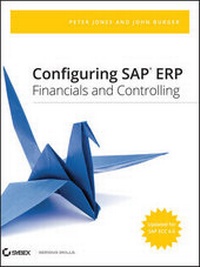
Configuring SAP ERP Financials and Controlling
Will be published approx. on 27. March 2009
Book
Hardback
960 pages
978-0-470-42328-8 (ISBN)
Description
SAP is the world leader in Enterprise Resource Planning (ERP) software; of the software's modules, the FI (Finance) and CO (Controlling) are by far the most popular and are widely implemented. This book has no competition-it is the only book on the market on how to configure and implement SAP's FI and CO modules to maximize functionality and features hands-on, step-by-step instructions and real-world examples that provide immediate and practical solutions. Updated for SAP's ECC 6.0, the book covers FI enterprise structure, general ledger, substitutions and validations, automatic account assignments, accounts payable and receivable, asset accounting, accrual engine, closing entries, credit management, lockbox, CO enterprise structure, profitability analysis (CO-PA), and more.
More details
Edition
1. Auflage
Language
English
Place of publication
New York
United States
Publishing group
John Wiley & Sons Inc
Product notice
Unsewn / adhesive bound
Paper over boards
Dimensions
Height: 241 mm
Width: 196 mm
Thickness: 61 mm
Weight
1616 gr
ISBN-13
978-0-470-42328-8 (9780470423288)
Schweitzer Classification
Other editions
Additional editions
Peter Jones | John Burger
Configuring SAP ERP Financials and Controlling
E-Book
02/2011
Sybex
€64.99
Available for download
Persons
Peter Jones is a platinum principal consultant for SAP America and speaks regularly at SAP-sponsored events. He is also on the technical advisory board and an editor for FICO Expert. John Burger is Senior Director of Global Sourcing at McKesson. He has implemented solutions in all of the modules within FI/CO for several Fortune 100 companies in several countries in North America, Asia, and Europe.
Content
1. Configuration Tools.
2. Financial Accounting Enterprise Structure.
3. General Ledger.
4. Accounts Payable.
5. Accounts Receivable.
6. Financial Supply Chain Management.
7. New GL Accounting.
8. Controlling Enterprise Structure.
9. Cost Element Accounting.
10. Cost Center Accounting.
11. Internal Order Accounting.
12. Profitability Analysis.
13. Profit Center Accounting.
14. Investment Management.
15. FI Closing Cockpit.